JHPIEGO
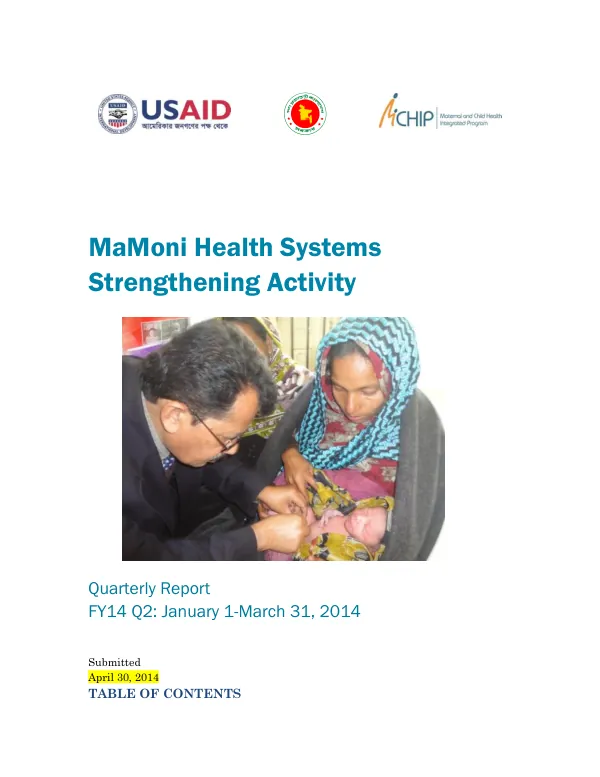
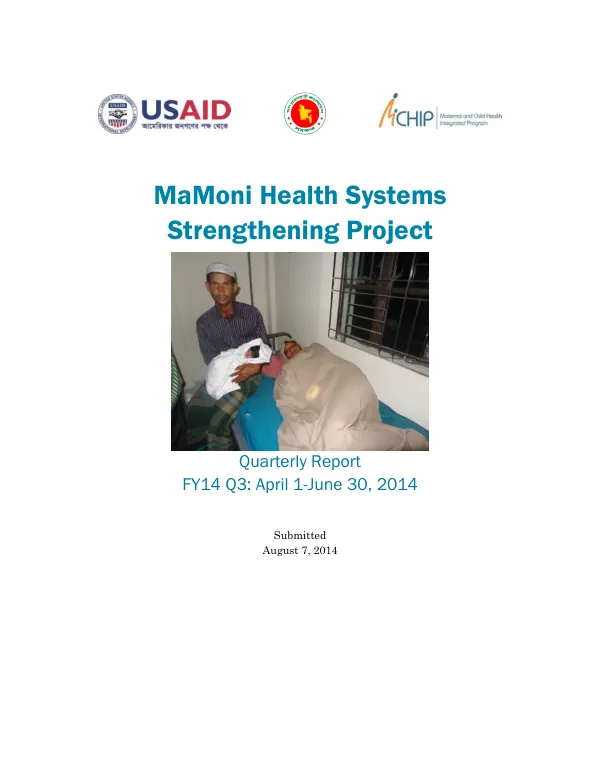
MaMoni Health Systems Strengthening Project Quarterly Report FY14 Q3
MaMoni Health Systems Strengthening (MaMoni HSS) project is a four-year Associate Award under the Maternal and Child Health Integrated Program (MCHIP), with a period of performance from September 24, 2013 to September 23, 2017.
2014 · 38 pages
Sign in to readA free account is required to download.
Abstract
The project focuses on strengthening the systems and standards for maternal, newborn and child health, family planning and nutrition (MNCH/FP/N) in seven districts in Bangladesh. MaMoni HSS builds on MaMoni's previous work and aims to result in declines in maternal, newborn and child mortality within these districts. The project supports the Ministry of Health and Family Welfare (MOH&FW) to introduce and leverage support for scale-up of evidence-based practices already acknowledged in Bangladesh. MaMoni HSS is implemented by Jhpiego in partnership with Save the Children (SC), John Snow, Inc. (JSI), and Johns Hopkins University (JHU)/Institute of International Programs (IIP), with national partners icddr,b, Dnet, and Bangabandhu Sheikh Mujib Medical University (BSMMU). SC serves as the functional operational lead partner for the Award in Bangladesh. MaMoni HSS engages with local government structures and non-governmental organizations (NGOs) to improve delivery of health services and strategically partners at the national level to build consensus around policies and standards that positively drive evidence-based interventions at all levels. The project supports the MOH&FW to strengthen the health systems in seven districts – Habiganj, Noakhali, Lakhsmipur, Bhola, Pirozepur, Jhalokathi, and Brahmanbaria. In addition, Sylhet district receives support for targeted newborn care interventions. The goal of MaMoni HSS is to improve utilization of integrated MNCH/FP/N services, which will be achieved through the project objective to increase availability and quality of high-impact interventions through strengthening district-level local management and health systems. This objective is well aligned with the Government of Bangladesh's Health, Population and Nutrition Sector Development Program (HPNSDP) 2011–2016. MaMoni HSS will also directly support the USAID/Bangladesh Development Objective 3 (DO 3) “Health Status Improved” under the Investing in People Objective, of the Country Development Cooperation Strategy (CDCS) Framework of USAID in Bangladesh. MaMoni HSS has four intermediate results (IRs). IR1 aims to improve service readiness through critical gap management, which includes increasing availability of health service providers, strengthening capacity of service providers to provide quality services, and strengthening infrastructure preparedness to improve MNCH service utilization. IR2 focuses on improving the quality of MNCH services, IR3 aims to increase the availability and accessibility of MNCH services, and IR4 seeks to improve the utilization of MNCH services. Implementation in Brahmanbaria district is planned to start in the second year. Habiganj, Noakhali, and Lakhsmipur districts received substantial support under the previous MCHIP Field Support funded District Health System Strengthening (DHSS) program, and implementation continues under MaMoni HSS. The project engages with local government structures and non-governmental organizations (NGOs) to improve delivery of health services and strategically partners at the national level to build consensus around policies and standards that positively drive evidence-based interventions at all levels. MaMoni HSS supports the MOH&FW to strengthen the health systems in seven districts, including Habiganj, Noakhali, Lakhsmipur, Bhola, Pirozepur, Jhalokathi, and Brahmanbaria. In addition, Sylhet district receives support for targeted newborn care interventions. The project aims to improve the quality of MNCH services, increase the availability and accessibility of MNCH services, and improve the utilization of MNCH services. The project has made significant progress in improving service readiness through critical gap management. The in-depth assessment of service readiness has identified individual facility and community needs vis-à-vis human resources. The human resource (HR) plan has been developed based on local needs, and institutional arrangements have been made for HR development. Project staff have been hired and placed in facilities to meet service delivery gaps as a stop-gap measure. Training of service providers on evidence-based interventions, including Helping Babies Breathe (HBB) guidelines, has been conducted. Guidelines and training on essential interventions for pre-term babies have also been developed and implemented. Facility assessment has been conducted to identify strategically located facilities, and infrastructure preparedness has been strengthened to improve MNCH service utilization. The project has also made progress in improving the quality of MNCH services. Training of service providers on essential interventions for pre-term babies has been conducted, and guidelines have been developed and implemented. The project has also strengthened the capacity of service providers to provide quality services through training and capacity-building activities. In addition, the project has made progress in increasing the availability and accessibility of MNCH services. The in-depth assessment of service
Related documents