NORTHERN ILLINOIS UNIVERSITY. CENTER FOR GOVERNMENTAL STUDIES
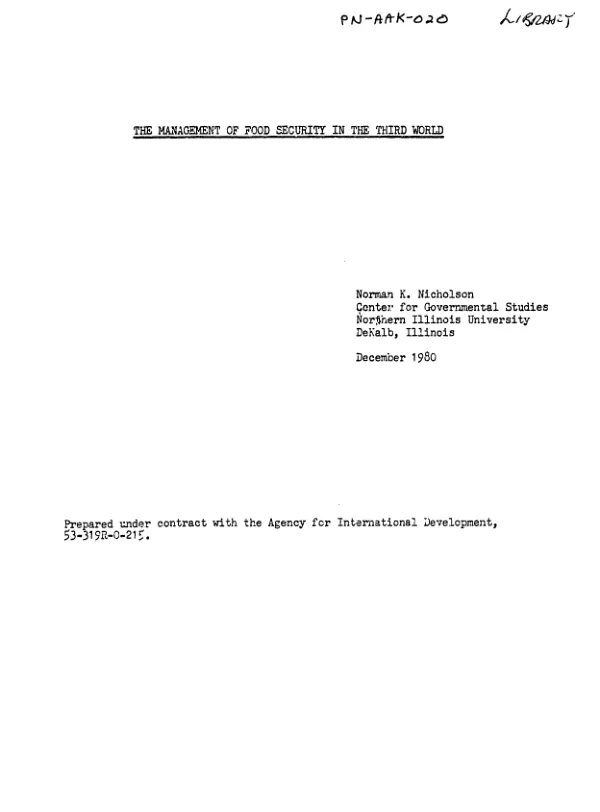
Management of food security in the Third World
The global food security problem is rooted in the growing number of malnourished people, food price instability, and the lack of domestic organizations capable of dealing with disasters.
Nicholson, Norman K. · 1970
Sign in to readA free account is required to download.
Abstract
This paper analyzes the food security problem and developing country needs in food security management and suggests key areas for A.I.D. intervention. An analysis of the foodgrain prospects in developing countries reveals that increased demand for food grains, precipitated by income and population growth, will exceed both increases in domestic production and available international supplies -- leaving developing countries, especially the low-income countries, with unstable grain supplies through the end of the century. International perceptions of the food security problem (e.g., through the 1974 World Food Conference and the 1980 Brandt Report) and U.S. responses to the international agenda (e.g., through the 1980 Presidential Commission on World Hunger) are reviewed, along with developing country food security policies and programs. It is concluded that, since the international system can be no more effective than the national systems with which it interacts, it is imperative to build on existing domestic capabilities for relief measures, price stabilization, and redistribution which serve complementary and multiple purposes. Three key management requirements of developing country food security systems are analyzed: information systems (early warning systems and the information needed for food sector planning and for reserves management and distribution systems); market interventions (public procurement and management of stocks and public efforts to improve private trade); and the distribution systems themselves (procedural problems in the administration of disaster relief, buffer stocks and public distribution systems). The author concludes with an analysis of suitable A.I.D. interventions that may be possible in Latin America (e.g., targeting the poor for distribution programs), Asia (e.g., establishing management systems for parastatals), and Africa (e.g., administering refugee programs), and the role of P.L. 480 grain imports in each of these regions.
Related documents
Documents in this collection
 1970
1970USAID DEC
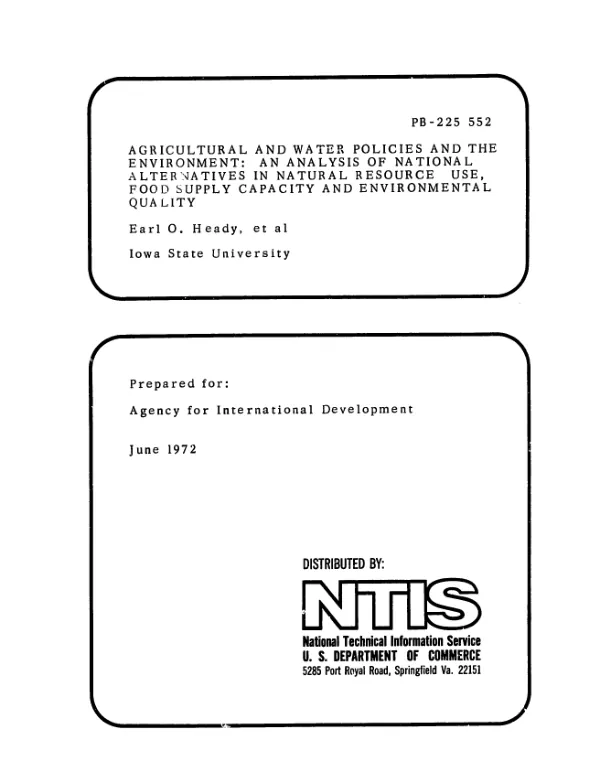
Agricultural and water policies and the environment; an analysis of national alternatives in natural resource use, food supply capacity, and environmental quality
Open record 1970
1970USAID DEC