USAID
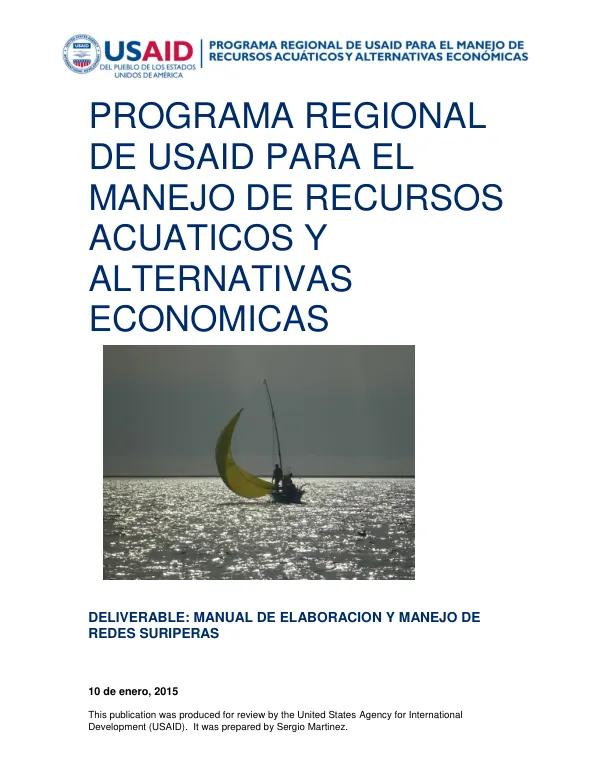
Manual de Elaboracion y Manejo de Redes Suriperas
The Miskito Coast of Honduras and Nicaragua is a remote, rural area inhabited by diverse ethnic groups, including Miskitos, Garifunas, Creoles, Sumos, and Mayangnas, as well as ladinos who participated in the "reconquering" of this natural enclave.
2015 · 34 pages
Sign in to readA free account is required to download.
Abstract
Historically, isolation has been the main problem facing this vast territory and its inhabitants, who are geographically, politically, and physically cut off from government centers in both countries and from access to technological developments and socioeconomic benefits. The lack of alternatives and economic benefits has left the region at a competitive disadvantage compared to the private industrial sector. Compounding this isolation, the lobster diving fishery has been the only employment option in the area since the 1960s. However, the benefits of this activity are outweighed by its negative impact on the health and productive capacity of a large percentage of the local population. The USAID Regional Program for the Management of Aquatic Resources and Economic Alternatives (USAID Regional Program) launched activities to help address this situation, based on its main objective of "strengthening management of coastal and marine resources to reduce threats posed by unsustainable fishing practices and coastal development, supporting biodiversity conservation, and improving the livelihoods of the populations in the region." To accomplish this objective, the USAID Regional Program identified a series of sea and land-based alternatives to improve the conditions of ethnic groups on the Miskito Coast of Honduras and Nicaragua. One of the Program's priorities was to allocate resources to support closing the spiny lobster (Panulirus argus) diving (SCUBA) fishery, support the processing of fisheries products, and provide training, technical assistance, and improved fishing gear with a view to achieving the much-sought-after sustainability of resources and fishing activities in general. The Program identified coastal shrimp harvesting with suripera nets as one alternative to diving. Used in the Gulf of California in Mexico since the 1970s, this method has had a positive impact due primarily to the relatively low production costs involved, the size of the shrimp harvested, low bycatch levels, and the virtually nonexistent need for fossil fuels. The USAID Regional Program introduced this fishing method in Honduras and Nicaragua, both of which have a three nautical mile (NM) zone reserved exclusively for artisanal fishing. In this sense, it is an invaluable tool that will enable ethnic groups to improve their socioeconomic status by exercising their access rights in the zone while minimizing the environmental impact caused by shrimp trawling to ensure the sustainability of these fisheries. This manual offers simple, practical guidelines for building and using suripera nets. It should be useful for artisanal fishermen and fishermen's associations and cooperatives, as well as entities or agencies willing to promote this fishery in the Central American region. The manual is divided into several sections, including an introduction, objectives, methodology, materials for constructing suriperas, and step-by-step instructions for making and using suriperas. The manual also includes references and annexes, which provide additional information on the efficiency of suripera nets and a comparison between trawling and suripera fishing. The introduction of suripera fishing in Honduras and Nicaragua is expected to have a positive impact on the socioeconomic status of ethnic groups in the region, enabling them to improve their livelihoods and exercise their access rights in the zone while minimizing the environmental impact caused by shrimp trawling.