USAID DEC
Manuel du formateur PHARE Formation des professeurs de Lettres et de Psychopédagogie des IFM à la didactique de la lecture/écriture
Sign inUSAID DEC
Manuel du formateur PHARE Formation des professeurs de Lettres et de Psychopédagogie des IFM à la didactique de la lecture/écriture
The training manual for PHARE trainers, titled "Formation des professeurs de Lettres et de Psychopédagogie des IFM à la didactique de la lecture/écriture," outlines a 4-day training program for instructors of Letters and Psychopedagogy at IFM (Instituts de Formation des Maîtres) to develop their skills in teaching reading and writing.
2010 · 22 pages
Sign in to readA free account is required to download.
Abstract
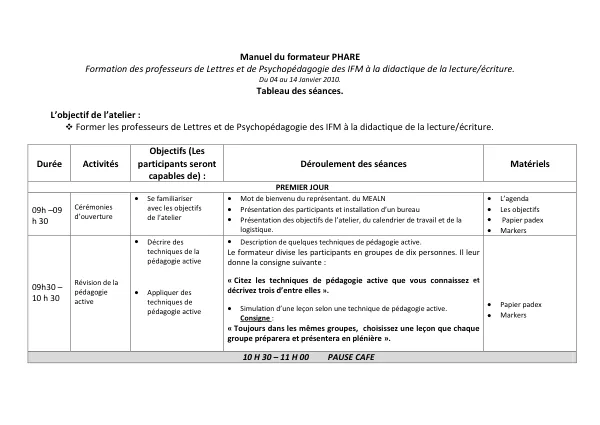
The training program took place from January 4 to 14, 2010. The training program aimed to equip participants with the necessary skills to teach reading and writing effectively. The program consisted of various activities, including presentations, group work, and practical exercises. The training covered topics such as pedagogy, language mechanisms, vocabulary development, and the use of information technology. On the first day, the training program began with a welcome ceremony, where participants were introduced to the objectives of the training program, the schedule, and the logistics. The program then focused on revising active pedagogy, where participants were divided into groups to discuss and apply various techniques of active pedagogy. They were also asked to simulate a lesson using one of the techniques. The second day of the training program focused on presenting the reference framework of competences. Participants were divided into groups and given a copy of the reference framework, which they were asked to study and answer questions related to it. They were also asked to identify the different articulations of the reference framework and describe the various fields of competence. The third day of the training program focused on language mechanisms, where participants were introduced to the concept of indices sémantiques and grammaticaux. They were asked to produce a text of 10 lines on a chosen theme and to identify the indices of comprehension in a given text. They were also asked to interpret and expand the meaning of the text. The fourth and final day of the training program focused on comprehension, where participants were asked to formulate hypotheses, identify and analyze the indices of comprehension, and interpret and expand the meaning of a given text. They were also asked to choose a text, formulate hypotheses, identify and analyze the indices of comprehension, and interpret and expand the meaning of the text. Throughout the training program, participants were encouraged to work in groups and to apply the various techniques and concepts learned during the training. The training program aimed to equip participants with the necessary skills to teach reading and writing effectively and to develop their competences in using information technology. The training program was designed to be practical and interactive, with a focus on applying the various techniques and concepts learned during the training. Participants were encouraged to work in groups and to share their experiences and ideas with each other. The training program aimed to equip participants with the necessary skills to teach reading and writing effectively and to develop their competences in using information technology. The training program covered a range of topics, including pedagogy, language mechanisms, vocabulary development, and the use of information technology. Participants were introduced to various techniques and concepts, including active pedagogy, language mechanisms, and comprehension. They were also asked to apply these techniques and concepts in practical exercises and group work. Overall, the training program aimed to equip participants with the necessary skills to teach reading and writing effectively and to develop their competences in using information technology. The program was designed to be practical and interactive, with a focus on applying the various techniques and concepts learned during the training.