USAID
Mapping Regional Patterns of Livestock Trade in West Africa
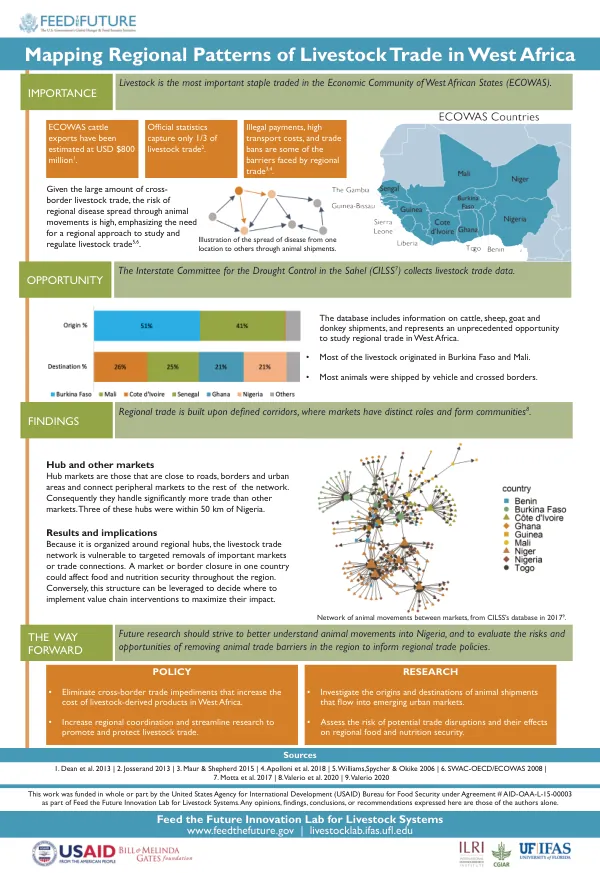
Livestock is the most important staple traded in the Economic Community of West African States (ECOWAS).
2020 · 1 pages
Sign in to readA free account is required to download.
Abstract
Regional trade is built upon defined corridors, where markets have distinct roles and form communities. Hub markets, located near roads, borders, and urban areas, handle significantly more trade than other markets. Three of these hubs are situated within 50 km of Nigeria. The Interstate Committee for the Drought Control in the Sahel (CILSS) collects livestock trade data, providing an unprecedented opportunity to study regional trade in West Africa. The database includes information on cattle, sheep, goat, and donkey shipments. Most of the livestock originated in Burkina Faso and Mali, with most animals shipped by vehicle and crossing borders. Official statistics capture only one-third of livestock trade, with barriers such as illegal payments, high transport costs, and trade bans hindering regional trade. Regional trade in ECOWAS has been estimated at USD $800 million. The livestock trade network is organized around regional hubs, making it vulnerable to targeted removals of important markets or trade connections. A market or border closure in one country could affect food and nutrition security throughout the region. Conversely, this structure can be leveraged to decide where to implement value chain interventions to maximize their impact. The network of animal movements between markets, as depicted in CILSS's database, highlights the risk of regional disease spread through animal movements. Given the large amount of cross-border livestock trade, a regional approach is necessary to study and regulate livestock trade. This approach would involve eliminating cross-border trade impediments, increasing regional coordination, and streamlining research to promote and protect livestock trade. Future research should focus on better understanding animal movements into Nigeria and evaluating the risks and opportunities of removing animal trade barriers in the region. This would inform regional trade policies and help mitigate the risks associated with regional disease spread.
Related documents