USAID DEC
Market-Based Mechanisms to Reduce Greenhouse Gas Emissions in Asia | Global Climate Change
Sign inICF
Market-Based Mechanisms to Reduce Greenhouse Gas Emissions in Asia | Global Climate Change
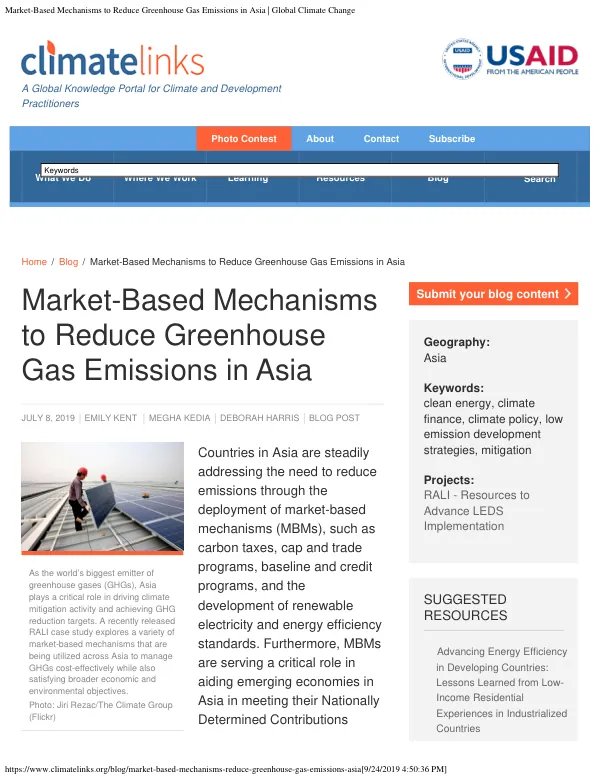
Market-based mechanisms (MBMs) are being utilized across Asia to manage greenhouse gas (GHG) emissions cost-effectively while satisfying broader economic and environmental objectives.
2019 · 5 pages
Sign in to readA free account is required to download.
Abstract
These mechanisms include carbon taxes, cap and trade programs, baseline and credit programs, and the development of renewable electricity and energy efficiency standards. MBMs are serving a critical role in aiding emerging economies in Asia in meeting their Nationally Determined Contributions (NDC) targets. The deployment of MBMs in Asia is driven by the need to reduce emissions and achieve GHG reduction targets. Countries in the region are mobilizing resources and navigating policy options to finance climate change mitigation projects and improve carbon-intensive activities. MBMs provide regulated entities the flexibility to reduce emissions in the most cost-effective way by internalizing the cost of emissions into decision-making and business processes. These regulating instruments foster innovation, engage the private sector, and provide more options for reducing GHGs than a typical command-and-control regulation. The most effective MBMs are structured around explicit objectives and capitalize on existing policies, stakeholder consultations, and cost management. When implemented effectively, MBMs provide immense benefits to regulators and regulated entities, as shown in countries such as China and Korea, where mitigation action is critical for sustainable development during rapid economic growth. MBMs can also be designed to generate revenue that can be deployed for sustainable development to help achieve additional goals. In emerging economies in Asia, MBMs can provide a platform to work toward the balance between climate change objectives and growth and development. A detailed case study by the Resources to Advance LEDS Implementation (RALI) project provides a comprehensive overview of market-based policies and lessons learned from a range of successfully implemented MBMs across Asia. The case study highlights the importance of explicit objectives, existing policies, stakeholder consultations, and cost management in the effective implementation of MBMs. The RALI project has been working to advance low-emission development strategies (LEDS) in Asia through the development of MBMs. The project has supported the development of various tools and methodologies that help quantify the impact of LEDS. The project's work focuses on development and implementation of greenhouse gas emission reduction programs, policies, and plans. The RALI project's efforts aim to provide a platform for emerging economies in Asia to work toward the balance between climate change objectives and growth and development.