FINTRAC
Market Brief #04: The Market for Processed Onion
The US market for processed onions is characterized by a high level of domestic production and processing, with the majority of demand met through domestic sources.
2012 · 5 pages
Sign in to readA free account is required to download.
Abstract
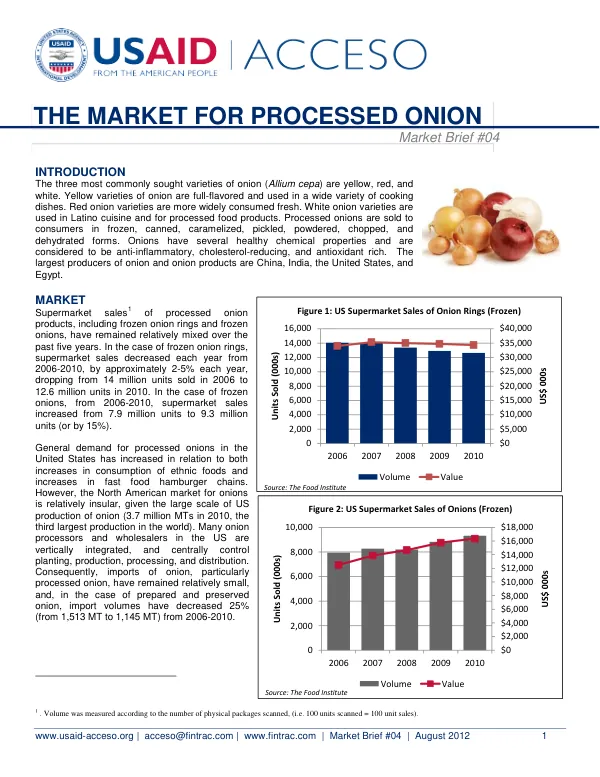
The US is a net exporter of fresh onions and processed onion products, with an estimated 70% of the US dehydrated onion crop being exported. In 2012, onion plantings in the US are expected to increase by 14% in response to increased producer prices experienced the previous season, further minimizing the need for importing. The largest international suppliers of US processed onions are Canada, China, and the EU. Canada is the single largest international supplier, with the bulk of processing companies based in Quebec. In 2010, Canada exported 358.3 MTs of processed and preserved onion products to the US, valued at $617,224 CIF. China is also a significant supplier, with Chinese processed onion products comprising the bulk of non-North American processed onion imports into the US and Canada. China's exports of onions (fresh and processed) increased 212% from 2000-2009, from 168,516 MTs to 526,313 MTs. The EU is also a supplier of processed onion products to the US, with 705 MTs exported in 2010. However, exports from the EU have decreased in recent years, with Belgium being a major player in both the fresh and processed onion markets. Buyers have indicated that they are still importing small quantities of processed onion from Belgium. India is a large producer of onions, but exports have fallen significantly due to the Indian government's fixed minimum export price (MEP). The MEP for onion was lowered to $150/MT in January 2012 in an effort to match Chinese and Egyptian export prices. Red and white varieties are grown in India and primarily target the Middle Eastern and East Asian markets. Central America is also a supplier of onions to the US, with Mexico being the most frequent Latin American supplier. However, Mexico primarily exports onions fresh, without processing. Prices for US imports of Mexican onions tend to be slightly below average prices for domestically supplied onions. The US market for processed onions is crowded and competitive, with limited growth opportunities for Honduran processed onion suppliers. Many suppliers of retail or wholesale processed onion products are vertically integrated, managing field production, postharvest activities, and processing directly. Smaller companies often insist on using local onion production only and have firm company policies against importing. The demand for fresh onions is limited, but several companies based in the southwestern US import fresh onions from Central America to supplement their own production. Fresh onions for processing face an easier inspection process during importing than processed onions, which undergo an inspection and require a license. Companies looking to import processed food products are more likely to be based in Canada, specifically Quebec, and are interested in importing IQF onions from Honduras at a competitive price (US$ 300 – US$ 400).