FOOD FOR THE HUNGRY, INTERNATIONAL
Market Report_TEFA_March 2020
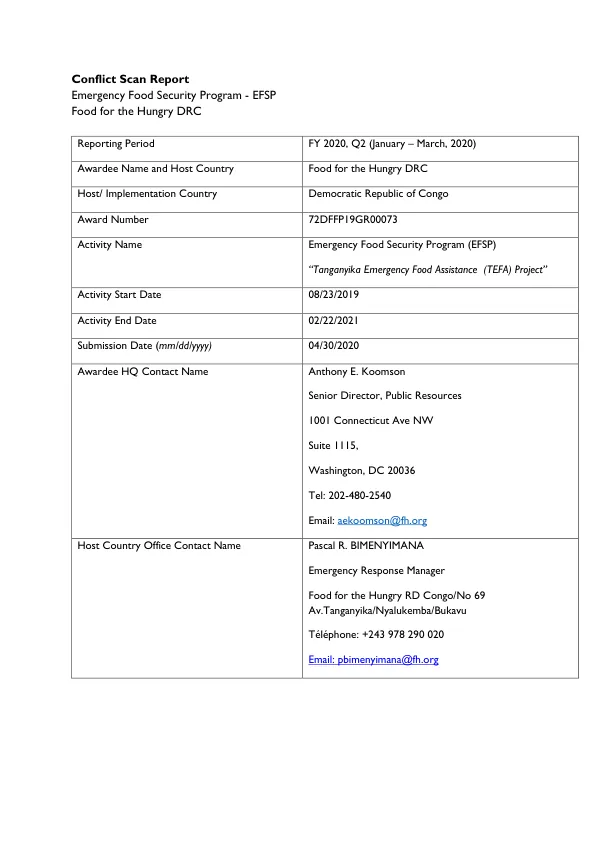
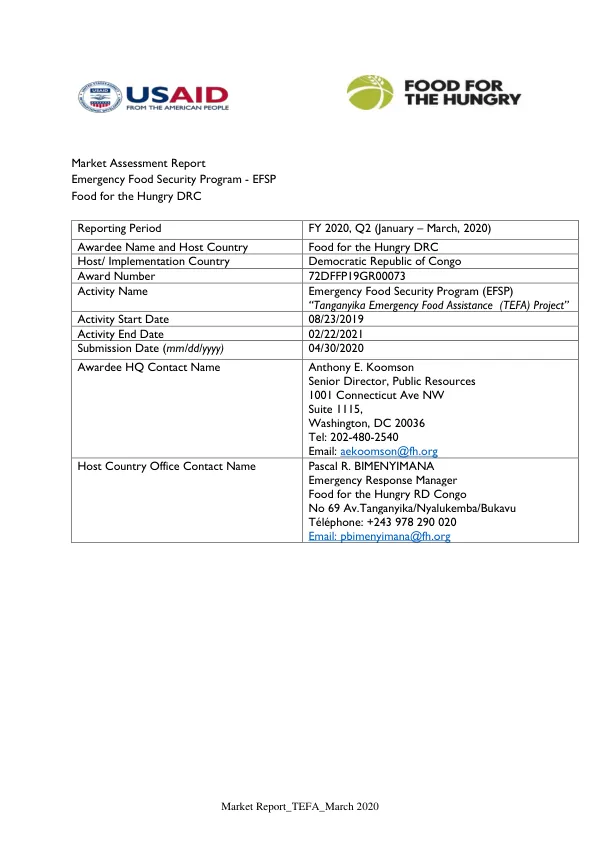
The Tanganyika Emergency Food Assistance project, also known as TEFA, is a humanitarian initiative implemented by Food for the Hungry DRC in the Democratic Republic of Congo.
2020 · 9 pages
Sign in to readA free account is required to download.
Abstract
The project aims to support 19,727 households affected by protracted insecurity in Tanganyika province to rebuild food security and self-resiliency through provision of tools, seeds, and agricultural inputs. The overall objective of the program is to support vulnerable households, including IDPs, returnees, and host communities, with monthly unconditional food assistance for the initial 4 months and 1,727 most vulnerable households with food to improve household-level food insecurity for a period of 6 months. The market study conducted in March 2020 during the second quarter of the project focused on the markets in the three health zones where the TEFA project operates. The study aimed to understand the functioning of the different markets, assess the modality and level of intervention, and evaluate the effects of the intervention on market players and people's access to the market. The study also aimed to assess market players and their capacity, understand whether altering the intervention is necessary, and know the prices of different foodstuffs and their behavior on the markets. The study found that women are more represented in trading activities in the markets, with 81.25% of traders being female compared to 18.75% male. The markets with the highest representation of men in agricultural trading activities are Mitonga Quarry, Kikumbe, and Kabwela. The massive involvement of women in agricultural trade activities is linked to their economic role in agriculture and within their households, as well as their ability to attract customers when competing with their male counterparts. The study also found that more than half of the traders (54.8%) sell only one commodity, while only 4.8% sell 4 commodities. A small proportion (1.6%) of traders stated that products are highly available on the different markets. Several reasons were reported as being at the root of this low availability in quantity of products on the market, including low productivity, poor condition of agricultural desert roads, insecurity, and bad weather conditions. The study collected data from 128 traders working in the different markets, with prices of agricultural products collected from 128 traders. The data was collected using both qualitative and quantitative methods, with direct interviews conducted with traders and market managers, and quantitative data collected using the ODK data collection software. The data was analyzed using SPSS and Stata software, and trends were generated in Excel. The study's findings have implications for the design of future programs, including the need to consider the capacity of market players and the effects of the intervention on market players and people's access to the market. The study also highlights the importance of understanding the prices of different foodstuffs and their behavior on the markets, as well as the need to address the root causes of low availability of products on the market, including low productivity, poor condition of agricultural desert roads, insecurity, and bad weather conditions.