FOOD FOR THE HUNGRY, INTERNATIONAL
Tuendelee Pamoja II DFSA Mid-Term Performance Evaluation
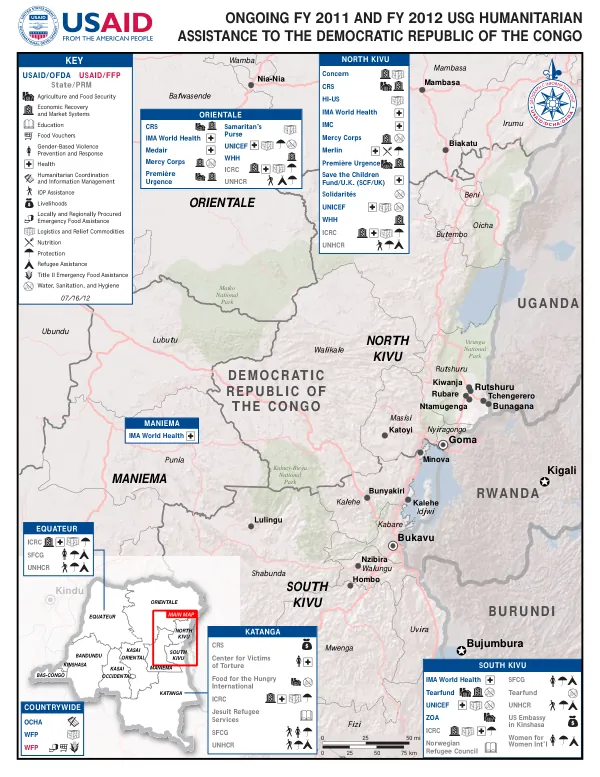
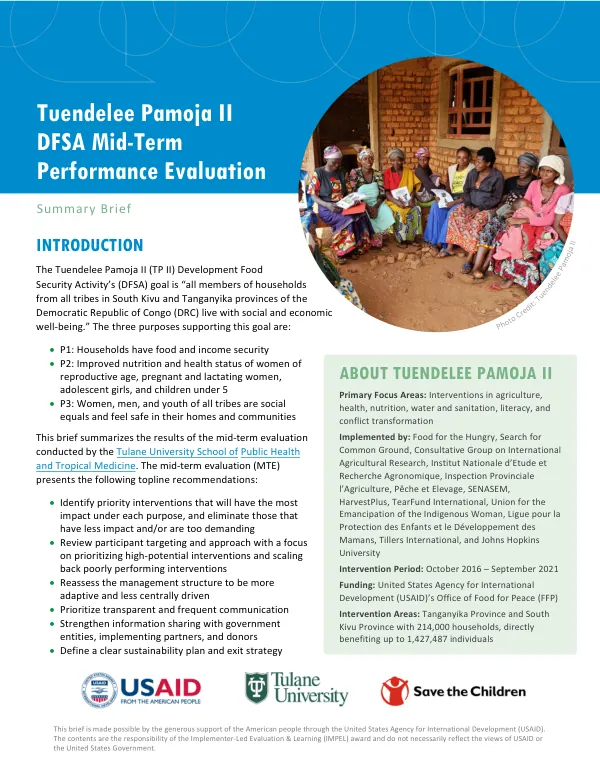
The Tuendelee Pamoja II Development Food Security Activity's goal is to ensure all members of households from all tribes in South Kivu and Tanganyika provinces of the Democratic Republic of Congo live with social and economic well-being.
2020 · 6 pages
Sign in to readA free account is required to download.
Abstract
The three purposes supporting this goal are: households have food and income security, improved nutrition and health status of women of reproductive age, pregnant and lactating women, adolescent girls, and children under 5, and women, men, and youth of all tribes are social equals and feel safe in their homes and communities. The mid-term evaluation conducted by Tulane University School of Public Health and Tropical Medicine identifies areas where Tuendelee Pamoja II has had important successes as well as areas where there is room for improvement. The evaluation highlights the need to identify priority interventions that will have the most impact under each purpose and eliminate those that have less impact and/or are too demanding. It also recommends reviewing participant targeting and approach, reassessing the management structure, prioritizing transparent and frequent communication, strengthening information sharing with government entities, implementing partners, and donors, and defining a clear sustainability plan and exit strategy. Tuendelee Pamoja II has implemented a wide range of interventions in agriculture, health, nutrition, water and sanitation, literacy, and conflict transformation. However, the project has experienced delays in implementation due to various external challenges, including staff turnover, security concerns, and elections. The project has also undertaken too many interventions, which has led to poor success and only partial implementation of several of these interventions. The mid-term evaluation recommends cutting certain interventions, such as oxen traction, youth and metal woodworking, fish racks, fish spawning, and training of community animal health workers. It also recommends increasing the focus on supporting the classic agriculture package, including skill transfer, improving value chains, and improving feeder roads to get products to market. In addition, the evaluation recommends reassessing approaches designed to increase the availability of high-quality foods for home consumption and ensuring that field agents understand the project approach and make adaptations to include adolescent females in Care Groups. The evaluation also highlights the need for the project to be more adaptive and less centrally driven, with leadership able to react more quickly to problems and staff encouraged to think of alternatives if they observe that standard practices are not working. Furthermore, the evaluation recommends revisiting the respective roles of Search for Common Ground and the Food for the Hungry gender team to ensure clarity in their missions and emphasizing the difference in their mandates.