USAID DEC
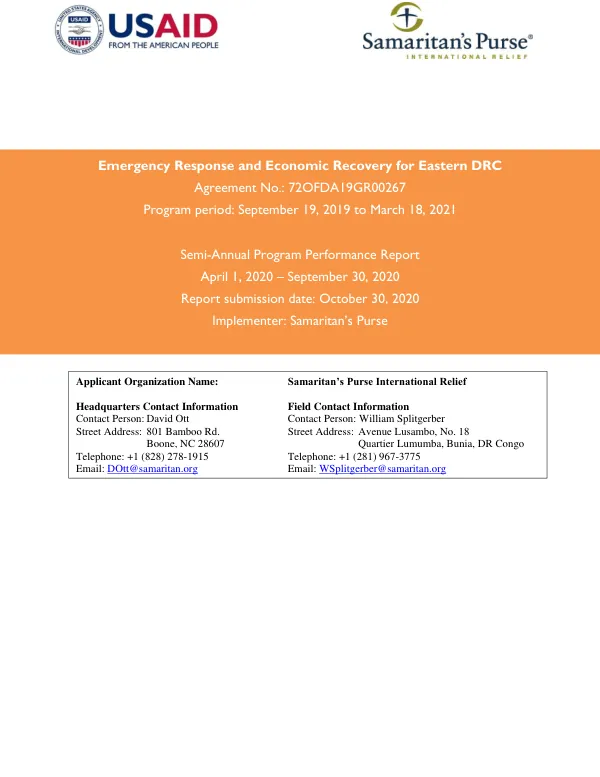
Emergency Response and Economic Recovery for Eastern DRC, Semi-Annual Report Oct 30th, 2020
Sign inUNITED NATIONS ORGANIZATION FOR THE COORDINATION OF HUMANITARIAN AFFAIRS
Emergency Response and Economic Recovery for Eastern DRC, Semi-Annual Report Oct 30th, 2020
The Democratic Republic of the Congo (DRC) remains one of the top four food-insecure countries of concern in the world.
2020 · 10 pages
Sign in to readA free account is required to download.
Abstract
The eastern provinces of DRC continue to experience a complex humanitarian crisis resulting in ever-increasing humanitarian needs. In addition to suffering the impacts of armed conflicts from many militia groups and increasing intercommunal intolerance, the population in eastern DRC is now exposed to the compounding effects of COVID-19, currency depreciation, and a drop in the Gross Domestic Product (GDP) that continues to impact their purchasing power, hence deteriorating their food security condition. With funding from USAID (OFDA/FFP), now USAID/BHA, Samaritan's Purse (SP) is responding to the immediate food, non-food item (NFI), and agricultural needs of 351,000 persons in 58,500 households (HHs) in eastern DRC who are impacted by armed conflict. The program is facilitating the humanitarian assistance in line with the local National Food Security Cluster, the Ministry of Health COVID-19 prevention measures and the 16th Cycle of the Integrated Food Security Phase Classification (IPC) recommendations. The program continued to respond to the humanitarian alerts issued by the Office for the Coordination of Humanitarian Affairs (OCHA) in Ituri and North Kivu Provinces. In particular, the program continued to provide humanitarian assistance to HHs impacted by conflicts in Kalunguta and Kamango Health Zones in North Kivu Province. Two new intervention sites were identified during the period under review. The program responded to the response appeal of OCHA Ituri to provide humanitarian assistance in Rimba Health Zone in Ituri Province and in Bengamisa / Tshopo Health Zones of Tshopo Province. Samaritan's Purse conducted internal security assessments and "Go & See" (feasibility) missions in the two new sites, then evaluated beneficiaries through a multi-sectoral vulnerability assessment. Beneficiaries were recruited based on food insecurity, NFI vulnerability, seed insecurity, access to farmland, and the willingness to actively participate in the program activities. The program adapted its intervention to match the requirements of the Ministry of Health guidelines on humanitarian interventions during the COVID-19 pandemic. This enabled resumption of field interventions resulting in the provision of assistance in the form of food, NFIs, farming tools, and accompanying essential agricultural information to 51,276 families. During the period under review, humanitarian assistance was provided to the beneficiaries through local fairs in which the vendors supported the provision of assorted food, NFIs, and agriculture support (farming tools and essential information sharing) to 350,285 program participants (comprising 161,875 males and 188,410 females in 51,276 HHs in Kamango I, Rimba, Kalunguta, Kamango II, and Tshopo). Cumulatively, the program has so far assisted 380,227 program participants (comprising 174,996 males and 205,296 females in 55,621 HHs in Kamango I, Rimba, Kalunguta, Kamango II, and Tshopo). Overall, this represents 95.1% program accomplishment out of the targeted 58,500 HHs. The program provided Sector I and II NFI assistance to 194,144 beneficiaries (inclusive of 187,133 internally displaced persons (IDPs) comprising 81,097 males and 106,036 females) in 29,214 HHs received during the period. The NFI assistance provided in the period represents 56.0% of the targeted 52,500 kits for the 52,500 HHs. Cumulatively, the program has so far provided NFI assistance to 49,267 HHs (90.0% of the program target). A total of 42,727 beneficiaries comprising 23,161 males and 19,566 females in 6,000 HHs were provided access to 30,701 pieces of assorted farming tools, 248.35 metric tons (MT) of seeds, and essential agricultural information. This represents 100% sector achievement to date. In Nobili, farming tools were provided through local fairs while seeds were provided as direct distributions. In Rimba, the seeds and tools were all provided through local fairs. Beneficiaries were provided with essential information on farming in Rimba Health Zone. It is hoped that the information shared will enable the HHs to register better yields due to effective utilization of farming inputs and better management of crops and vegetables. The program facilitated provision of 71,467 food rations (45.5% of the total program rations, n=157,500) to 45,276 HHs during the reporting period. Overall, the program has cumulatively provided 92,714 food rations (58.9% of the total program rations, n=157,500) to 49,647 HHs. All the food assistance in the reporting period and cumulatively has been provided
Related documents