USAID
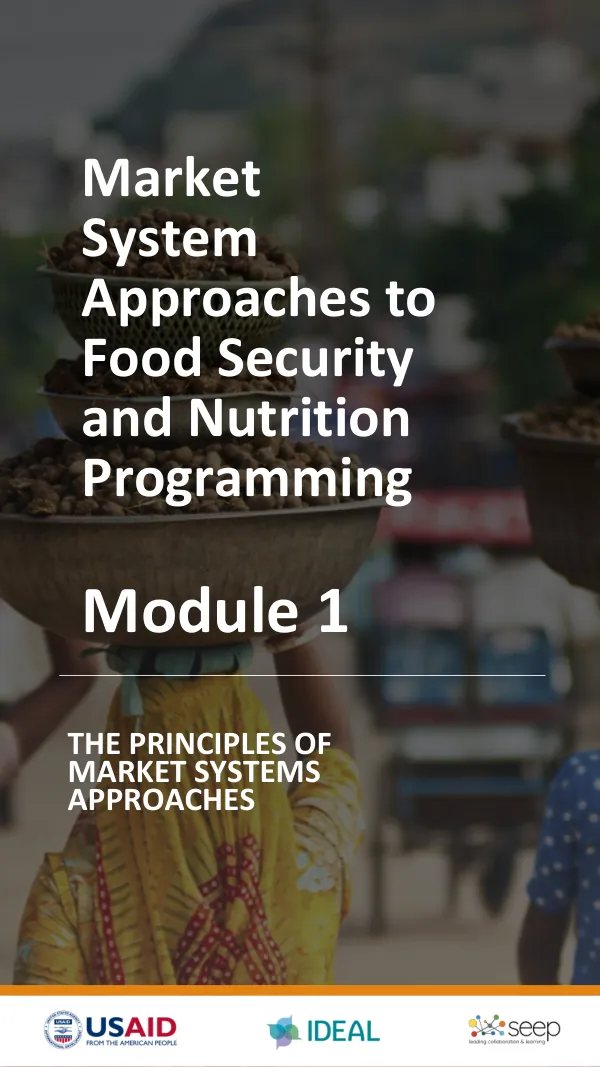
Market System Approaches to Food Security and Nutrition Programming Module 1
Market systems approaches to food security and nutrition programming aim to improve the functionality and accessibility of markets to enhance food security and nutrition outcomes.
2022 · 47 pages
Sign in to readA free account is required to download.
Abstract
A market system is comprised of various elements that facilitate exchange, including supporting functions, rules and norms, and market actors. Understanding the basics of markets and market systems is essential for practitioners to effectively design and implement market system development (MSD) programs. A market is defined as an exchange of goods or services between demand and supply sides. The demand side consists of households, businesses, and other organizations seeking to acquire goods or services, while the supply side comprises individuals or organizations providing goods or services. Marketplaces are physical or virtual spaces where market exchanges occur. Marketplaces can be formal or informal, and they may be influenced by various factors, including cultural norms, regulation, and infrastructure. Market systems are influenced by a complex array of factors, including finance, information, input supplies, land, transport, storage, regulation, and cultural norms. These factors can impact access to goods and services, and they can also influence the functioning of the market system. For example, limited access to finance can result in low demand for certain goods or services, leading to reduced supply and lower market functionality. Market system terminology includes supporting functions, rules and norms, and market actors. Supporting functions refer to services and physical structures that facilitate exchange, such as infrastructure, information access, financial services, communications, and transportation. Rules and norms govern market behavior and can be explicit or tacit. Market actors comprise all individuals or groups performing exchange, including demand and supply side actors, as well as those performing supporting functions and rules and norms. Market system development (MSD) programs aim to address market system constraints to improve market functionality and accessibility. MSD programs focus on understanding the market system, identifying constraints, and developing interventions to address these constraints. MSD programs can be designed to improve supply-side constraints, such as input supplies and infrastructure, or demand-side constraints, such as finance and information. Typical market system constraints in food security and nutrition systems include limited access to finance, information, and input supplies. These constraints can result in reduced market functionality and lower food security and nutrition outcomes. MSD programs can be designed to address these constraints and improve market functionality, ultimately enhancing food security and nutrition outcomes. Market system approaches to food security and nutrition programming offer a promising strategy for improving market functionality and accessibility. By understanding the basics of markets and market systems, practitioners can design and implement effective MSD programs to address market system constraints and enhance food security and nutrition outcomes.