JOHN SNOW INTERNATIONAL
Mauritania: Collaborates with UNFPA to Leverage Resources, June 2016
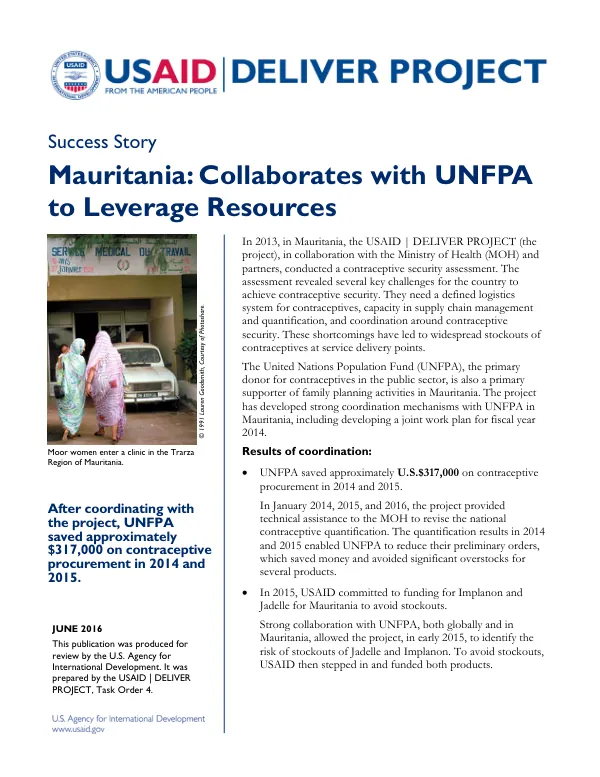
Mauritania's Contraceptive Security Initiative began in 2013 with a comprehensive assessment conducted by the USAID | DELIVER PROJECT in collaboration with the Ministry of Health (MOH) and partners.
2016 · 2 pages
Sign in to readA free account is required to download.
Abstract
The assessment revealed several key challenges for the country to achieve contraceptive security, including a defined logistics system for contraceptives, capacity in supply chain management and quantification, and coordination around contraceptive security. These shortcomings have led to widespread stockouts of contraceptives at service delivery points. The United Nations Population Fund (UNFPA) is a primary supporter of family planning activities in Mauritania and the primary donor for contraceptives in the public sector. The USAID | DELIVER PROJECT has developed strong coordination mechanisms with UNFPA in Mauritania, including a joint work plan for fiscal year 2014. As a result of this collaboration, UNFPA saved approximately $317,000 on contraceptive procurement in 2014 and 2015. The project provided technical assistance to the MOH to revise the national contraceptive quantification in January 2014, 2015, and 2016. The revised quantification enabled UNFPA to reduce their preliminary orders, which saved money and avoided significant overstocks for several products. In 2015, USAID committed to funding for Implanon and Jadelle for Mauritania to avoid stockouts. Strong collaboration with UNFPA allowed the project to identify the risk of stockouts of Jadelle and Implanon, and USAID then stepped in and funded both products. The project and UNFPA jointly funded training in logistics and quantification for 20 central- and regional-level MOH and NGO representatives. The training participant stated that the workshop gave them the necessary skills in logistics management to assure the availability of health products. The funding commitment allowed the project to expand the scope of its planned activities. UNFPA has also been supporting integration of contraceptives into the storage distribution network of essential medicines, and the project designed a new logistics system for contraceptives. This system was piloted in two regions starting in 2014 and is being rolled out by the MOH with support from the project and UNFPA.