USAID DEC
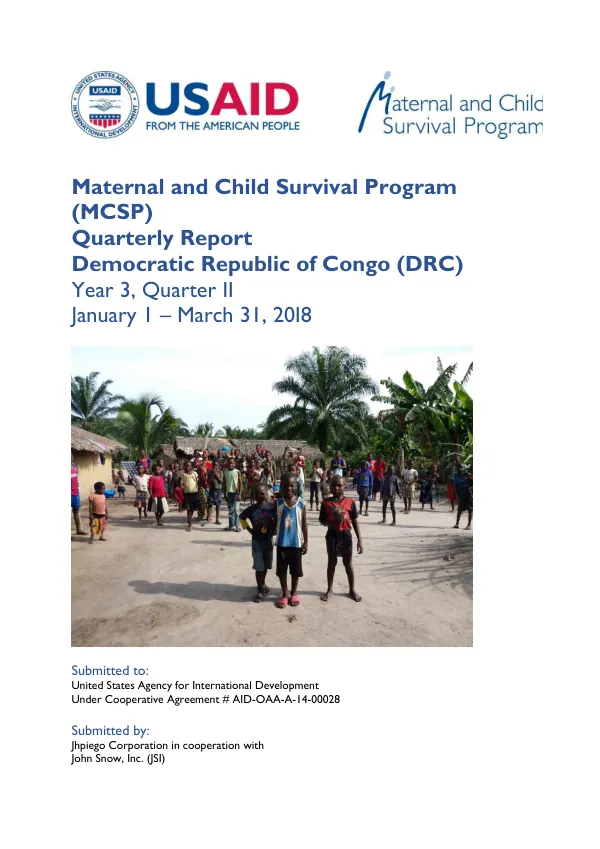
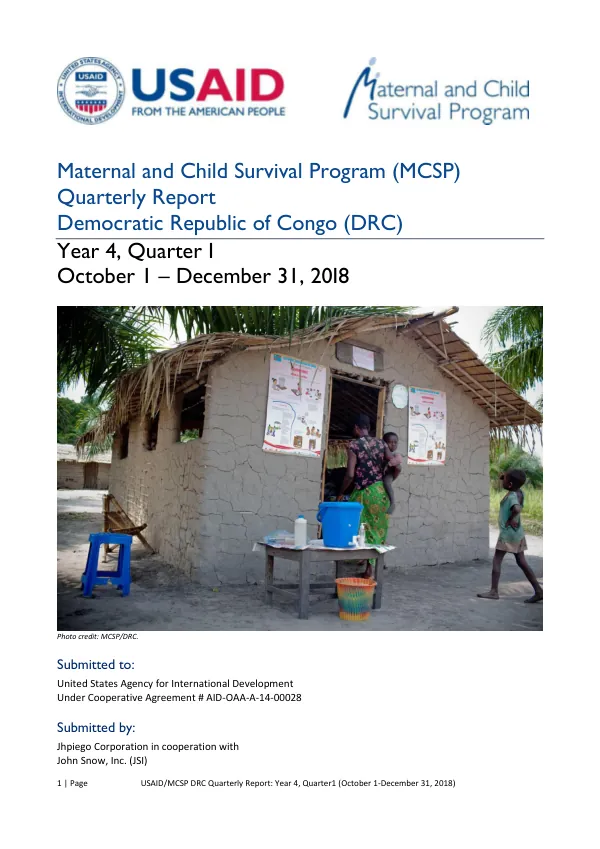
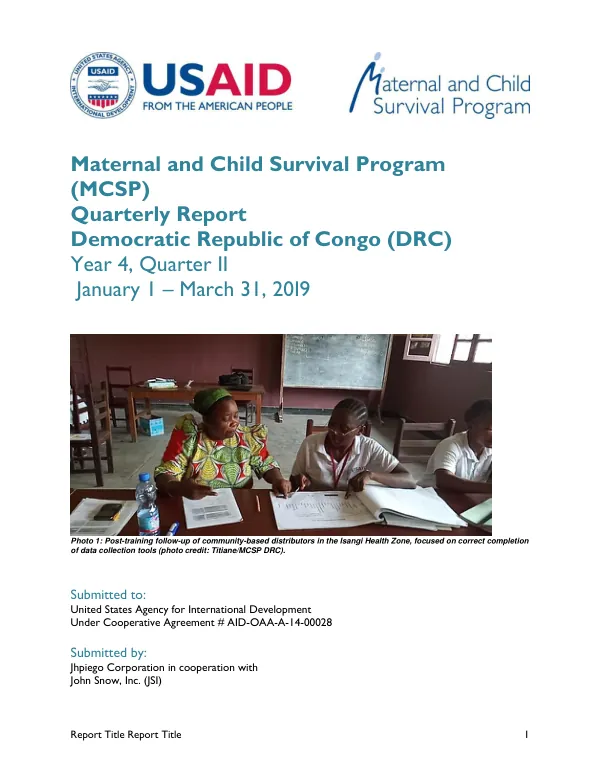
Maternal and Child Survival Program (MCSP) Quarterly Report Democratic Republic of Congo (DRC) Year 4, Quarter II January 1 – March 31, 2019
Sign inJHPIEGO
Maternal and Child Survival Program (MCSP) Quarterly Report Democratic Republic of Congo (DRC) Year 4, Quarter II January 1 – March 31, 2019
The Maternal and Child Survival Program (MCSP) in the Democratic Republic of Congo (DRC) aims to support the country in institutionalizing effective organizational plans, structures, and processes for the sustainable implementation of evidence-based reproductive, maternal, newborn, and child health (RMNCH) practices.
2019 · 35 pages
Sign in to readA free account is required to download.
Abstract
The program's goal is to accelerate reductions in maternal and child mortality by strengthening national Ministry of Health (MOH) capacity to strategically scale up cost-effective, evidence-based interventions. MCSP works in close partnership with the MOH, USAID, and other RMNCH stakeholders to support improved planning, coordination, monitoring, evaluation, documentation, and scale-up of RMNCH activities at national and provincial levels. The program brings expertise in maternal, newborn, and child health; family planning (FP); nutrition; water, sanitation, and hygiene (WASH); community engagement; health information systems, and other aspects of health systems strengthening. At the national level, MCSP works to strengthen the MOH Directorate of Family and Specific Groups' Health, known as the 10th Directorate (D10), to drive policy development and implementation, updating clinical protocols and guidelines, human resource capacity-building, partner coordination, and financing. MCSP supports the D10 through participation in the national reproductive, maternal, newborn, child, and adolescent health (RMNCAH) Task Force and associated technical working groups (TWG), contributing to efforts to increase coverage of and mobilize resources for high-impact interventions and accelerate reductions in maternal, neonatal, and child mortality. Under Objective 2, MCSP works with Congolese associations of professional birth attendants/midwives, pediatricians, nurses, and obstetrician/gynecologists to strengthen association members' technical capacities to train and mentor others within their profession. MCSP and its sub-partner, Canadian University Services Overseas (Cuso) International, are providing organizational and institutional capacity strengthening to these associations. In addition, MCSP has helped the MOH to establish a model training center at the Kintambo Maternity, Clinique Libota Lilamu, and Pediatric Unit of the Kintambo General Hospital to improve the clinical training experience of students conducting their clinical rotations for maternal, newborn, and postpartum family planning (PPFP) care. Under Objective 3, MCSP is working in eight health zones in the northeastern provinces of Bas-Uélé and Tshopo. MCSP's provincial-level activities aim to strengthen the Provincial Health Office (Division Provinciale de Santé, DPS) and health zone teams, health facilities, and community care sites to improve the quality of and expand access to child health, family planning, nutrition, and WASH services. Since Program Year (PY) 3, MCSP has been working to strengthen the capacity of Congolese health professional organizations at national level to provide quality in-service training and pre-service education on key maternal and newborn health and post-partum family planning interventions. MCSP's activities in the DRC are focused on improving maternal and newborn survival, reducing child mortality, and increasing access to family planning methods in underserved rural communities. The program's work is aligned with the DRC's National Health Development Plan (PNDS) and the USAID's DRC Country Development Cooperation Strategy (CDCS) 2014-2019.
Related documents