GOVERNMENT OF SENEGAL
USAID Senegal: Buy-In to the Feed the Future EnGRAIS Project
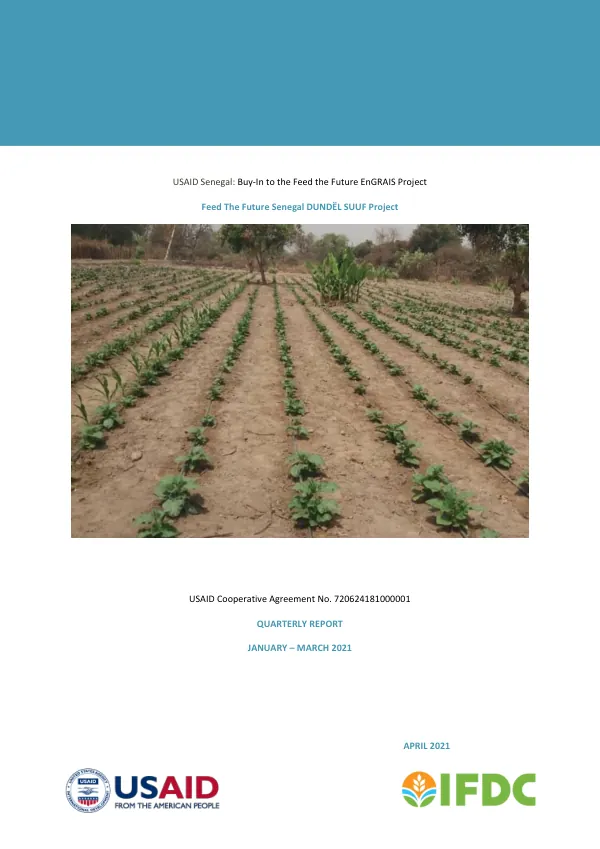
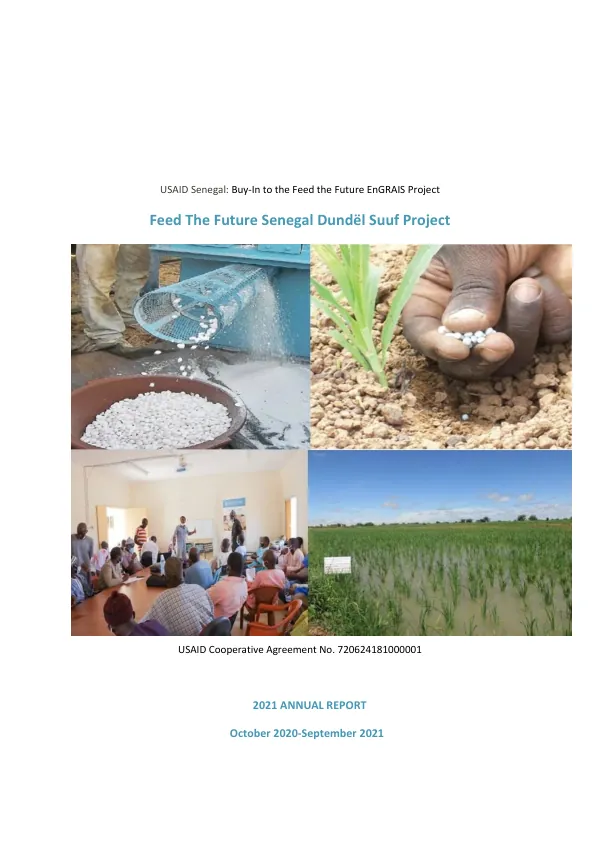
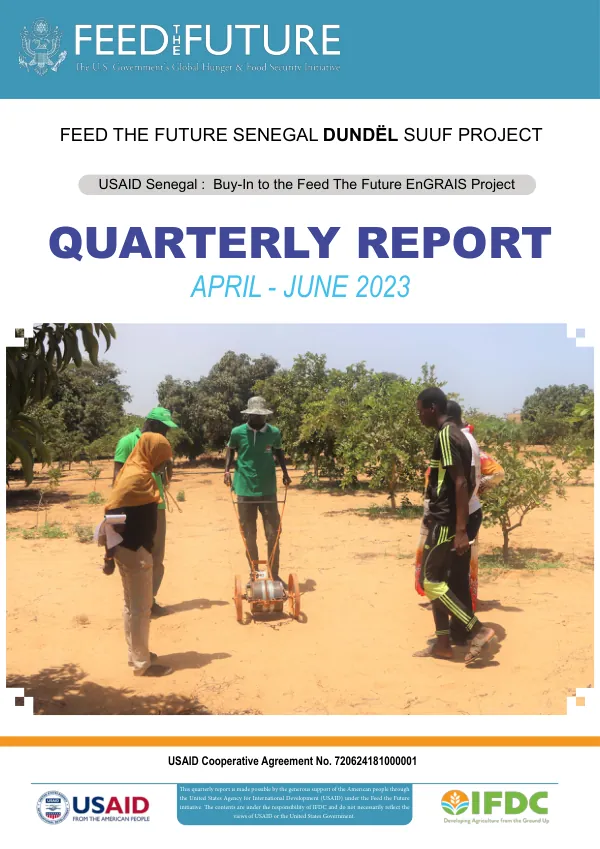
The agricultural development initiative in Senegal, known as the Dundël Suuf project, aims to increase agricultural productivity by promoting an inclusive and sustainable reduction of hunger, poverty, and malnutrition.
2021 · 27 pages
Sign in to readA free account is required to download.
Abstract
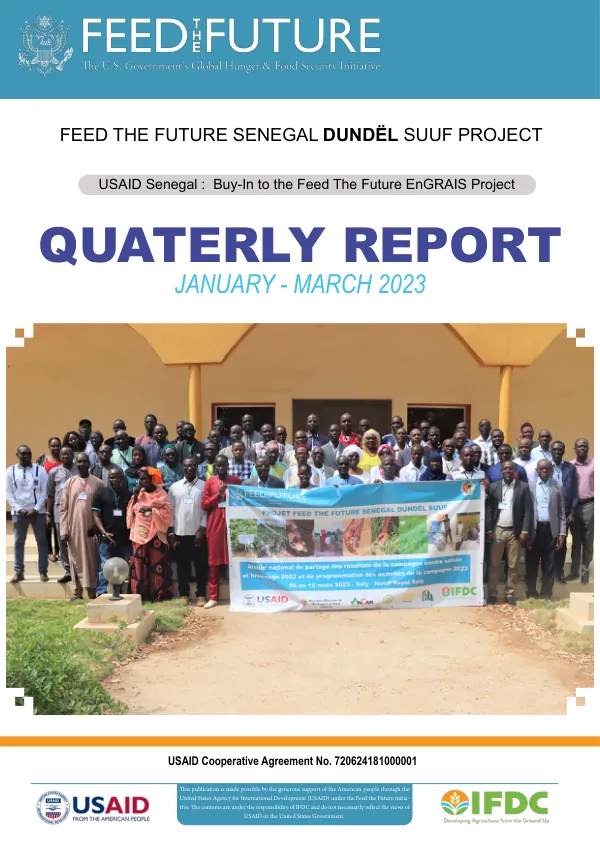
The project is funded by USAID through the Feed the Future initiative and is implemented by the International Fertilizer Development Center (IFDC). The main beneficiaries of the project are small farmers, input supply chain actors, extension and research agents, and vulnerable groups, including women and youth. The project operates in the five Feed the Future Zones of Influence (ZoIs) in Senegal, which are Casamance, Senegal Oriental, the Peanut Basin, Niayes, and the Senegal River Valley. The target crops are dry cereals, rice, and vegetables. The project's strategic objective is to increase the availability and use of new and quality fertilizers through efficient private sector-led supply systems to improve and sustain soil fertility in Senegal. The project's results framework presents the goal and strategic objective of the project, which is to increase agricultural productivity to foster inclusive and sustained reduction in hunger, poverty, and malnutrition. To achieve this goal, the project has three intermediate results (IR) and three cross-cutting activities. The IRs are: IR 1, Improved and appropriate fertilizer formulas developed and made available to farmers; IR 2, Proven and environmentally sound fertilizer products and technologies disseminated and upscaled; and IR 3, Improved fertilizer policy and regulatory environment. The cross-cutting issues are: Improved access of women to productive resources; Increased participation of young people in agriculture; and Communication and information sharing more effective. The project's activities are organized into three major components: (1) Improved and appropriate fertilizer formulas developed and made available to farmers; (2) Proven and environmentally sound fertilizer products and technologies disseminated and upscaled; and (3) Improved fertilizer policy and regulatory environment. During the third quarter of the second year of implementation, the project achieved several key milestones. A total of 2,374 soil samples were analyzed, and 126 soil samples were sent to CropNuts for analysis. Additionally, 28,057 individuals participated in the project's activities, including 15,872 farmers who received training, of which 6,869 were women (43%) and 2,621 were youth (17%). Furthermore, 7,054 farmers applied FDP, MD, and ISFM technologies, and 437 hectares of demonstration and extension of UDP, MD, and ISFM technologies were implemented. The project also published 3 Dundël Suuf monthly Flash Info and organized 1 national workshop to share the results of the 2020/2021 rainy season campaign and to plan the activities for the 2021/2022 wet season campaign. Additionally, 2 training workshops were organized on Environmental impact mainstreaming and Stata and advanced Excel. The Senegalese Agricultural Research Institute (ISRA) is the partner in charge of field activities related to the soil fertility mapping and worked closely with the National Institute of Pedology (INP). The project's activities are focused on developing and making available improved and appropriate fertilizer formulas to farmers, disseminating and upscaled proven and environmentally sound fertilizer products and technologies, and improving the fertilizer policy and regulatory environment. The project's results framework presents the goal and strategic objective of the project, which is to increase agricultural productivity to foster inclusive and sustained reduction in hunger, poverty, and malnutrition. The project's activities are organized into three major components, and the project has achieved several key milestones during the third quarter of the second year of implementation.
Related documents