USAID
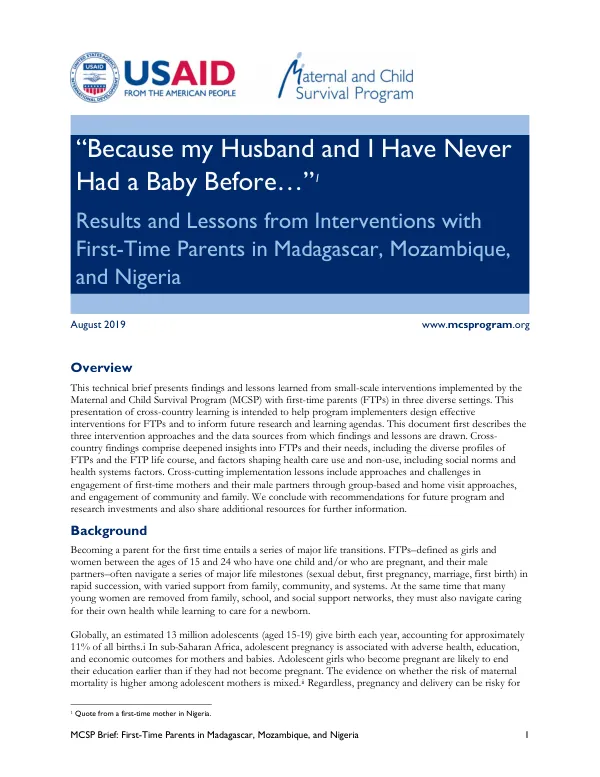
MCSP Brief: First-Time Parents in Madagascar, Mozambique, and Nigeria
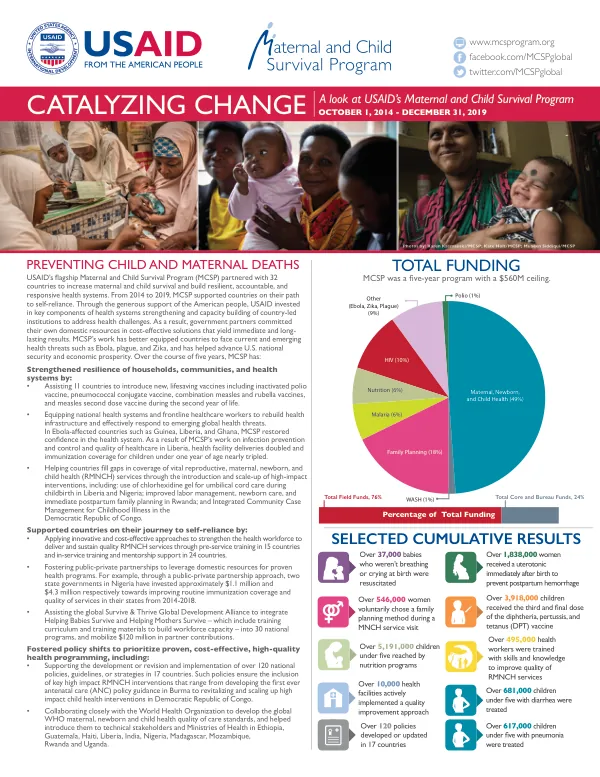
The Maternal and Child Survival Program (MCSP) conducted small-scale interventions with first-time parents (FTPs) in Madagascar, Mozambique, and Nigeria between 2015 and 2019.
2019 · 16 pages
Sign in to readA free account is required to download.
Abstract
The interventions aimed to increase demand for and access to reproductive and maternal health services among FTPs in diverse settings. Each intervention was tailored to the local context and used elements of a socioecological approach recognizing influences at the individual, couple, family, community, and health systems levels. In Madagascar, MCSP conducted qualitative formative research to explore the factors that shape FTPs' use of reproductive and maternal health services. Findings showed that FTPs face supply-side barriers to service use, such as poor quality of services, and family pressure to continue traditions of seeking care from traditional birth attendants and traditional healers. In response, MCSP developed and launched the Tanora Mitsinjo Taranaka (TMT) initiative in two districts of Menabe region to increase FTPs' use of reproductive and maternal health services. TMT entailed household visits by community health workers to provide life-stage-tailored health information and encourage FTPs to access health services. In Mozambique, MCSP used a similar approach to create a contextually adapted package of adolescent-geared reproductive and maternal, newborn, and child health (RMNCH) services. The package, called Our First Baby, includes nine group discussion sessions designed to meet the needs of FTPs and their partners. Each session is conducted by a community health worker trained to lead the implementation and supervised by a Community Development Officer. The program also provided referrals to health facilities and capacity strengthening support to improve the quality of RMNCH services. In Nigeria, MCSP conducted a similar intervention, adapting Save the Children's My First Baby initiative to include male partners, calling the reframed package Our First Baby. The program includes nine group discussion sessions designed to meet the needs of FTPs and their partners, with each session conducted by a community health worker trained to lead the implementation and supervised by a Community Development Officer. The program also provided referrals to health facilities and capacity strengthening support to improve the quality of RMNCH services. The interventions in Madagascar, Mozambique, and Nigeria showed promising results, with increased use of reproductive and maternal health services among FTPs. The programs also highlighted the importance of engaging male partners, addressing harmful gender norms, building intracouple communication, and encouraging male involvement in family planning and parenting. The findings and lessons learned from these interventions can inform future program and research investments to improve the health and well-being of FTPs and their children. The socioecological model was used as an organizing framework to understand the factors that shape FTPs' use of reproductive and maternal health services. The model recognizes influences at the individual, couple, family, community, and health systems levels, and the interventions were designed to address these factors in a holistic manner. The use of a socioecological approach allowed for a comprehensive understanding of the complex factors that shape FTPs' health-seeking behaviors and the development of effective interventions to address these factors. The interventions also highlighted the importance of engaging community health workers and other local stakeholders in the delivery of reproductive and maternal health services. Community health workers were trained to provide life-stage-tailored health information and to encourage FTPs to access health services. The use of community health workers and other local stakeholders can help to increase the reach and effectiveness of reproductive and maternal health services, particularly in resource-constrained settings. Overall, the interventions conducted by MCSP in Madagascar, Mozambique, and Nigeria demonstrate the potential of small-scale, contextually adapted interventions to improve the health and well-being of FTPs and their children. The findings and lessons learned from these interventions can inform future program and research investments to improve the health and well-being of FTPs and their children.