INTERNATIONAL CONFEDERATION OF MIDWIVES
MCSP Madagascar Technical Brief: Pre-Service Midwifery Education
The World Health Organization recommends one midwife for every 5,000 people, but Madagascar has only one midwife per 16,000 people.
2019 · 5 pages
Sign in to readA free account is required to download.
Abstract
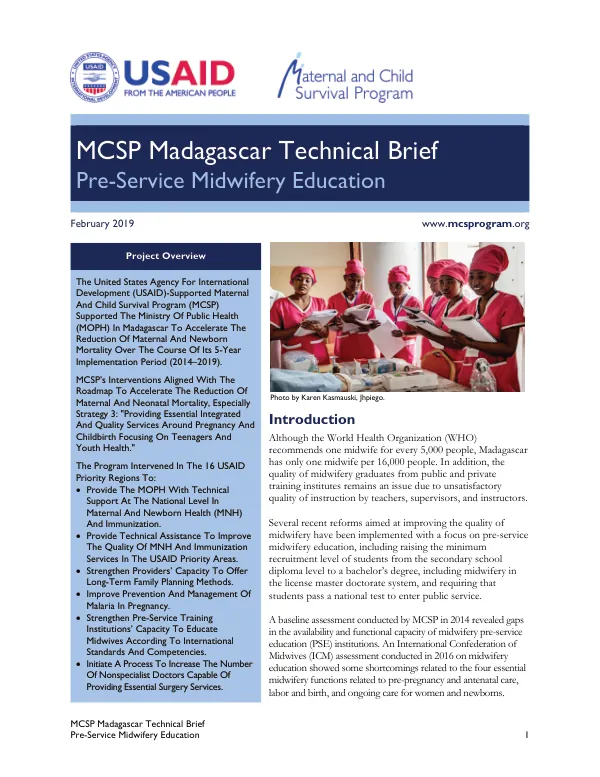
The quality of midwifery graduates from public and private training institutes remains an issue due to unsatisfactory quality of instruction by teachers, supervisors, and instructors. Several recent reforms aimed at improving the quality of midwifery have been implemented with a focus on pre-service midwifery education. The minimum recruitment level of students from the secondary school diploma level to a bachelor's degree has been raised, and midwifery has been included in the license master doctorate system. Students are now required to pass a national test to enter public service. A baseline assessment conducted by MCSP in 2014 revealed gaps in the availability and functional capacity of midwifery pre-service education institutions. An International Confederation of Midwives assessment conducted in 2016 showed some shortcomings related to the four essential midwifery functions. The United States Agency For International Development (USAID)-Supported Maternal And Child Survival Program (MCSP) supported the Ministry Of Public Health (MOPH) in Madagascar to accelerate the reduction of maternal and newborn mortality over the course of its 5-year implementation period (2014-2019). MCSP's interventions aligned with the Roadmap to Accelerate the Reduction of Maternal and Neonatal Mortality, especially Strategy 3: "Providing Essential Integrated And Quality Services Around Pregnancy And Childbirth Focusing On Teenagers And Youth Health." MCSP intervened in the 16 USAID priority regions to provide technical support at the national level in maternal and newborn health (MNH) and immunization. Technical assistance was provided to improve the quality of MNH and immunization services in the USAID priority areas. Providers' capacity to offer long-term family planning methods was strengthened, and prevention and management of malaria in pregnancy were improved. Pre-service training institutions' capacity to educate midwives according to international standards and competencies was also strengthened. To help the country train midwives who can immediately provide quality services upon graduation, MCSP supported revisions to the pre-service midwifery education (PSE) curricula and improvements in teaching quality in public and private PSE institutions. MCSP supported the revision of the midwifery program according to WHO and ICM standards, together with the faculties of medicine, which oversees the public midwifery institutions. Capacity-building of teachers, preceptors, and monitors at midwifery institutions was also supported, which received technical updates on evidence-based MNH standards and a training on effective teaching. Following the trainings, supervision visits were conducted to monitor implementation of new acquired skills. The establishment of skills laboratories in public pre-service institutions was also supported to enable students to develop and master essential skills on anatomic models before their clinical placements. The national training curriculum for midwifery education was updated to reflect the latest recommendations from WHO and the ICM, including the emphasis on an even balance between theory and practice. MCSP strengthened Madagascar's six faculties of medicine and 27 private institutions, resulting in 79 teachers, 51 training preceptors, and 17 monitors receiving training in effective teaching methods to strengthen the quality of teaching and coaching provided to students. Four skills laboratories were developed at the pre-service training institutions in Toamasina, Fianarantsoa, Antsiranana, and Mahajanga, and were supported by the donation of training for 52 staff on skills lab management. Eight clinical midwifery training sites were equipped with basic materials and supplies, including instrument trays, trash bins, decontamination boxes, and newborn resuscitation kits. MCSP supported midwifery training institutes to conduct regular supervision of their instructors and students using a monitoring and supervision method developed in collaboration with the faculties of medicine to improve teaching quality. The midwifery curriculum was revised according to ICM standards in six faculties of medicine and 27 private midwifery institutions. Standardization in MNH was achieved, and 52 public institution teachers, 27 private institution teachers, 51 public supervisors, and 17 public instructors were reached. Effective teaching training was provided to 79 teachers, 51 preceptors, and 17 instructors, and four sites were rehabilitated and equipped with furniture, anatomic models, resuscitation kits, materials, and consumables. Clinical placement sites were strengthened and equipped with materials and consumables in three university hospitals and five urban health centers.