USAID DEC
Community Health Volunteers and Malaria: Their contribution in malaria prevention, screening and treatment
Sign inJSI RESEARCH & TRAINING INSTITUTE, INC
Community Health Volunteers and Malaria: Their contribution in malaria prevention, screening and treatment
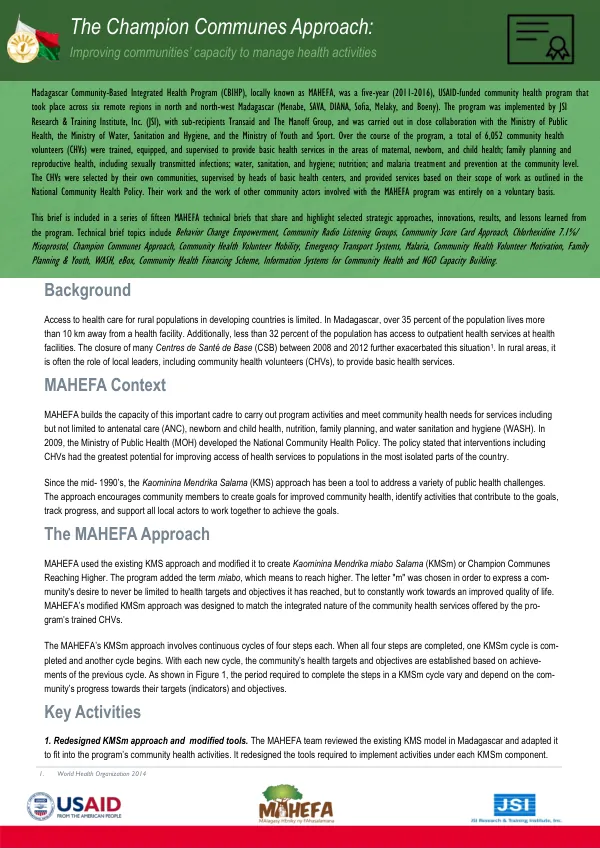
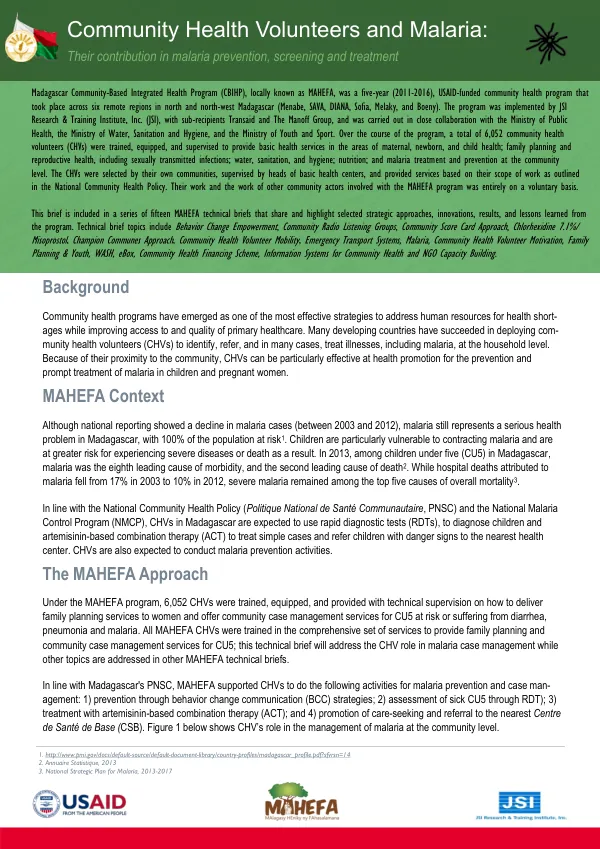
Community Health Volunteers and Malaria: Their Contribution in Malaria Prevention, Screening, and Treatment The Madagascar Community-Based Integrated Health Program (CBIHP), locally known as MAHEFA, was a five-year (2011-2016) community health program implemented across six remote regions in north and north-west Madagascar.
2016 · 4 pages
Sign in to readA free account is required to download.
Abstract
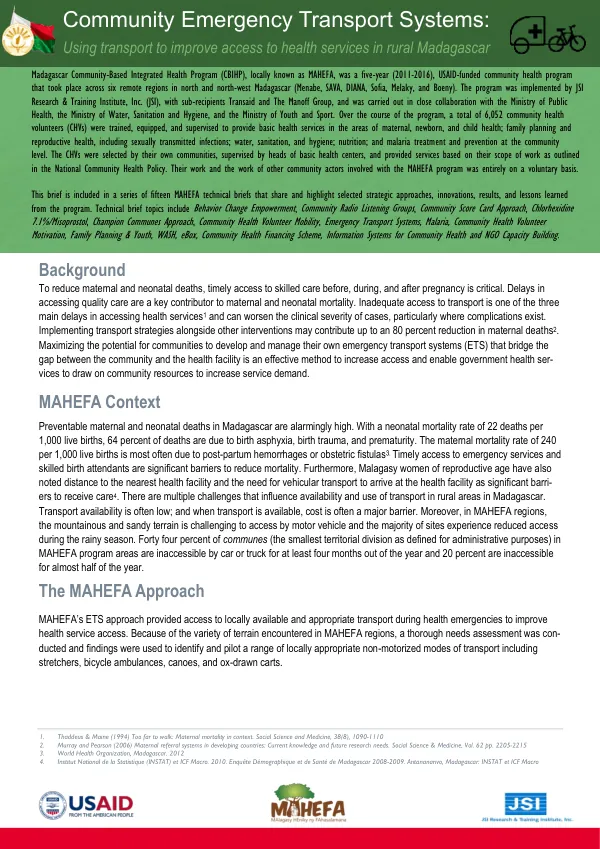
The program was funded by USAID and implemented by JSI Research & Training Institute, Inc. (JSI), with sub-recipients Transaid and The Manoff Group, in close collaboration with the Ministry of Public Health, the Ministry of Water, Sanitation and Hygiene, and the Ministry of Youth and Sport. A total of 6,052 community health volunteers (CHVs) were trained, equipped, and supervised to provide basic health services in the areas of maternal, newborn, and child health; family planning and reproductive health, including sexually transmitted infections; water, sanitation, and hygiene; nutrition; and malaria treatment and prevention at the community level. The CHVs were selected by their own communities, supervised by heads of basic health centers, and provided services based on their scope of work as outlined in the National Community Health Policy. The CHVs played a crucial role in malaria prevention, screening, and treatment. They conducted malaria prevention activities, including behavior change communication (BCC) strategies, and assessed sick children using rapid diagnostic tests (RDTs). CHVs treated children determined to be positive for malaria with artemisinin-based combination therapy (ACT) and referred them to the nearest Centre de Santé de Base (CSB) in cases of danger signs. They also encouraged care-seeking behaviors and made referrals to the nearest CSB. The MAHEFA program achieved significant results in malaria prevention and treatment. The number of people reached with key messages on malaria increased from FY 2013 through FY 2016. In 2015, the last full year of the program, almost half (47%) of children under five (CU5) with fever who received a RDT from CHVs tested positive for malaria, a rate that is substantially lower than rates reported in previous years. The reduction in malaria cases could be attributed to the large, MOH-backed LLITN distribution campaign in 2013 and the increased malaria prevention activities offered by CHVs and other community health actors. The CHVs' services in testing, treatment, and referrals in the program area showed a significant increase since the beginning of the program (2012-2016). The number of CU5 treated with ACT by CHVs was higher than the number of CU5 testing positive, partially due to RDT shortages and the MOH reporting forms used. The MAHEFA program demonstrated the effectiveness of community health volunteers in malaria prevention, screening, and treatment, and their contribution to improving access to and quality of primary healthcare in Madagascar. The MAHEFA program's approach to malaria prevention and treatment was in line with Madagascar's National Community Health Policy and the National Malaria Control Program. The program's results and lessons learned were shared and highlighted in a series of fifteen MAHEFA technical briefs, including this brief on the CHV role in malaria case management. The MAHEFA program's success in malaria prevention and treatment has implications for the implementation of similar community-based health programs in other countries.