USAID
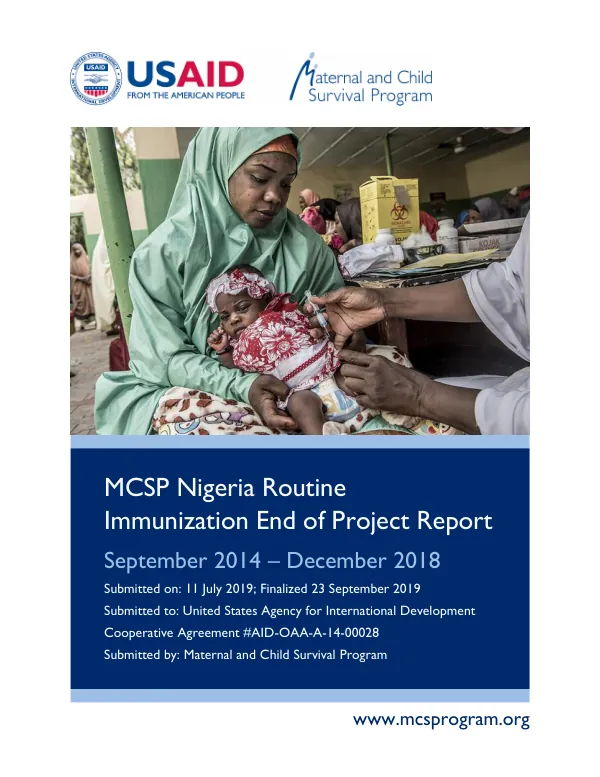
MCSP Nigeria Routine Immunization End of Project Report
The Maternal and Child Survival Program (MCSP) is a global, $560 million, 5-year cooperative agreement funded by the United States Agency for International Development (USAID) to introduce and support scale-up of high-impact health interventions among USAID's 25 maternal and child health priority countries, as well as other countries.
2019 · 64 pages
Sign in to readA free account is required to download.
Abstract
MCSP is focused on ensuring that all women, newborns, and children most in need have equitable access to quality health care services to save lives. MCSP supports programming in maternal, newborn, and child health, immunization, family planning and reproductive health, nutrition, health systems strengthening, water/sanitation/hygiene, malaria, prevention of mother-to-child transmission of HIV, and pediatric HIV care and treatment. The MCSP Nigeria Routine Immunization (RI) program was implemented from September 2014 to December 2018, with the goal of improving routine immunization services in Nigeria. The program was supported by USAID under the terms of the Cooperative Agreement AID-OAA-A-14-00028. The program's major accomplishments include improvements in governance and accountability, accessibility and utilization of immunization services, vaccine security, cold chain, and logistics, monitoring and use of data, community partnerships, capacity-building and training, and national-level program support. The program implemented six thematic areas, including governance and accountability, improving accessibility and utilization, vaccine security, cold chain, and logistics, monitoring and use of data, community partnerships, and capacity-building and training. The program also supported national-level program support and cross-cutting and global learning themes. The program's results and findings showed improvements in immunization coverage, particularly in Bauchi and Sokoto states, where DPT3 coverage increased from 2014 to 2018. Administrative data also showed increased DPT3 coverage in MCSP-supported areas. The program's success stories include the power of partnerships for improved routine immunization in Nigeria, where barbers in Northern Nigeria played a crucial role in reducing newborn mortality by promoting immunization services. The program also developed various materials and tools, including a learning matrix, a RI MOU partnership model, and a list of presentations at conferences and publications. The program's approach to improving the quality and use of data to strengthen routine immunization involved background research, strategies, and interventions, which resulted in improved data quality and use. The program also implemented community engagement strategies for improved health outcomes, which included background research, approach, strategies, interventions, and program results. The program's recommendations include improving the quality and use of data to strengthen routine immunization, improving RI service provision through mentorship, and community engagement strategies for improved health outcomes. The program's lessons learned and best practices include the importance of partnerships, community engagement, and data-driven decision-making in improving routine immunization services. The program's way forward involves continuing to support routine immunization services in Nigeria and scaling up successful interventions to other countries.
Related documents