USAID DEC
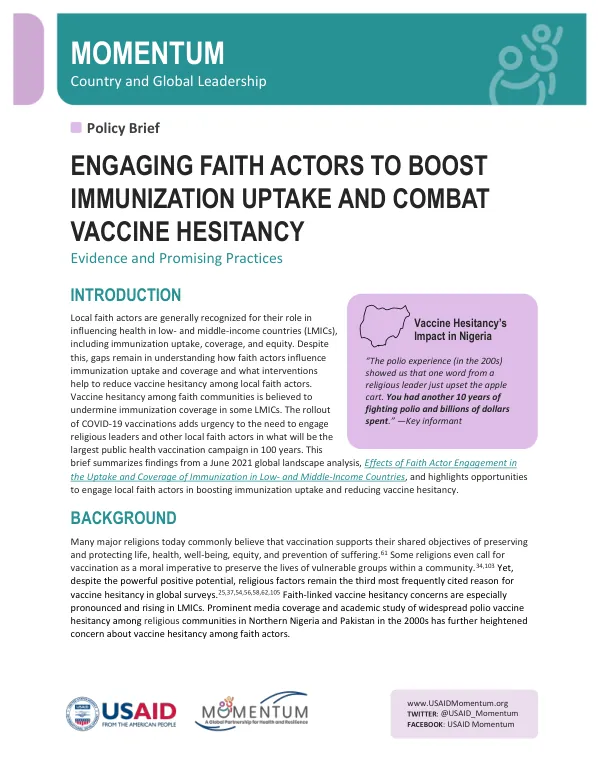
Policy Brief - Engaging Faith Actors to Boost Immunization Uptake and Combat Vaccine Hesitancy
Sign inUSAID
Policy Brief - Engaging Faith Actors to Boost Immunization Uptake and Combat Vaccine Hesitancy
Local faith actors play a significant role in influencing health in low- and middle-income countries (LMICs), including immunization uptake, coverage, and equity.
2021 · 7 pages
Sign in to readA free account is required to download.
Abstract
Despite their influence, gaps remain in understanding how faith actors impact immunization uptake and coverage, and what interventions help to reduce vaccine hesitancy among local faith actors. Vaccine hesitancy among faith communities is believed to undermine immunization coverage in some LMICs. The rollout of COVID-19 vaccinations adds urgency to the need to engage religious leaders and other local faith actors in what will be the largest public health vaccination campaign in 100 years. Analysis of the literature demonstrates four main ways that religious leaders and faith-based organizations (FBOs) impact immunization uptake in LMICs: influencing household vaccine decision-maker beliefs and values, impacting access to resources that facilitate immunization uptake, communicating immunization messages and conducting mobilization, and providing routine immunization in hard-to-reach areas or humanitarian settings and reaching underserved populations. The consensus was that continued engagement of local faith actors is necessary to positively influence immunization uptake. Vaccine hesitancy is often cloaked under the guise of religion without a theologically grounded objection. Instead, religious objections to vaccination serve as a proxy for concerns about safety, social norms, sociocultural issues, political, and economic factors. Common faith-linked vaccine hesitancy beliefs across religions include the idea that humans should not attempt to override God's will with manufactured solutions, that God created a perfect world and a perfect immune system, and that the human body is a temple of God. There is extensive documentation of vaccine hesitancy among Muslim populations in LMICs, amounting to 69% of all single-religion studies reviewed. Major drivers of vaccine hesitancy among Muslim communities included concerns about the halal status of vaccines, fears that immunization would impact fertility, and beliefs that vaccinations were part of a Western conspiracy to harm their population. On the other hand, several information sources clarify that Islamic theology generally supports immunization. Christian faiths accounted for 23% of all studies reviewed, many of which were focused on Apostolic faiths in Zimbabwe. Multiple studies showed lower immunization uptake and completion in Zimbabwe among Apostolic communities, with varying degrees of refusal toward immunization, indicating a need for interventions to address this growing population in Southern Africa. Local faith actors did not have explicit objections to most childhood routine vaccines, but the polio vaccine was cited most as a vaccine with objections within the literature. Few rigorous studies tested approaches for engaging local faith actors to strengthen immunization uptake. In general, most past immunization interventions involved engaging religious leaders and the local community in dialogue-based interventions and engaging religious leaders and church structures in social mobilization and advocacy to promote vaccination. Promising practices identified during the review include ensuring immunization promotion with local faith actors is included as part of a multipronged strategy, using religious infrastructure and places of worship for vaccine messaging and service delivery points, and engaging with male decision-makers through male religious groups and Friday prayer meetings to promote vaccination messaging and services.