USAID. MISSION TO BRAZIL
MDC [i.e. ADC (advanced developing country)] training project
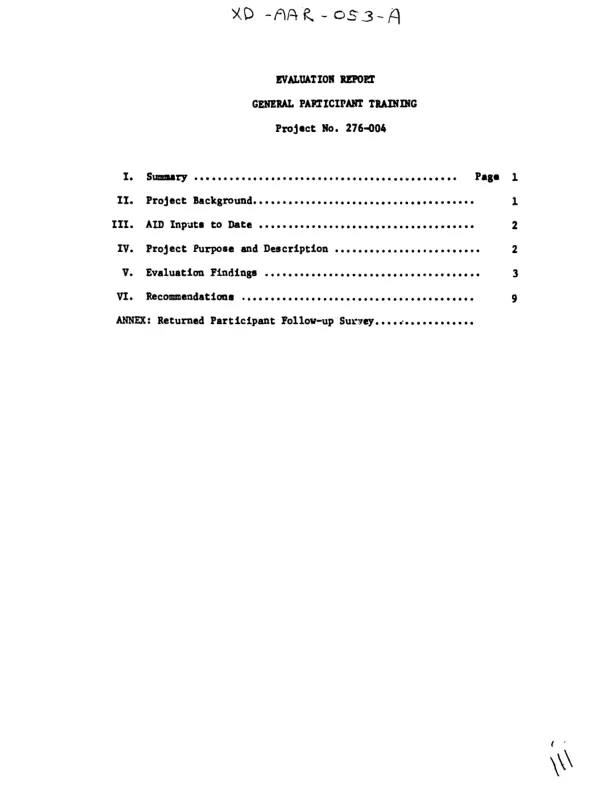
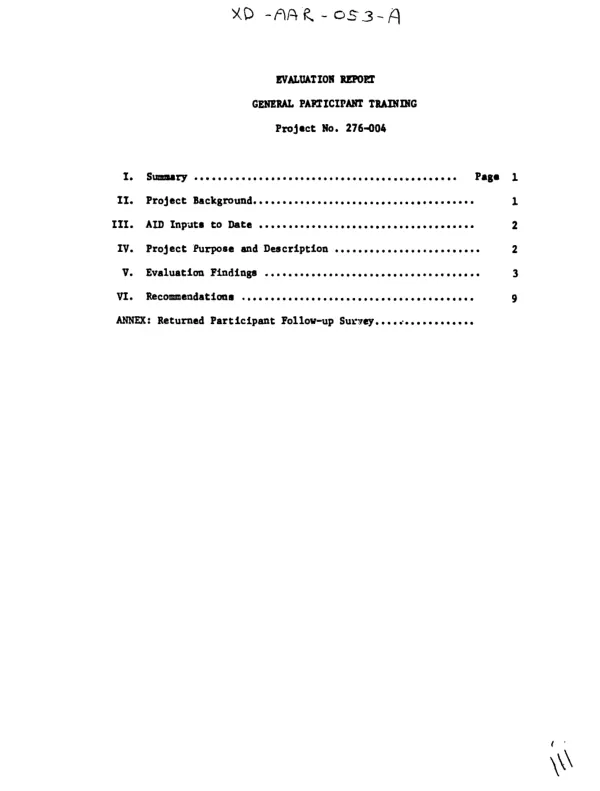
Summarizes attached mid-term evaluation (XD-ABJ-363-A) of a project to provide academic and/or technical training for Brazilian professionals, in the United States, Brazil, or third countries.
1994
Sign in to readA free account is required to download.
![MDC [i.e. ADC (advanced developing country)] training project](https://covers.devme.ai/gen/36453.webp)
Abstract
The State University of New York (SUNY) is implementing the project. The evaluation covered the period 9/91-4/94. The project is being executed conscientiously and intelligently by staff of high professional quality and responsiveness, and contract costs compare favorably with other A.I.D. training contracts and in some categories are lower. To date, 291 persons have received training in areas relating to the Mission"s five priority areas (AIDS education, drug awareness/prevention, environment/global climate change, economic modernization, and democratic initiatives) -- 171 overseas and 120 in-country. Early involvement of participants in the design of their training program has led to a high level of satisfaction with program outcome, as both trainees and their supervisors feel that the training is of high quality and relevance. Most of the trainees interviewed are applying various aspects of the training in their work. Several areas might be strengthened. First, follow-on activities are sporadic and in some instances non-existent. Although selection procedures were designed to locate participants who can multiply training upon return, there is no formal structure in place to assure that this vital element is in fact carried out on a consistent basis. Nor has predeparture orientation been consistently provided. Also, English-language training is not funded, and even though interpreters are provided for short study tours when necessary, this means that not all participants have the ability to engage in in-depth dialogue with their trainers, although they can understand and follow 85-90% of discussions. Finally, the work order system of operation somewhat limits the contractor"s ability to initiate programmatic actions.
Related documents
![USAID Brazil -- evaluation of the ADC [advanced developing country] training project](https://covers.devme.ai/gen/7425.webp)
![CLASP II [Caribbean and Latin American scholarship program]](https://covers.devme.ai/gen/33211.webp)