USAID DEC
MEASURE Evaluation–Tanzania’s Technical Assistance for Malaria Surveillance in Mainland Tanzania and Zanzibar: Progress 2016–2018
Sign inCAROLINA POPULATION CENTER AT THE UNIVERSITY OF NORTH CAROLINA AT CHAPEL HILL
MEASURE Evaluation–Tanzania’s Technical Assistance for Malaria Surveillance in Mainland Tanzania and Zanzibar: Progress 2016–2018
The MEASURE Evaluation–Tanzania (MEval-TZ) project provides technical assistance for malaria surveillance in Mainland Tanzania and Zanzibar.
2018 · 2 pages
Sign in to readA free account is required to download.
Abstract
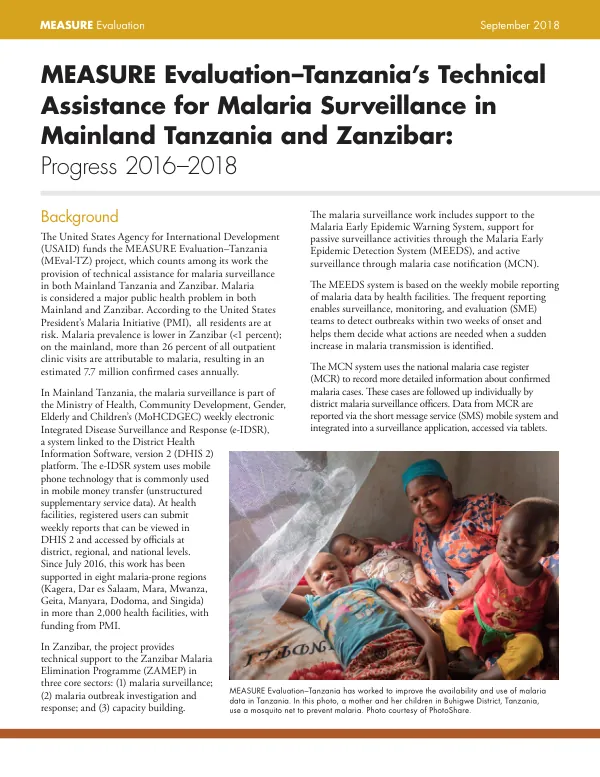
Malaria is a major public health problem in both areas, with all residents at risk. According to the United States President’s Malaria Initiative (PMI), malaria prevalence is lower in Zanzibar (<1 percent) compared to Mainland Tanzania, where more than 26 percent of all outpatient clinic visits are attributable to malaria, resulting in an estimated 7.7 million confirmed cases annually. In Mainland Tanzania, the malaria surveillance is part of the Ministry of Health, Community Development, Gender, Elderly and Children’s (MoHCDGEC) weekly electronic Integrated Disease Surveillance and Response (e-IDSR) system. The e-IDSR system uses mobile phone technology to collect data from health facilities, which is then viewed in the District Health Information Software, version 2 (DHIS 2) platform. Since July 2016, this work has been supported in eight malaria-prone regions in more than 2,000 health facilities, with funding from PMI. In Zanzibar, the project provides technical support to the Zanzibar Malaria Elimination Programme (ZAMEP) in three core sectors: malaria surveillance, malaria outbreak investigation and response, and capacity building. MEval-TZ supports the Malaria Early Epidemic Warning System, passive surveillance activities through the Malaria Early Epidemic Detection System (MEEDS), and active surveillance through malaria case notification (MCN). The MEEDS system uses weekly mobile reporting of malaria data by health facilities, while the MCN system uses the national malaria case register (MCR) to record more detailed information about confirmed malaria cases. MEval-TZ has worked to improve the availability and use of malaria data in Tanzania. The project provides technical assistance to the National Malaria Control Programme (NMCP) and ZAMEP for analysis of malaria surveillance data, including a monthly update on reported malaria cases to stakeholders. In Mainland, the average reporting rate across the regions implementing e-IDSR improved from 30 percent in August 2016 to 75 percent in July 2018. In Zanzibar, the average malaria case reporting rate through MEEDS also improved, with Unguja (Zanzibar Island) moving from a 69 percent reporting rate in July 2017 to 86 percent a year later. MEval-TZ has also supported the development of malaria case investigation guidelines, case investigation forms, and creation of their respective databases. The databases were created using a free and open-source software that can develop a data collection tool, collect data using a mobile device, aggregate the collected data, and transmit data to the server. The project has also provided technical assistance to NMCP in the use of malaria dashboards at the district council and health facility levels to enhance the use of malaria surveillance data in planning and implementing effective malaria control interventions.