USAID DEC
Measuring HIV Stigma and Discrimination Among Health Facility Staff: Standardized Brief Questionnaire
Sign inAVENIR HEALTH
Measuring HIV Stigma and Discrimination Among Health Facility Staff: Standardized Brief Questionnaire
The standardized brief questionnaire for measuring HIV stigma and discrimination among health facility staff was developed by an international team of researchers to provide practical guidance for action.
2015 · 24 pages
Sign in to readA free account is required to download.
Abstract
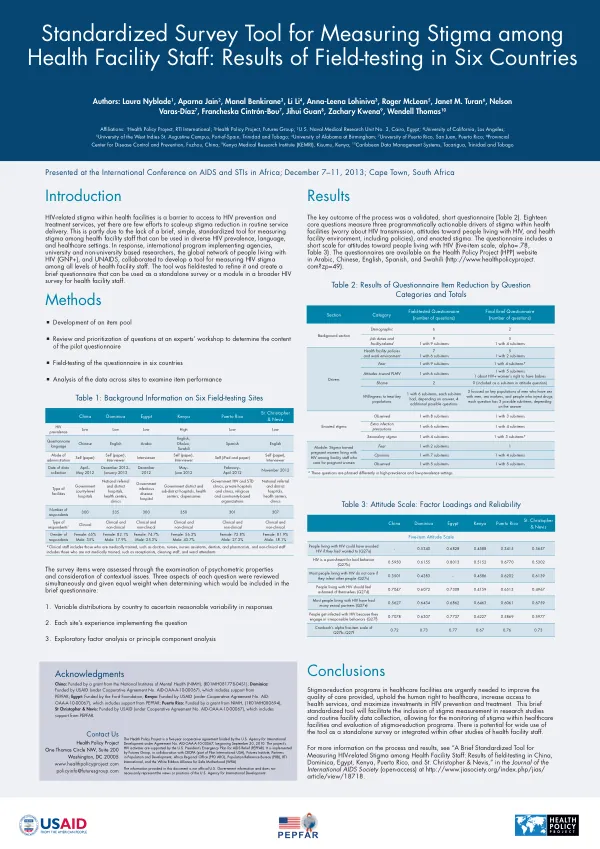
The comprehensive development process involved a content development workshop, where experts reviewed and prioritized existing questions and measurements in the area of HIV-related stigma and discrimination. The questionnaire was pilot-tested in six sites in diverse settings, including China, Dominica, Egypt, Kenya, Puerto Rico, and St. Kitts & Nevis. The questionnaire is designed to be administered among all levels and types of staff, including clinical and medical staff, administrative staff, and support staff. Data should be collected from all staff levels, not just doctors and nurses, because a patient living with HIV or other stigmatized groups can experience stigma at every level of contact within a healthcare facility. By including a broad range of staff in the data collection process and subsequent stigma-reduction programming, stigma can be addressed across an entire health facility. The questionnaire measures various forms of stigma, including anticipated stigma, experienced stigma, perceived stigma, secondary stigma, internalized stigma, compound/layered stigma, and observed stigma. It also measures discrimination, which is unfair and unjust treatment of an individual on the basis of a real or perceived status or attribute. The questionnaire is intended for use by program managers, facility managers, researchers, and others interested in exploring, assessing, and reducing HIV-related stigma and discrimination in healthcare settings. It can be used to obtain data to inform the development of tailored stigma-reduction interventions, as a baseline for program monitoring and evaluation to assess the effect of intervention activities on reducing HIV stigma and discrimination, and as a monitoring tool to assess levels of stigma and discrimination over time. Reducing HIV stigma and discrimination in healthcare settings is crucial in removing barriers to accessing HIV prevention, care, and treatment services and improving the quality of those services. Research has shown that stigma in healthcare facilities may occur in many different forms, including refusal to provide treatment services, referral of patients to another provider or health facility, placement of patients at the end of a queue, gossiping about patients, disclosure of patients' HIV status to colleagues/family members without consent, and the use of degrading language when interacting with patients living with HIV. Staff who offer care to patients living with HIV also can experience stigma, known as secondary stigma, from colleagues, friends, or family members due to their association with patients living with HIV. Measuring and reducing secondary stigma is important because it has the potential to impact the way services are offered. The questionnaire is designed to provide practical guidance for action and can be used to inform the development of tailored stigma-reduction interventions. The questionnaire has been field-tested in diverse settings and has been shown to be effective in measuring HIV stigma and discrimination among health facility staff. It is a valuable tool for healthcare providers, researchers, and policymakers who are interested in reducing stigma and improving the quality of care for patients living with HIV. The questionnaire can be used to identify areas where stigma and discrimination are most prevalent and to develop targeted interventions to address these issues. The standardized brief questionnaire for measuring HIV stigma and discrimination among health facility staff is a comprehensive tool that can be used to inform the development of tailored stigma-reduction interventions, as a baseline for program monitoring and evaluation, and as a monitoring tool to assess levels of stigma and discrimination over time. It is a valuable resource for healthcare providers, researchers, and policymakers who are interested in reducing stigma and improving the quality of care for patients living with HIV.