USAID DEC
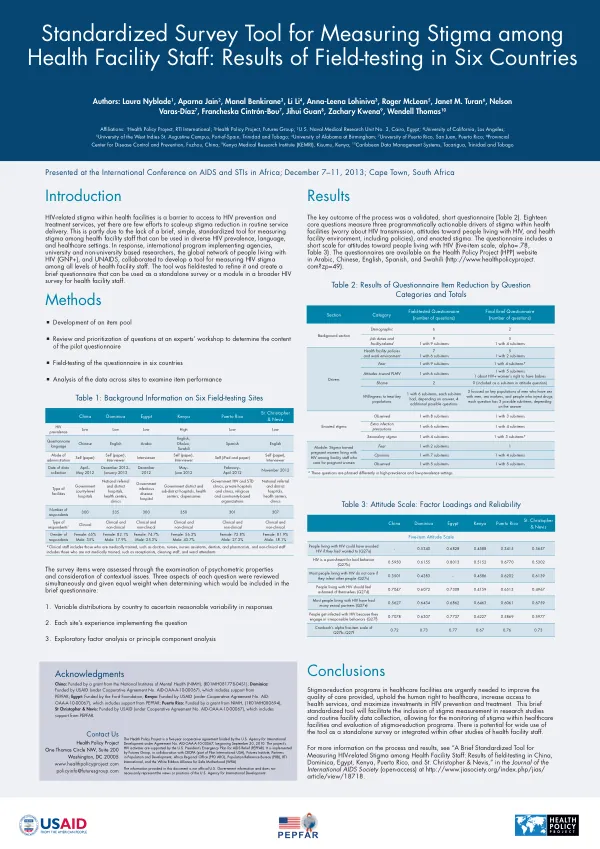
A Brief Standardized Tool for Measuring HIV-related Stigma among Health Facility Staff: Results of field-testing in Six Countries
Sign inFORD FOUNDATION
A Brief Standardized Tool for Measuring HIV-related Stigma among Health Facility Staff: Results of field-testing in Six Countries
HIV-related stigma within health facilities is a significant barrier to access to HIV prevention and treatment services.
2013 · 1 pages
Sign in to readA free account is required to download.
Abstract
To address this issue, a collaborative effort was undertaken by international program implementing agencies, researchers, the global network of people living with HIV (GNP+), and UNAIDS to develop a standardized tool for measuring stigma among health facility staff. The development of the tool involved several stages, including the creation of an item pool, review and prioritization of questions at an experts' workshop, field-testing in six countries, and analysis of the data across sites to examine item performance. The field-testing sites included China, Dominica, Egypt, Kenya, Puerto Rico, and St. Christopher & Nevis, which varied in terms of HIV prevalence, language, and healthcare settings. The survey items were assessed through the examination of psychometric properties and consideration of contextual issues. Three aspects of each question were reviewed simultaneously and given equal weight when determining which would be included in the brief questionnaire: variable distributions by country, each site's experience implementing the question, and exploratory factor analysis or principle component analysis. The key outcome of the process was a validated, short questionnaire that measures three programmatically actionable drivers of stigma within health facilities: worry about HIV transmission, attitudes toward people living with HIV, and health facility environment, including policies, and enacted stigma. The questionnaire includes a short scale for attitudes toward people living with HIV, which has a high level of reliability (alpha=.78). The questionnaire has been field-tested in six countries and has shown good psychometric properties. It is available on the Health Policy Project website in multiple languages, including Arabic, Chinese, English, Spanish, and Swahili. The tool has the potential for wide use as a standalone survey or integrated within other studies of health facility staff. The development of this tool is a significant step forward in addressing HIV-related stigma within health facilities. Stigma-reduction programs in healthcare facilities are urgently needed to improve the quality of care provided, uphold the human right to healthcare, increase access to health services, and maximize investments in HIV prevention and treatment. The tool will facilitate the inclusion of stigma measurement in research studies and routine facility data collection, allowing for the monitoring of stigma within healthcare facilities and evaluation of stigma-reduction programs. The Health Policy Project is a five-year cooperative agreement funded by the U.S. Agency for International Development under Agreement No. AID-OAA-A-10-00067, beginning September 30, 2010. The project's HIV activities are supported by the U.S. President's Emergency Plan for AIDS Relief (PEPFAR). It is implemented by Futures Group, in collaboration with CEDPA (part of Plan International USA), Futures Institute, Partners in Population and Development, Africa Regional Office (PPD ARO), Population Reference Bureau (PRB), RTI International, and the White Ribbon Alliance for Safe Motherhood (WRA). The information provided in this document is not official U.S. Government information and does not necessarily represent the views or positions of the U.S. Agency for International Development. The development of this tool was funded by various organizations, including the National Institutes of Mental Health (NIMH), the Ford Foundation, and USAID, which includes support from PEPFAR.
Related documents
Documents in this collection
 2015
2015USAID DEC
Measuring HIV Stigma and Discrimination Among Health Facility Staff: Standardized Brief Questionnaire
Open record 2015
2015USAID DEC