USAID
Measuring Impact in Education: Reporting Requirements—FAQs
The U.S.
2020 · 6 pages
Sign in to readA free account is required to download.
Abstract
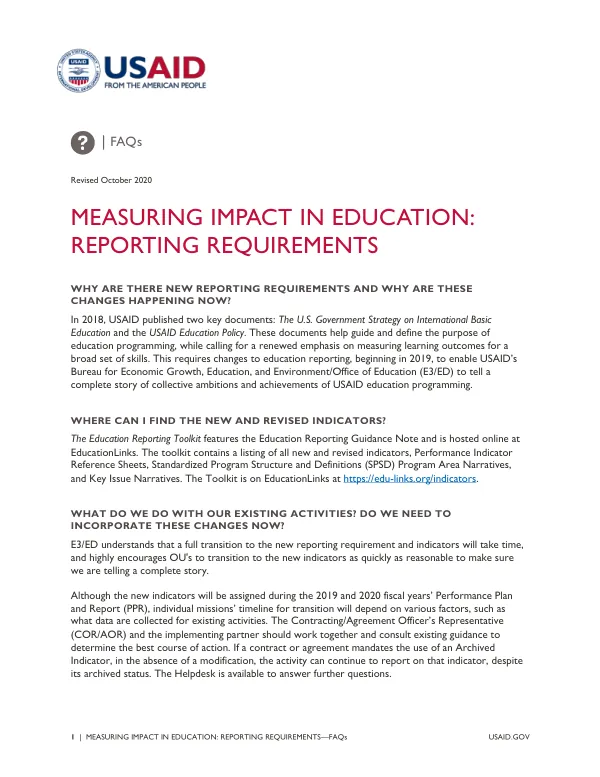
Government Strategy on International Basic Education and the USAID Education Policy, published in 2018, guide and define the purpose of education programming. These documents call for a renewed emphasis on measuring learning outcomes for a broad set of skills, requiring changes to education reporting. The changes, beginning in 2019, enable USAID's Bureau for Economic Growth, Education, and Environment/Office of Education (E3/ED) to tell a complete story of collective ambitions and achievements of USAID education programming. The Education Reporting Toolkit features the Education Reporting Guidance Note and is hosted online at EducationLinks. The toolkit contains a listing of all new and revised indicators, Performance Indicator Reference Sheets, Standardized Program Structure and Definitions (SPSD) Program Area Narratives, and Key Issue Narratives. The toolkit is available at https://edu-links.org/indicators. For new activities, the new reporting requirements must be reflected in the Performance Monitoring and Evaluation Plan (PMEP) for new awards. Programs may still report on indicators that were archived, using them as Custom Indicators, but results reported through archived indicators will not be included in aggregate reporting to Congress. Archived Indicators should only be used if an operating unit (OU) is unable to transition to a new indicator. The PPR will be E3/ED's main reporting mechanism starting in 2019, replacing the Data Call used with the previous USAID Education Strategy (2011-2015). Missions and implementing partners will still be asked to help E3/ED with current tasks, such as submitting datasets and learning assessments to the Development Data Library and updating the Education Activity Roster. There will be a shift from a top-down, USAID/Washington-led exercise to a bottom-up, mission-led approach to target setting. Missions should report targets for all indicators in PPR, even if the target is zero. The ADS 201 currently provides general guidance on target setting, and education-specific guidance is being developed for the Education Reporting Toolkit and is expected to be available in 2020. E3/ED assigns Standard Foreign Assistance Indicators (Standard Indicators) to OUs, which include 26 Standard Indicators. OUs are required to report Standard Indicators that are relevant to their programming. Supplemental Indicators are a new category that respond to the priorities of the Policy and focus on topics such as numeracy skills, teacher quality, social-emotional skills, and an expanded range of youth workforce skills. Disaggregates are essential to making sure programs reach their intended beneficiaries and monitoring USAID's engagement with children and youth who are marginalized and vulnerable. While not all disaggregates are mandated, E3/ED includes them in reporting requirements because the information they provide is central to the Policy and USAID's education work that promotes equity and inclusion. Disaggregates are a way of breaking out data by key categories of interest, such as demographic characteristics. Sex disaggregates are required for all individual-level data. Geography disaggregates are recommended by ADS 201, and OUs should report on these disaggregates if they work in crisis- and conflict-affected countries or areas, or with crisis- and conflict-affected populations in any context. Persons with Disabilities disaggregates should be reported for the ES.1 standard indicators if they have activities that focus specifically on children with disabilities as target beneficiaries or sub-beneficiaries. E3/ED is developing a training plan and toolkit to support setting internationally linked benchmarks in early grade reading and math, which are expected to be available early 2020. These changes are intended to complement, not replace existing guidance on the PPR or the monitoring policy in the Automated Directive System (ADS) 201.