USAID DEC
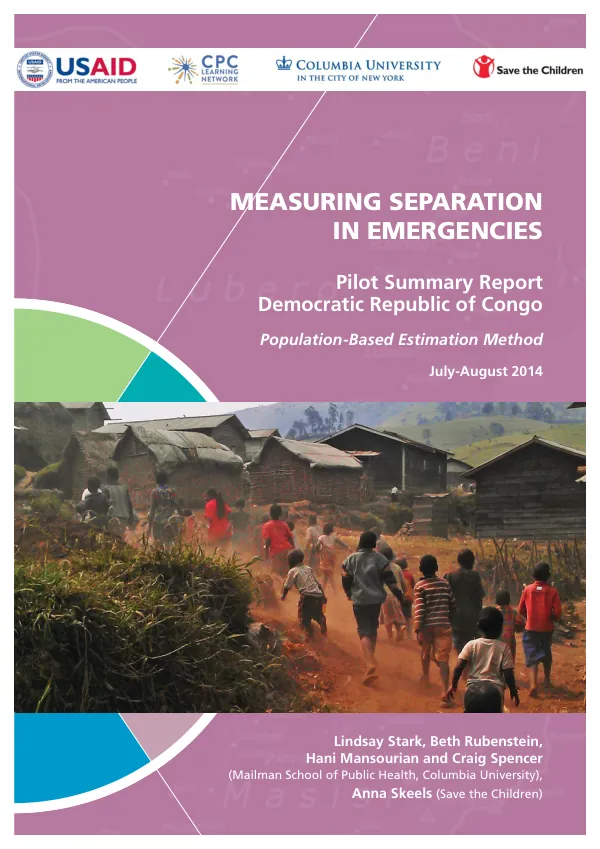
MEASURING SEPARATION IN EMERGENCIES Pilot Summary Report, Democratic Republic of Congo Community-Based Surveillance Method
Sign inICAP AT COLUMBIA UNIVERSITY
MEASURING SEPARATION IN EMERGENCIES Pilot Summary Report, Democratic Republic of Congo Community-Based Surveillance Method
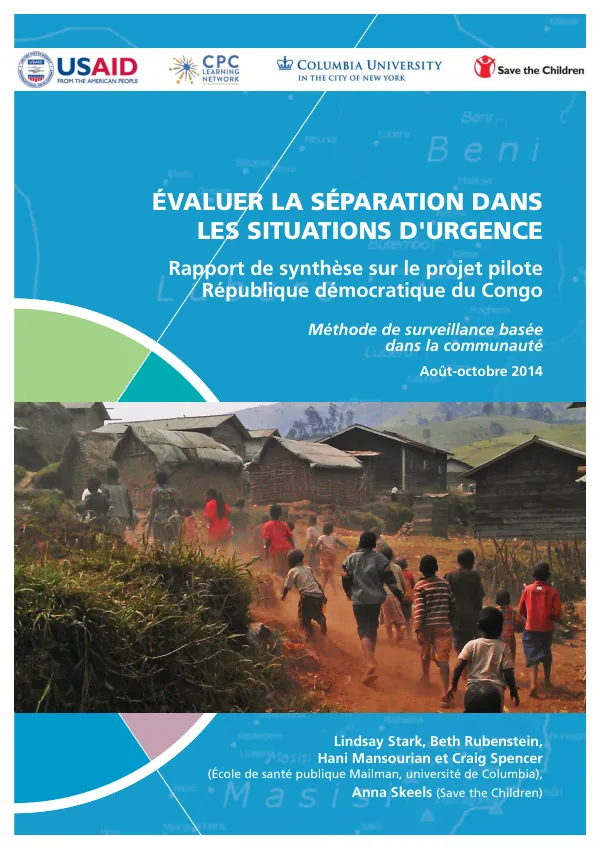
The project "Évaluer la séparation dans les situations d'urgence" is an initiative led by Save the Children in partnership with Columbia University and Johns Hopkins University.
2014 · 21 pages
Sign in to readA free account is required to download.
Abstract
The project is funded by the Bureau of U.S. Foreign Disaster Assistance (OFDA) and aims to develop practical tools to estimate the extent and nature of child separation in emergency situations. The project's global objective is to strengthen emergency response programs for unaccompanied and separated children by developing field-tested tools to improve the estimation of the scope and nature of child separation in emergency situations. The project is directed by an inter-institutional advisory group, including members of the Inter-Agency Working Group on Unaccompanied and Separated Children and the Global Protection Cluster's Child Protection Working Group. The project's global objective is to develop practical tools to estimate the extent and nature of child separation in emergency situations. Three methods of evaluating child separation in emergency situations are being studied, including the projection method, the estimation method based on a population, and the community-based surveillance method. The community-based surveillance method incorporates a community-based surveillance system to measure trends in the frequency and characteristics of unaccompanied and separated children over time. The pilot project in the Democratic Republic of Congo (DRC) used the community-based surveillance method to monitor new cases of separation in real-time in ten villages in the Nyiragongo territory. The project was conducted over an 11-week period from August to October 2014. Data collection for the project was carried out by 31 community-based reference persons. The community-based surveillance method involves identifying and training community-based reference persons to collect data on unaccompanied and separated children. The reference persons are responsible for identifying new cases of separation and reporting them to the project team. The data collected is then used to monitor trends in child separation and to inform emergency response programs. The project team worked closely with local organizations, including PAMI, to implement the project. The team also received technical assistance and support from the DRC's Protection of the Child cluster. The project's success was dependent on the collaboration and support of local communities, including the identification and training of community-based reference persons. The project's findings indicate that the community-based surveillance method is a viable approach for monitoring child separation in emergency situations. The method allows for real-time monitoring of new cases of separation and provides valuable data for informing emergency response programs. The project's results also highlight the importance of community engagement and participation in emergency response efforts. The project's methodology and findings have implications for emergency response programs and policy development. The community-based surveillance method can be adapted and scaled up for use in other emergency situations, providing a valuable tool for monitoring child separation and informing emergency response efforts. The project's results also highlight the need for continued support and investment in emergency response programs for unaccompanied and separated children.