ICAP AT COLUMBIA UNIVERSITY
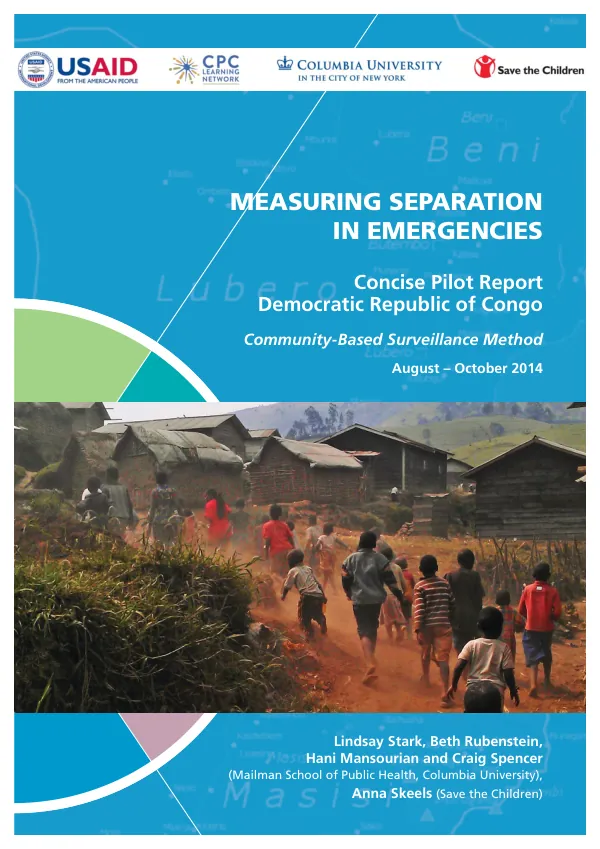
Measuring Separation in Emergencies: Concise Pilot Report
The Measuring Separation in Emergencies (MSiE) project is an interagency initiative aimed at strengthening emergency response programs for unaccompanied and separated children (UASC) in crisis situations.
2014 · 5 pages
Sign in to readA free account is required to download.
Abstract
Funded by the USAID Office of Foreign Disaster Assistance (OFDA), the project is coordinated by Save the Children in partnership with Columbia University and Johns Hopkins University. The project's overall aim is to develop practical, field-tested tools to enhance the assessment of the scale and nature of separation in emergencies. The MSiE project explores three methods for measuring separation in emergencies: the projection method, the population-based estimation method, and the community-based surveillance method. The community-based surveillance method, which is the focus of this pilot report, involves a community-based surveillance system capable of continuous, ongoing measurement of trends in the frequency and basic characteristics of UASC in defined areas over time. This method was field-tested in North Kivu in the Democratic Republic of Congo (DRC) from August to October 2014. During the 11-week pilot, 31 Community Focal Points collected data using a mobile phone-based surveillance system. The system allowed for the identification of new cases of separation in real-time, with a Coordinator verifying the data through contacting Focal Points in the field and automatically transmitting the data to a web-based inbox. Over the 11 weeks, 62 verified new cases of separation were reported across the ten village sites, with most cases being between 5-14 years of age and having been under the care of their parents prior to separation. The data collected during the pilot revealed a high number of unaccompanied children, with more than half the reported cases being unaccompanied. The death or disappearance of parents or family members was the most common reason for separation. The pilot also demonstrated the effectiveness of the community-based surveillance method, with a sensitivity of 90.3% (56 out of 62 cases confirmed by FTR field agents). The implementing organization, PAMI, found the system more efficient and effective in identifying UASC than previous approaches. The pilot in North Kivu has demonstrated the potential of the community-based surveillance method to provide continuous, real-time information about trends and basic characteristics of UASC in a protracted emergency setting. The majority of Community Focal Points and community members gave positive feedback on the system, noting its importance in finding and supporting UASC in their communities. Lessons learned from the pilot include the need to establish the surveillance system over a longer period to better understand its performance over time, the importance of fostering motivation in Focal Points and providing adequate technical support, and the need to further explore and monitor response mechanisms linked to community surveillance.
Related documents