ICAP AT COLUMBIA UNIVERSITY
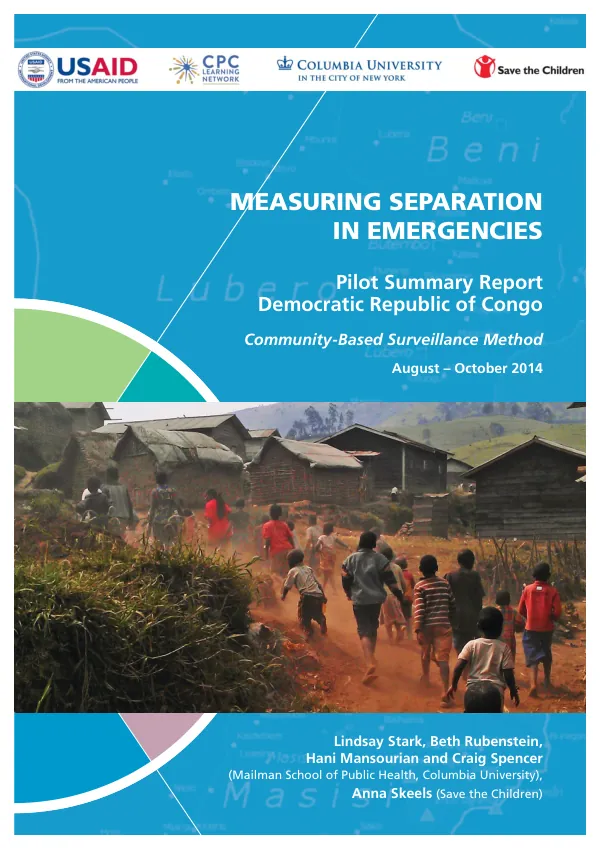
Measuring Separation in Emergencies: Pilot Summary Report
The Measuring Separation in Emergencies (MSiE) project is an interagency initiative funded by the USAID Office of Foreign Disaster Assistance (OFDA) and coordinated by Save the Children in partnership with Columbia University and Johns Hopkins University.
2014 · 21 pages
Sign in to readA free account is required to download.
Abstract
The project aims to strengthen emergency response programs for unaccompanied and separated children (UASC) through the development of practical, field-tested tools to enhance the assessment of the scale and nature of separation in emergencies. The MSiE project is steered by a multi-agency Advisory Panel, including members of the Inter Agency Working Group on Unaccompanied and Separated Children (IAWG UASC) and the Assessment and Measurement Task Force (A&MTF) of the Global Child Protection Working Group (CPWG). The overall aim of the MSiE project is to develop practical tools to enhance the assessment of the scale and nature of separation in emergencies. The project is exploring three methods for measuring separation in emergencies: the projection method, the population-based estimation method, and the community-based surveillance method. The community-based surveillance method incorporates a community-based surveillance system capable of continuous, ongoing measurement of trends in the frequency and basic characteristics of UASC in defined areas over time. A pilot study was conducted in North Kivu in the Democratic Republic of Congo (DRC) to field test the community-based surveillance method. The pilot ran for an 11-week period from August to October 2014 and involved 31 Community Focal Points who collected data using a mobile phone-based surveillance system. The data collected included basic information on the specific child, such as age and gender, and the nature of the separation, such as cause and current caretaker. Over the 11 weeks of the pilot, 62 verified new cases of separation were reported by the Community Focal Points across the ten village sites. The majority of cases were between 5-14 years of age, and most had been under the care of their parents prior to separation. The data also showed that more than half the reported cases were unaccompanied, and twice as many cases were considered as unintentional separation compared to intentional separation. The death or disappearance of parents or family members was the most common reason for separation. The pilot study demonstrated the feasibility of using a community-based surveillance system to monitor new cases of separation in real-time. The data collected provided valuable insights into the scale and nature of separation in the study area, and the findings have implications for emergency response programs for UASC. The results of the pilot study will inform the development of practical tools to enhance the assessment of the scale and nature of separation in emergencies. The community-based surveillance method has the potential to provide timely and accurate data on the number and characteristics of UASC in a given area. This information can be used to inform emergency response programs and ensure that the needs of UASC are addressed. The method also has the potential to be scaled up and used in other contexts, providing a valuable tool for humanitarian actors responding to emergencies.
Related documents