USAID DEC
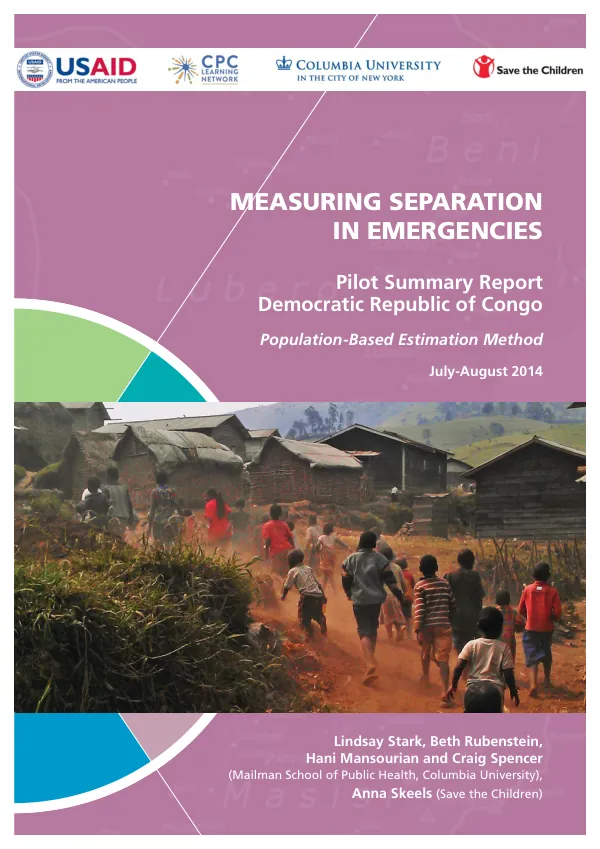
Measuring Separation in Emergencies: Pilot Summary Report, Democratic Republic of Congo, Population-Based Estimation Method
Sign inICAP AT COLUMBIA UNIVERSITY
Measuring Separation in Emergencies: Pilot Summary Report, Democratic Republic of Congo, Population-Based Estimation Method
Unaccompanied and separated children are particularly vulnerable in emergency situations, facing increased risks of violence, abuse, exploitation, or neglect.
2014 · 26 pages
Sign in to readA free account is required to download.
Abstract
Identifying protective and supportive interim care for these children and carrying out family tracing and reunification activities are crucial humanitarian interventions. The Measuring Separation in Emergencies (MSiE) project aims to strengthen emergency response programs for unaccompanied and separated children through the development of practical, field-tested tools to assess the scale and nature of separation in emergencies. The MSiE project is an interagency initiative funded by the USAID Office of Foreign Disaster Assistance (OFDA) and coordinated by Save the Children in partnership with Columbia University and Johns Hopkins University. The project's overall aim is to enhance the assessment of the scale and nature of separation in emergencies through the development of three methods: the projection method, the population-based estimation method, and the community-based surveillance method. The population-based estimation method, which is the focus of this pilot report, aims to provide a population-based estimation of the prevalence, number, and basic characteristics of unaccompanied and separated children in a defined area affected by an emergency. The pilot study was conducted in North Kivu in the Democratic Republic of Congo (DRC) from July to August 2014, using a population-based cluster survey tool. A total of 20 sites or clusters (villages and internally displaced persons camps) were selected randomly from a list of accessible and secure sites within the areas affected by the emergency. Systematic random sampling was used to select 25 households to be surveyed within each cluster. The pilot also piloted a technique known as the neighborhood method, which facilitates the collection of information on multiple individuals through a single survey by asking survey respondents to also report about their neighbors. The data collected during the pilot study revealed that 8.47% of the children living in the respondents' homes at the time of data collection were separated children who had newly arrived in the household since the M23 attack. In contrast, 5.31% of the children living in the respondents' homes prior to the M23 attack had since departed from the household, resulting in separation from their parents or usual caregivers. The characteristics of arriving children (arrivals) and departing children (departures) diverge in a few striking ways, with arrivals being more likely to be very young (0-4 years) and unintentional separations related to the death of parents or family members. The situation in camps may deserve special attention, but due to the limited number of households surveyed in four camps, it is difficult to draw conclusions from the data. However, the pilot study provides valuable insights into the scale and nature of separation in emergencies and highlights the need for further research and development of practical tools to enhance the assessment of separation in emergencies.
Related documents