GOVERNMENT OF INDONESIA
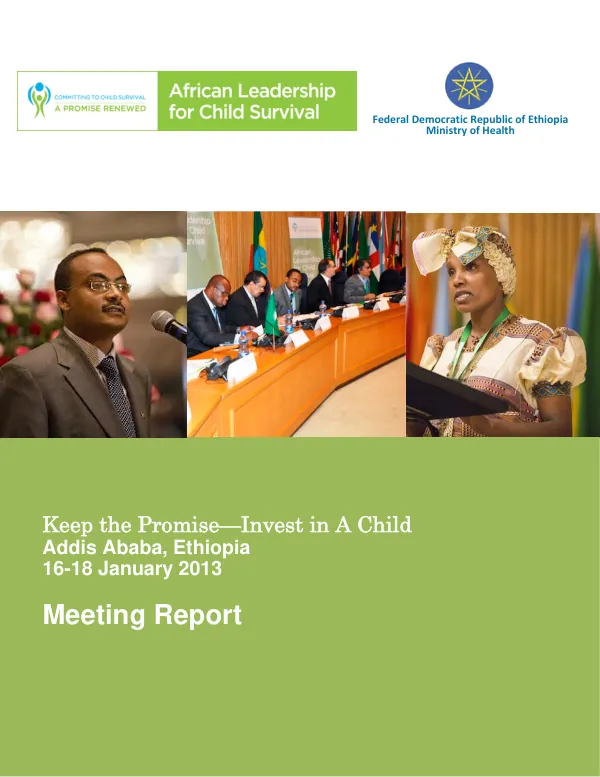
Meeting Report: African Leadership for Child Survival—A Promise Renewed
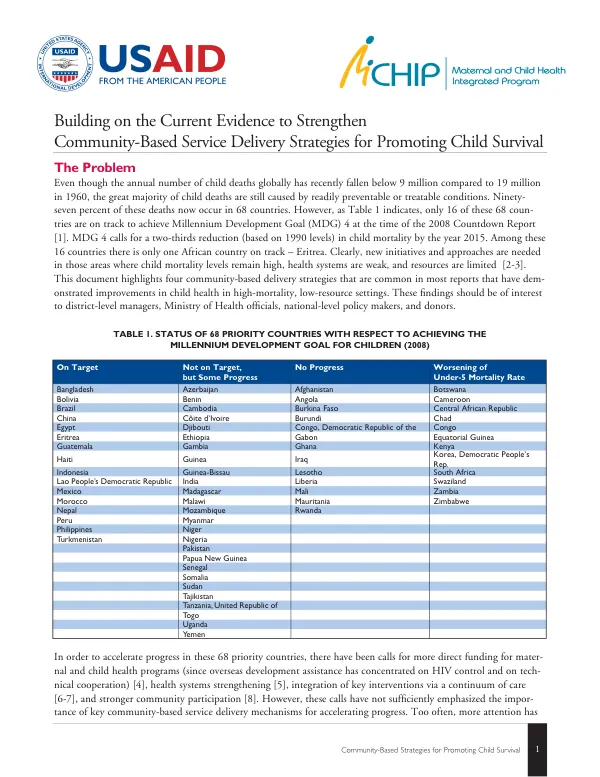
The Child Survival Call to Action was a high-level forum convened by the governments of Ethiopia, India, and the United States, in collaboration with UNICEF.
2013 · 65 pages
Sign in to readA free account is required to download.
Abstract
The meeting aimed to galvanize global efforts to end preventable child deaths and accelerate progress toward the Millennium Development Goals (MDGs) 4 and 5. The forum brought together over 80 countries, governments, and partners from the private sector, civil society, and faith-based organizations. The meeting resulted in several new partnerships and commitments to increase child survival in various countries. The Democratic Republic of Congo pledged to increase its health budget and monitor and evaluate all activities to strengthen supervision and coordination. Ethiopia declared child survival a powerful indicator of a country's overall development and committed to exceeding MDG 4 targets by 2015. India committed to preparing a global roadmap to end preventable child deaths and gave priority to convergence of Health and Child Care Services under universal health coverage. Nigeria made a commitment to reduce substantially the under-five mortality rate through its Subsidy Reinvestment and Empowerment (SURE-P) Program. Pakistan committed to a partnership with donors and the private sector to track progress toward reducing under-five child deaths and developing a Score Card to track progress at the federal and provincial level. The United Kingdom Department for International Development, the Australian Agency for International Development, and USAID are working together with the Government of Pakistan to prevent approximately 195,000 under-five child deaths over three years through an investment of $485 million. The Child Survival Call to Action has three main goals: mobilize political leadership to end preventable child deaths, achieve consensus on a global roadmap highlighting innovative and proven strategies to accelerate reductions in child mortality, and drive sustained collective action and mutual accountability. Sub-Saharan Africa has the highest risk of death in the first month of life and is among the regions showing the least progress. However, the region has seen a decline in its under-five mortality rate, with the annual rate of reduction doubling from 1.5 to 3.1 percent between 1990-2000 and 2000-2011. Sub-Saharan Africa accounts for 38 percent of global neonatal deaths and has the highest newborn death rate, globally (34 deaths per 1,000 live births in 2011). Neonatal deaths account for about one-third of under-five deaths globally (1.1 million newborns die in the first month of life). The region has reduced under-five mortality by 39 percent between 1990 and 2011. If current trends persist, 1 in 3 children in the world will be born in sub-Saharan Africa, and its under-five population will grow rapidly. The highest rates of child mortality are still in the region, where 1 in 9 children dies before age five, more than 16 times the average for developed regions (1 in 152). The under-five mortality rate in Africa declined from 163 in 1990 to 100 per 1,000 live births in 2011. These rates of decline are still insufficient to achieve Millennium Development Goal 4 by 2015. Liberia, Rwanda, Malawi, and Madagascar are among the top 10 countries with the greatest percentage decline in their under-five mortality rates from 1990-2011. The under-five mortality rates decreased in these countries by 68 percent, 65 percent, 64 percent, and 62 percent, respectively. The Child Survival Call to Action aims to accelerate progress toward the MDGs 4 and 5 and end preventable child deaths by 2035. Reaching this historic target will save an additional 45 million children's lives by 2035. The meeting resulted in several new partnerships and commitments to increase child survival in various countries, and the Child Survival Call to Action has three main goals: mobilize political leadership, achieve consensus on a global roadmap, and drive sustained collective action and mutual accountability.