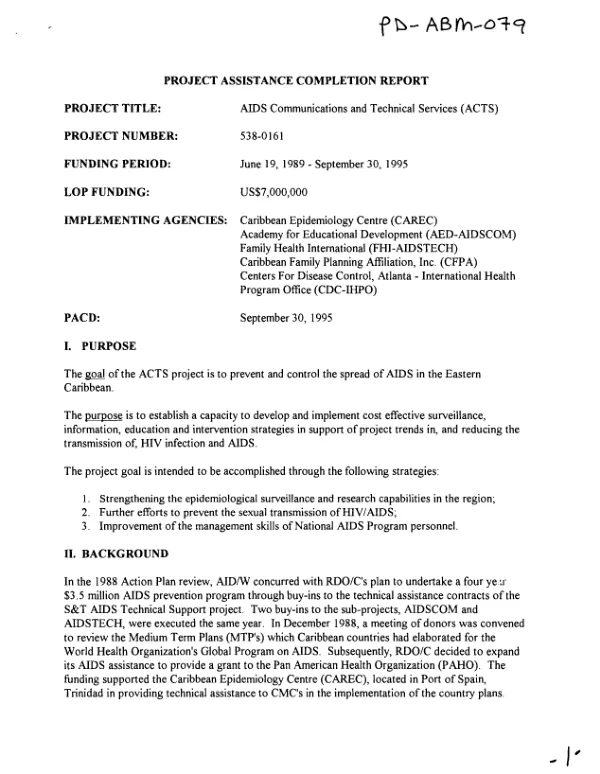
USAID. BUR. FOR LATIN AMERICA AND THE CARIBBEAN. REGIONAL DEVELOPMENT OFC.
Mid term evaluation : epidemiological surveillance and training
Evaluates project to help the Caribbean Epidemiology Center (CAREC) provide epidemiological surveillance (ES) training and support to member countries (MC's).
Bassett, David|Laskin, Mark J. · 1981
Sign in to readA free account is required to download.
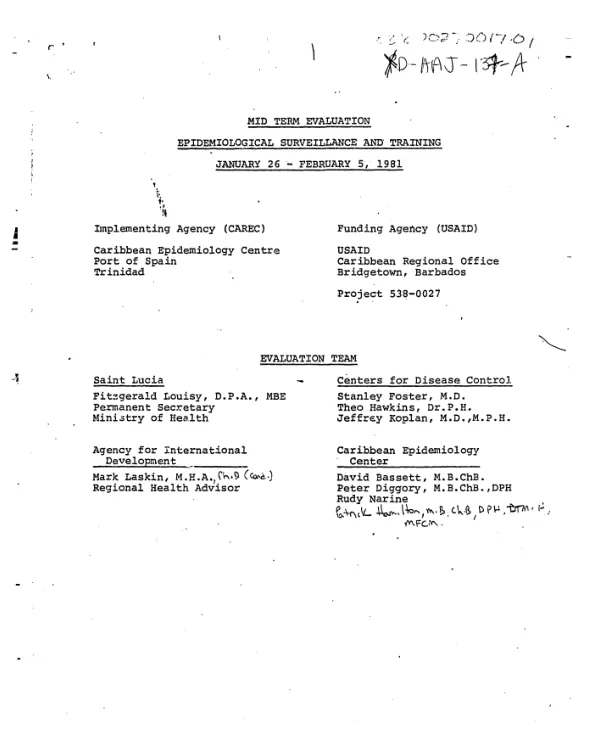
Abstract
Special evaluation covers the period 10/79-1/81 and is based on document review, interviews with project and MC personnel, and visits to six MC's. Of 24 project outputs, 21 are on target. The project has effected major improvements in ES. It has fostered the creation of public health positions for designated epidemiologists, surveillance statistical officers (SSO's), and deputy epidemiologists and has trained the persons filling these positions. A CAREC training unit established by the project has organized both CAREC-based and in-country training in public health, ES, and microbiology. Three short-term ES traineeships have been provided; workshops were held for designated epidemiologists and SSO's; and 11 in-country training sessions were held for public health nurses and inspectors and medical officers. Epidemiologic investigation supplies have been purchased and the CAREC Surveillance Report has greatly enlarged its circulation. Medical traineeships and medical student clerkships, however, have lacked targeted numbers of candidates and computer use has been delayed by electrical and delivery problems. CAREC has provided MC laboratories with formal training on bacteriology and malaria, workshops for their directors, proficiency testing, referrals for cultures and specimens, onsite training in microbiology and laboratory management, and limited emergency supplies. CAREC has also provided training, equipment, and evaluation for the Expanded Program on Immunization (EPI). All CAREC activities have been well received and it is essential that CAREC be maintained as a regional resource. Key recommendations are to: (1) emphasize outbreak/problem recognition and control; (2) seek country-specific solutions to ES and EPI shortcomings; (3) improve EPI management and cold storage equipment; (4) gear future training more to specific MC needs and formalize training objectives and evaluation procedures; (5) train more public health nurses; and (6) intensify efforts to identify major causes of death and illness (including noncommunicable diseases) and determine effective prevention and control measures, especially for gastroenteritis.