USAID DEC
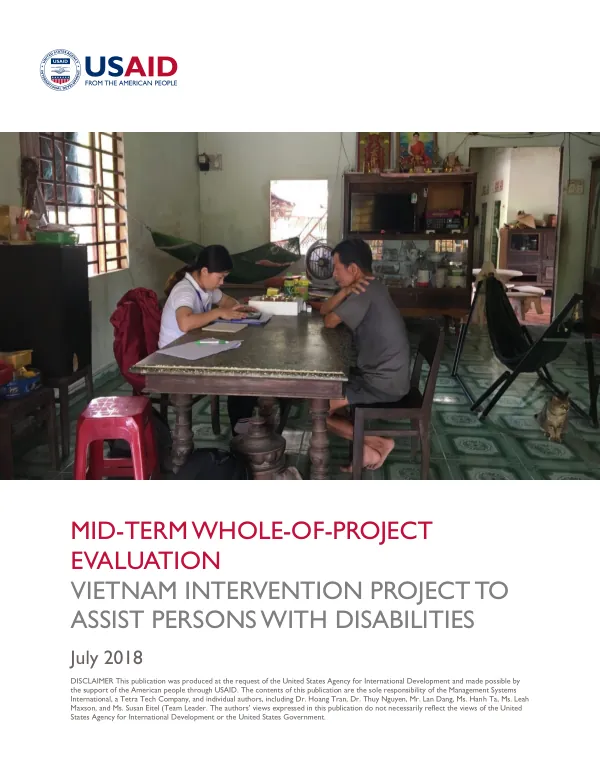
Mid-Term Whole-of-Project Evaluation: Vietnam Intervention Project to Assist Persons with Disabilities
Sign inGOVERNMENT OF VIETNAM
Mid-Term Whole-of-Project Evaluation: Vietnam Intervention Project to Assist Persons with Disabilities
The Vietnam Disability Project 2015-2020 is a USAID-funded initiative aimed at improving the inclusion of persons with disabilities in USAID target provinces.
2018 · 197 pages
Sign in to readA free account is required to download.
Abstract
The project design centers around the results framework and the sustainable model, which are not fully defined or unified. The project has made progress in achieving its purpose, but measuring the extent of progress is limited by the lack of clearly defined targets. The project's six Activities focus on various aspects of disability inclusion, including disability rights policies, physical, occupational, and speech therapy services, and improved local capacity to provide services. Implementing partners have exceeded targets for indicators established at the project onset, but coordination between implementing partners and links with former USAID projects and existing rehabilitation initiatives is underdeveloped. The mid-term whole-of-project evaluation (WOPE) provides an opportunity to assess collaborative efforts toward achieving the project purpose, which are not captured in other evaluations. The evaluation highlights the need to further refine elements of the project model, as well as the links between the original project design and the refined 2017 version. To fulfill the project purpose, USAID should establish benchmarks for sustainability and inclusion. The project's theory of change (TOC) is a key component of the project's design, but its strengths and weaknesses are not clearly defined. The evaluation aims to provide USAID/Vietnam, the Government of Vietnam, and other in-country stakeholders with objective information on what has been achieved to date, what is working, and what is not. The information will inform decisions related to appropriate modifications in the remaining period of performance of the project and will serve as a reference for the design of future interventions. The project has a long history of supporting programs for persons with disabilities in Vietnam, dating back to 1989. The current project is a continuation of this effort, with a focus on expanding opportunities for vulnerable populations. The project's three key outputs are: 1) disability rights policies, coordination, and advocacy fostered; 2) physical, occupational, and speech therapy services delivered to assist persons with disabilities to participate in society; and 3) improved local capacity to provide services. In late 2017, USAID/Vietnam amended the Project Appraisal Document (PAD) to adjust the project purpose to: A sustainable model for improving persons with disabilities' inclusion developed in USAID's target provinces. The amended PAD introduces five highly measurable elements that constitute the sustainable model, refines the previous results framework, expands the geographic coverage of the project, and extends the PAD completion date to 2024. The evaluation team consisted of two international consultants, two Vietnamese consultants, and staff of the Vietnam Evaluation, Monitoring and Survey Services (VEMSS) mechanism implemented by Management Systems International, a Tetra Tech Company. The team conducted joint fieldwork and initial analysis in Vietnam from April 2 to May 5, 2018. The evaluation categories and questions focus on assessing progress toward achieving the project purpose, contributions of the six Activities, and the strengths and weaknesses of the project's theory of change (TOC).