USAID DEC
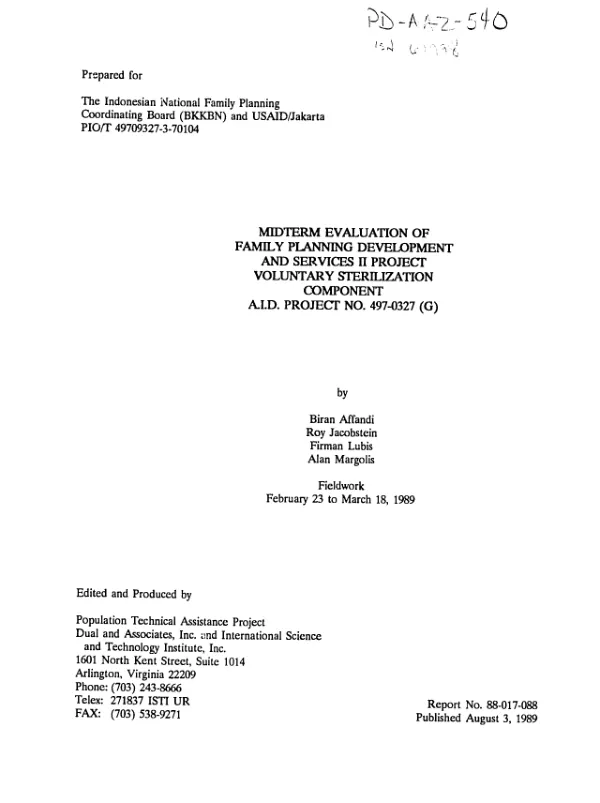
Midterm evaluation of family planning development and services II project -- voluntary sterilization component, AID project no. 497-0327 (G)
Sign inDUAL & ASSOCIATES, INC.
Midterm evaluation of family planning development and services II project -- voluntary sterilization component, AID project no. 497-0327 (G)
Mid-term evaluation of a project component to expand the voluntary sterilization (VS) activities of the Indnesian Association for Secure Contraception (PKMI).
Affandi, Biran|Jacobstein, Roy · 1989
Sign in to readA free account is required to download.
Abstract
The evaluation covers the period 1984-3/89. There have been a number of accomplishments. Some 201 district hospitals and 269 health centers in 13 provinces (including 70% of the country's population) have been renovated and equipped to support the provision of VS services. Over 400 medical teams and 1,000 counselors have been trained, and 143 community leaders oriented to VS. A sterilization reversal center, located at the Raden Saleh Clinic in downtown Jakarta, has been established by the Department of Obstetrics and Gynecology of the University of Indonesia, Jakarta. On the negative side, PKMI has little authority to assure that its wishes are being implemented, and it lacks a mechanism to guarantee quality assurance. Medical supervision is not carried out by highly qualified, motivated experts. Reporting procedures are inadequate - timely reporting of deaths and major complications among patients does not regularly occur. Vasectomy training is not meeting targeted levels, while provincial chapters of PKMI do not possess sufficient funding/staffing for medical trainee follow-up. Reimbursements to service units from the National Family Planning Coordinaton Board (BKKBN) are often delayed, and approximately 25% of the laparoscopes used in tubectomies are in need of repair due to a lack of maintenance funding. Poor communications have caused strains between USAID/Indonesia and the cooperating agency, the Association for Voluntary Surgical Contraception. A total of 24 recommendations address the above-noted problems. These include: considering the creation of sliding scale so that clients pay acording to their ability; expanding IEC; and continuing efforts to obtain more support from support of private practioners and hospitals for VS.
Related documents