AFRICAN CHRISTIAN HEALTH ASSOCIATION PLATFORM
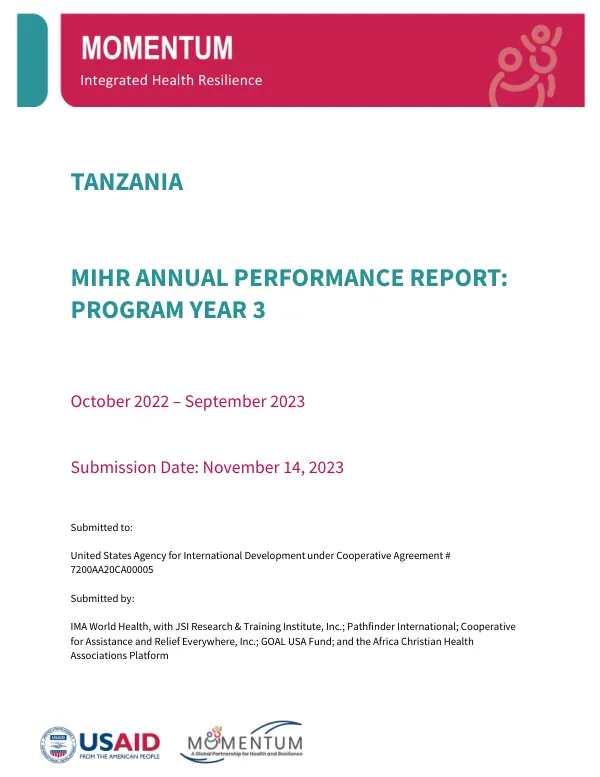
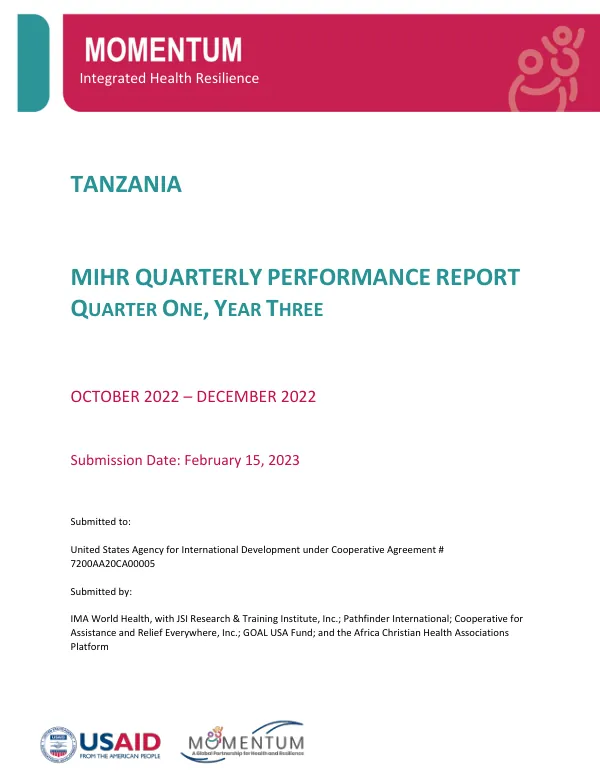
MIHR Tanzania PY3Q1 Report
The MOMENTUM Integrated Health Resilience (MIHR) initiative in Tanzania is a USAID-funded program implemented by IMA World Health in collaboration with several partners.
2023 · 57 pages
Sign in to readA free account is required to download.
Abstract
The program aims to improve access to quality reproductive, maternal, newborn, child, and adolescent health (RMNCAH) services, particularly in the areas of family planning (FP), maternal and newborn health (MNCH), and health promotion (PHE). The program operates in three landscapes: the Northern Tanzania Region (NTR), the Great Lakes East (GME), and the Rufiji River Ecosystem (RRE). The initiative focuses on strengthening the capacity of the government, health, and community systems to deliver quality RMNCAH services. This is achieved through training of healthcare providers, community health workers, and PHE champions on evidence-based practices and health promotion. One of the key interventions is the provision of FP services at health facilities, community health worker (CHW) outreach, and integrated mobile outreach services. In the first quarter of year three, over 12,000 FP clients were served, with a significant increase in the number of first-time users. The method mix for FP clients served in project-supported health facilities showed a shift towards more modern contraceptive methods, with a notable increase in the use of long-acting reversible contraceptives (LARCs). The program also focuses on strengthening the capacity of healthcare providers and CHWs through supportive supervision and mentorship. In the first quarter of year three, over 200 healthcare providers and CHWs received training and supportive supervision, resulting in improved performance in key indicators such as maternal and newborn health. The initiative also promotes cross-sectoral collaboration and innovative partnerships to improve RMNCAH outcomes. This includes promoting adoption of positive PHE behaviors at the household and village level, strengthening economic resilience of households, and communicating the demographic dividend in Tanzania. The program's performance is monitored through various indicators, including the number of FP clients served, CYP (clients served per provider), and method mix percentages. The data shows a significant improvement in key indicators, including a 27% increase in the number of FP clients served compared to the previous quarter. The MIHR initiative in Tanzania has made significant progress in improving access to quality RMNCAH services, particularly in the areas of FP, MNCH, and PHE. The program's focus on strengthening the capacity of healthcare providers, CHWs, and community systems has resulted in improved performance in key indicators. The initiative's commitment to cross-sectoral collaboration and innovative partnerships has also contributed to improved RMNCAH outcomes. The program's success can be attributed to the strong collaboration among partners, including IMA World Health, JSI Research & Training Institute, Inc., Pathfinder International, GOAL USA Fund, and the Africa Christian Health Associations Platform. The program's performance will continue to be monitored through various indicators, and adjustments will be made as necessary to ensure continued improvement in RMNCAH outcomes. The MIHR initiative in Tanzania has also made significant progress in promoting economic resilience of households, particularly among young girls and women. The program's focus on inclusive and diversified environmentally friendly income-generating activities has resulted in improved economic outcomes for households. The program's achievements in communicating the demographic dividend in Tanzania have also been significant. The initiative has promoted awareness about the importance of investing in RMNCAH services, particularly among young people. Overall, the MIHR initiative in Tanzania has made significant progress in improving access to quality RMNCAH services, particularly in the areas of FP, MNCH, and PHE. The program's focus on strengthening the capacity of healthcare providers, CHWs, and community systems, as well as its commitment to cross-sectoral collaboration and innovative partnerships, has resulted in improved RMNCAH outcomes.
![MOMENTUM INTEGRATED HEALTH RESILIENCE [Tanzania PY3 Q2] Performance Report](https://covers.devme.ai/gen/148192.webp)