AFRICAN CHRISTIAN HEALTH ASSOCIATION PLATFORM
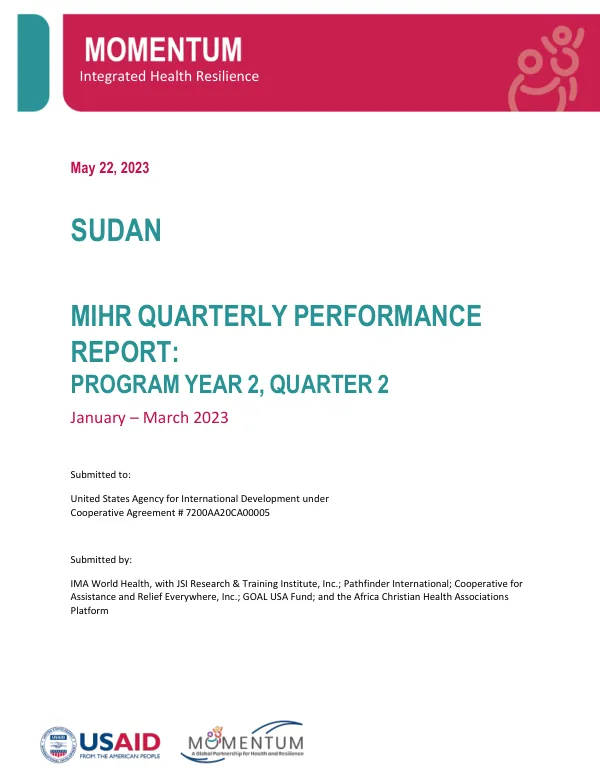
MOMENTUM Integrated Health Resilience Sudan PY2 Q2 Performance Report
Maternal and Neonatal Health Services in Sudan The MOMENTUM Integrated Health Resilience (MIHR) project in Sudan aims to strengthen the capacity and resilience of health and community systems to deliver quality maternal and neonatal health (MNH) services.
2023 · 38 pages
Sign in to readA free account is required to download.
Abstract
The project is part of the USAID's MOMENTUM suite of awards, designed to ensure that investments in USAID countries are tailored to country contexts and foster sustainability. MIHR supports countries in mitigating the impacts of fragility on the population's health and contributes to countries' movement along the development continuum toward reduced maternal and child mortality and sustainable development. The project focuses on improving health and non-health-related outcomes, such as the health and wellbeing of women, children, and their families; empowering women and girls; and improving interactions between populations, health, and the environment. To achieve this, MIHR strengthens the capacity of health and community systems to plan and implement health strategies that reach underserved populations and address the underlying determinants of poor health and the effects of fragility. In Sudan, MIHR received a project description for a health system strengthening (HSS) initiative in January 2021. The initiative aims to improve the quality of MNH services at primary healthcare centers (PHCCs) and community levels. The project focuses on improving access to and use of evidence-based, quality MNH and WASH information and services; strengthening the capacity of host country institutions and providers at state and locality levels to deliver quality MNH and WASH services; and adaptive learning and use of evidence in MNH and WASH programming. Implementation progress has been made in the first two quarters of program year 2. The project has established a core implementation team (CIT) and a technical working group (TWG) to oversee the implementation of the project. The CIT has conducted a health facility assessment (HFA) to identify gaps in MNH services and develop a plan to address these gaps. The project has also established a quality assurance (QA) system to ensure that MNH services are delivered to high-quality standards. The project has made significant progress in improving access to MNH services. The number of women receiving antenatal care (ANC) services has increased by 25% compared to the same period last year. The number of women delivering at PHCCs has also increased by 15%. The project has also made progress in improving the quality of MNH services. The percentage of women receiving postnatal care (PNC) services has increased by 20%. The project has also made progress in strengthening the capacity of host country institutions and providers. The Federal Ministry of Health (FMOH) has developed a standard operating procedure (SOP) for MNH services, and the project has provided technical assistance to the FMOH to implement the SOP. The project has also provided training to healthcare providers on MNH services, and the number of healthcare providers trained has increased by 50%. The project has also made progress in adaptive learning and use of evidence. The project has established a monitoring and evaluation (M&E) system to track progress and identify areas for improvement. The project has also conducted a social analysis and action (SAA) to identify the underlying determinants of poor health and the effects of fragility. The project has also made progress in collaboration, learning, and adaptation. The project has established a technical working group (TWG) to oversee the implementation of the project and provide technical assistance to the FMOH. The project has also established a quality assurance (QA) system to ensure that MNH services are delivered to high-quality standards. The project has planned activities for the next quarter, including the establishment of a community strategy for sustainable operation, maintenance, and management (CMOM) of PHCCs; the provision of technical assistance to the FMOH to implement the SOP for MNH services; and the conduct of a social analysis and action (SAA) to identify the underlying determinants of poor health and the effects of fragility.
Related documents