USAID DEC
Milestones: NeoSyp: Low Cost Mechanical Syringe Pump to Regulate IV-Fluid Delivery in Low-Resource Settings
Sign inUSAID
Milestones: NeoSyp: Low Cost Mechanical Syringe Pump to Regulate IV-Fluid Delivery in Low-Resource Settings
The NeoSyp project aims to develop a low-cost mechanical syringe pump to regulate IV-fluid delivery in low-resource settings.
2 pages
Sign in to readA free account is required to download.
Abstract
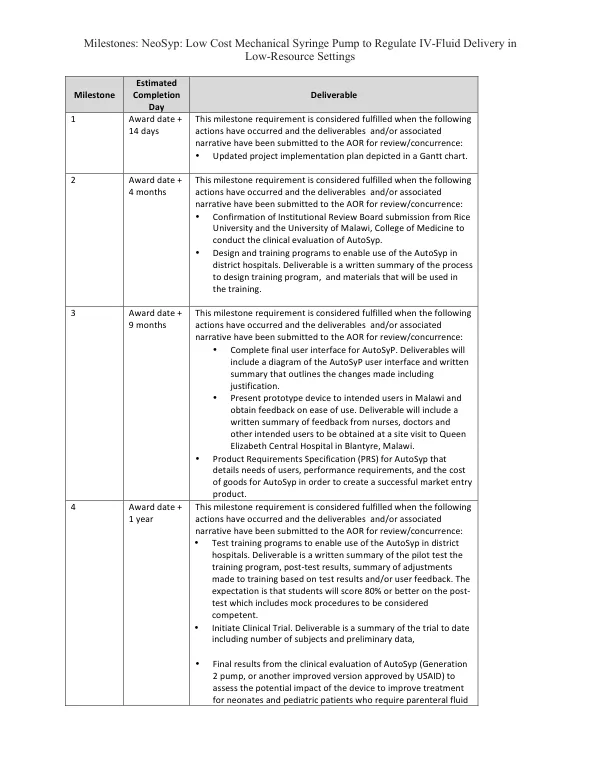
The project is a collaborative effort between Rice University and the University of Malawi, College of Medicine. The project's primary objective is to improve treatment outcomes for neonates and pediatric patients who require parenteral fluid and/or IV medication. The project's milestones are outlined in a detailed plan, with specific deliverables and timelines for each milestone. The first milestone is the award date plus 14 days, during which the project team must submit an updated project implementation plan depicted in a Gantt chart. This plan outlines the project's scope, timeline, and resource allocation. The second milestone is the award date plus four months, during which the project team must confirm Institutional Review Board (IRB) submission from Rice University and the University of Malawi, College of Medicine to conduct the clinical evaluation of AutoSyp. The team must also design and train programs to enable the use of AutoSyp in district hospitals. The third milestone is the award date plus nine months, during which the project team must complete the final user interface for AutoSyp, present a prototype device to intended users in Malawi, and obtain feedback on ease of use. The team must also develop a Product Requirements Specification (PRS) for AutoSyp, which details the needs of users, performance requirements, and the cost of goods for AutoSyp. The fourth milestone is the award date plus one year, during which the project team must test training programs to enable the use of AutoSyp in district hospitals, initiate a clinical trial, and obtain final results from the clinical evaluation of AutoSyp. The fifth and final milestone is the award date plus one year and three months, during which the project team must submit a final report that includes a summary of the stakeholders' meeting, additional steps required for country-wide scale-up, financial requirements to support the scale-up plan, partnerships required to implement the scale-up plan, and lessons learned from the project.
Related documents
![Measurement Approaches for Effective Coverage Estimation [MR31]](https://covers.devme.ai/gen/138167.webp)