USAID DEC
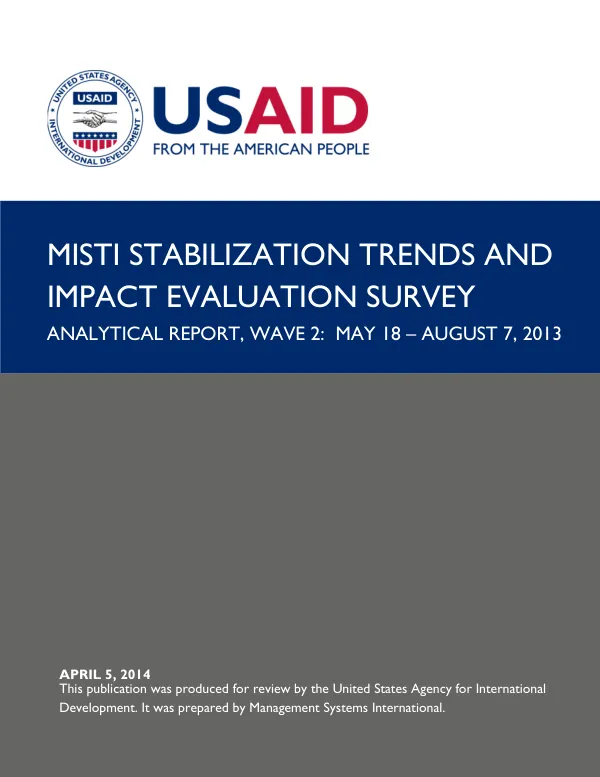
MISTI Stabilization Trends and Impact Evaluation Survey Analytical Report, Wave 2: May 18 – August 7, 2013
Sign inMANAGEMENT SYSTEMS INTERNATIONAL
MISTI Stabilization Trends and Impact Evaluation Survey Analytical Report, Wave 2: May 18 – August 7, 2013
MISTI Stabilization Trends and Impact Evaluation Survey Analytical Report, Wave 2, was conducted from May 18 to August 7, 2013.
2014 · 153 pages
Sign in to readA free account is required to download.
Abstract
The report focuses on stability trends and impact evaluation in Afghanistan. The survey was contracted under AID-OAA-I-10-00002, Task Order 306-TO-12-00004, and was prepared by Management Systems International for review by the United States Agency for International Development. Stability trends indicate a mixed picture, with some improvements and declines in various indicators. The Stability Index, which measures overall stability, showed a slight decline from Wave 1 to Wave 2. However, optimism about the right direction of the country increased, with 44% of respondents expressing a positive outlook. Local area security also improved, with 55% of respondents reporting a decrease in violence. The presence of armed opposition groups remained a concern, with 22% of respondents reporting the presence of such groups in their local area. Confidence in local government increased, with 35% of respondents expressing trust in their local government. Corruption in local government, however, remained a significant issue, with 62% of respondents reporting that corruption was widespread. Government services delivery improved, with 45% of respondents reporting an increase in access to basic services such as healthcare and education. Local area resilience also improved, with 40% of respondents reporting an increase in community cohesion and social capital. Quality of life, however, remained a concern, with 55% of respondents reporting a decline in their overall well-being. The impact evaluation section of the report presents findings on the effectiveness of various interventions aimed at promoting stability and security in Afghanistan. The analysis suggests that support for the Taliban and the Government of the Islamic Republic of Afghanistan (GIRoA) is influenced by a range of factors, including individual-level characteristics, spatial patterns, and the effects of violence. The survey experiments section of the report presents findings on the spatial patterns of support for the Taliban and GIRoA, as well as individual-level factors affecting support for these groups. The analysis suggests that support for the Taliban is higher in areas with high levels of violence and poverty, while support for GIRoA is higher in areas with better access to basic services and infrastructure. The report concludes that the stability trends and impact evaluation findings have important implications for policymakers and practitioners working to promote stability and security in Afghanistan. The analysis suggests that a range of interventions, including community-based initiatives, infrastructure development, and support for local government, may be effective in promoting stability and security in the country.