WORLD HEALTH ORGANIZATION
Mobile Technology for Improved Contraceptive Care in Morocco
The development of an evidence-based patient-centered contraceptive app, referred to as MyContraception, aimed to facilitate informed decision-making about contraceptive choices among women.
2021 · 20 pages
Sign in to readA free account is required to download.
Abstract
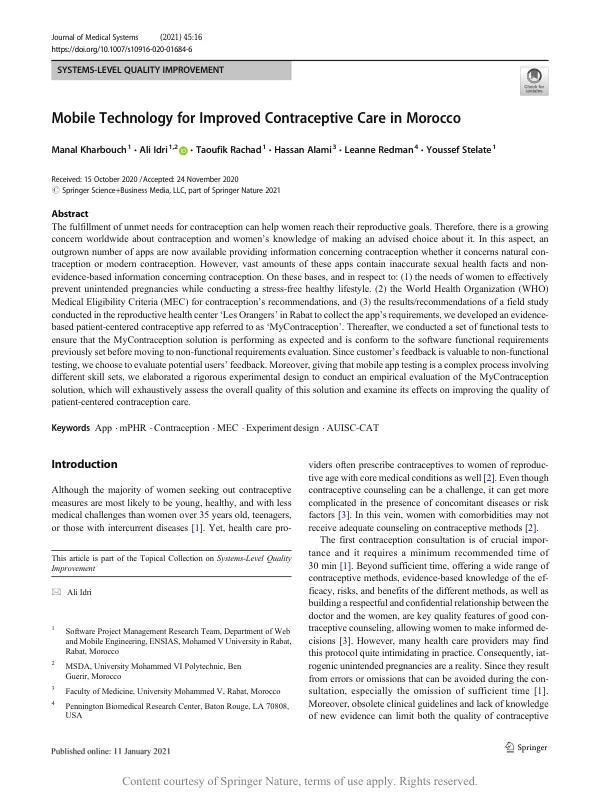
The app was designed to provide interactive, individually tailored information and decision support for contraceptive use, preparing women for their contraception consultations with healthcare providers and serving as a clinician extender to support the delivery of evidence-based contraception awareness. The app's development was informed by the World Health Organization's (WHO) Medical Eligibility Criteria (MEC) for contraceptive use and the results of a field study conducted in the reproductive health center 'Les Orangers' in Rabat to collect the app's requirements. The app's features and functionalities were designed to take into account the needs of women to effectively prevent unintended pregnancies while conducting a stress-free healthy lifestyle. The app's theoretical foundation is based on the Fertility Awareness-Based (FAB) contraception method, which is a form of natural birth control to prevent unwanted pregnancy. FAB-based apps are designed around a statistical algorithm that provides a 'safe' or 'unsafe' result to the user regarding the risk of pregnancy. The algorithm takes into account the day of ovulation, the yellow phase, the follicular phase, the duration of the cycle, as well as the average temperature between the different phases, and sets the safe/unsafe periods. In addition to FAB, the app also provides information on modern contraceptive methods, which are techniques and technologies designed to overcome biology and allow complete sexual freedom while reducing the risk of pregnancy. Modern contraceptive methods include short-acting contraceptives like pills, injectables, and condoms, as well as Long-Acting Reversible Contraceptives (LARC) such as implants and Intrauterine Devices and systems (IUDs). The app's development was guided by the WHO's MEC for contraceptive use, which provides recommendations for the use of contraceptive methods in various medical conditions. The app's features and functionalities were designed to take into account the needs of women with comorbidities, who may not receive adequate counseling on contraceptive methods. The app's experimental design was developed to empirically evaluate its effectiveness in improving the quality of patient-centered contraception care. The study procedure involved recruiting participants, collecting data on their contraceptive use and experiences, and evaluating the app's features and functionalities. The quality and potential assessment tools used in the evaluation included surveys, interviews, and focus groups. The results of the study showed that the app was effective in improving the quality of patient-centered contraception care, with participants reporting increased knowledge and confidence in their contraceptive choices. The app's features and functionalities were well-received by participants, who appreciated the interactive and individually tailored information provided. The study's findings have implications for the development of future contraceptive apps, highlighting the importance of evidence-based design and user-centered development. The app's effectiveness in improving the quality of patient-centered contraception care suggests that it has the potential to be a valuable tool for healthcare providers and women seeking to make informed decisions about their contraceptive choices.
Related documents