USAID DEC
Assessment of universal access to comprehensive sexual and reproductive health services in Egypt
Sign inMINISTRY OF HEALTH AND POPULATION
Assessment of universal access to comprehensive sexual and reproductive health services in Egypt
The World Health Organization (WHO) resolution in 2005 called for health systems to move towards universal coverage, ensuring everyone has access to promotive, preventive, curative, and rehabilitative health interventions at an affordable cost.
2015 · 6 pages
Sign in to readA free account is required to download.
Abstract
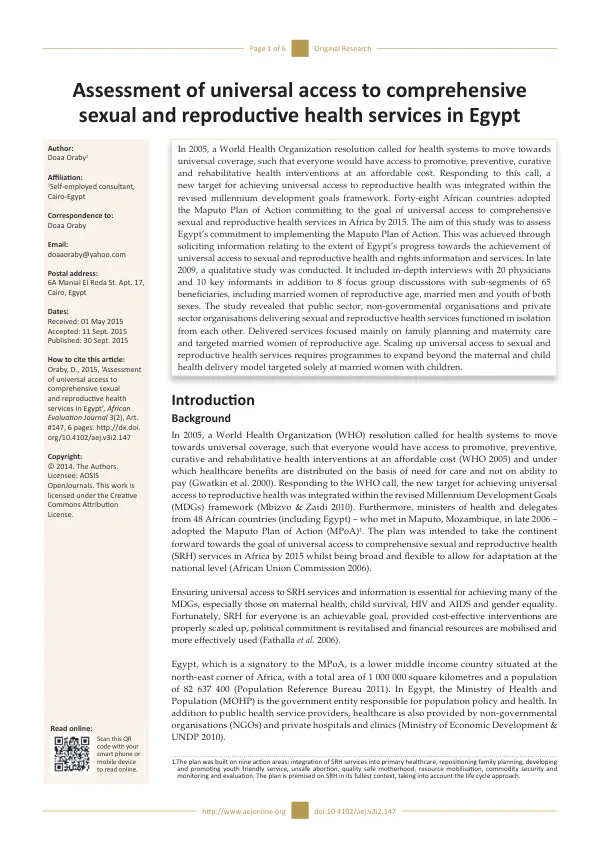
This resolution led to the integration of a new target for achieving universal access to reproductive health within the revised Millennium Development Goals (MDGs) framework. Forty-eight African countries, including Egypt, adopted the Maputo Plan of Action (MPoA) in 2006, committing to universal access to comprehensive sexual and reproductive health (SRH) services in Africa by 2015. Egypt, a lower middle-income country, has made progress towards achieving the MDGs, but regional disparities still need to be addressed. The 2008 Egypt Demographic and Health Survey (EDHS) revealed that the total fertility rate was 3.0 births per woman, and 57.6% of married women were using modern non-traditional methods of contraception. However, almost 29% of women discontinued the use of modern contraceptive methods within 12 months of use, mostly due to reasons that could be avoided by proper counselling. Maternal mortality has declined from 60.7 per 100,000 live births in 2001 to 55.0 in 2009, but coverage of maternity care services is inadequate in rural Upper Egypt, where regular antenatal care was received for 49% of births. The study aimed to assess Egypt's commitment to implementing the MPoA through soliciting information on Egypt's progress towards the achievement of universal access to SRH information and services. The assessment included a desk review of existing reference documents, 10 in-depth interviews with key informants, 20 in-depth interviews with physicians, and 8 focus group discussions with 65 participants representing sub-segments of the beneficiaries. The themes discussed during the focus group discussions and in-depth interviews included service integration, family planning, quality safe motherhood, unsafe abortion, and youth-friendly services. The study revealed that public sector, non-governmental organizations, and private sector organizations delivering SRH services functioned in isolation from each other. Delivered services focused mainly on family planning and maternity care and targeted married women of reproductive age. Scaling up universal access to SRH services requires programs to expand beyond the maternal and child health delivery model targeted solely at married women with children. The study synthesizes recommendations meant to strengthen the health system and ensure universal access to SRH. The study was conducted in late 2009 in three governorates: Greater Cairo, Lower Egypt governorate, and Upper Egypt governorate. The selection of governorates was intended to represent different geographic regions in the country. The assessment included a desk review of existing reference documents, 10 in-depth interviews with key informants, 20 in-depth interviews with physicians, and 8 focus group discussions with 65 participants representing sub-segments of the beneficiaries. Informed oral consent was obtained from participants of the focus group discussions and in-depth interviews after researchers explained the purpose and procedures of the study, its voluntary nature, participants' right to withdraw or refuse to answer questions, and attaining permission to record the interviews. The study's findings indicate that Egypt's health system needs to be strengthened to ensure universal access to SRH services. The recommendations include expanding SRH services beyond the maternal and child health delivery model, increasing access to SRH services in rural Upper Egypt and slum areas, and improving the quality of SRH services. The study's results provide valuable insights into the challenges facing Egypt's health system and offer recommendations for strengthening the system to ensure universal access to SRH services.