USAID DEC
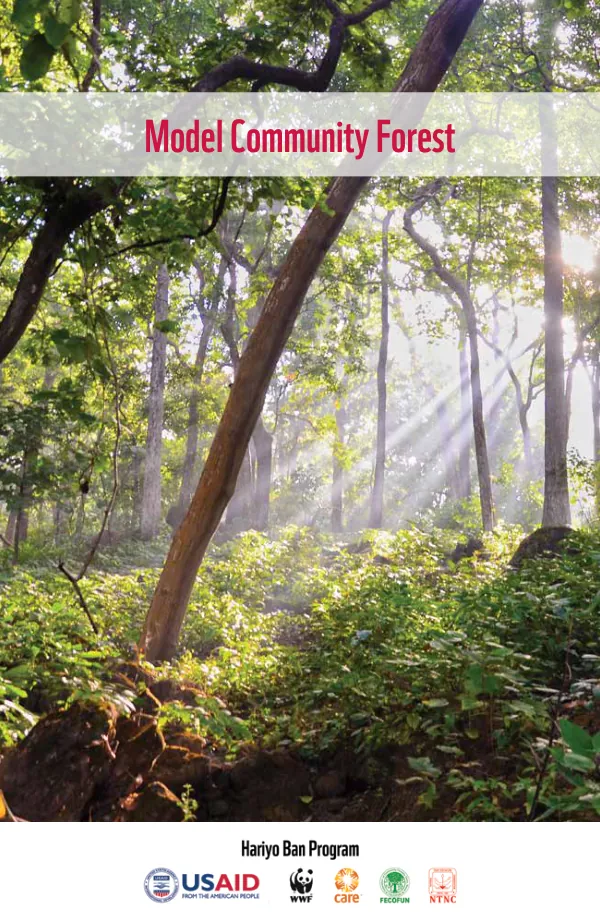
Model Community Forest: A Concept for Sustainable Forest Management in Nepal
The Model Community Forest initiative in Nepal aims to improve the livelihood status of forest-dependent, disadvantaged, Dalit, and marginalized communities through sustainable forest management.
2019 · 8 pages
Sign in to readA free account is required to download.
Abstract
This participatory model of forest management has been in place for four decades and has contributed to increasing the forest area of Nepal, enhancing the capacity of local communities in forest management, biodiversity conservation, and advocacy, and diversifying their livelihood options. The initiative is guided by the Forest Act, Community Forest Development Guideline, 2071, and the concept of sustainable forest management. The main goal of the model community forest is to improve the livelihood status of forest-dependent, disadvantaged, Dalit, and marginalized communities, enhance participatory biodiversity conservation, and maintain or increase the continuous flow of forest products and services for long-term use through sustainable forest management. The model community forest has three interwoven pillars: management of forest (environment), GESI and management of users' group (social), and livelihood and enterprise promotion (economic). The community needs to adopt proper methods of forest conservation and promotion by addressing the demands of forest users and considering the context and environmental condition of the forest. Community Forest Users' Group committee should be made inclusive and accountable, and capacity-building programs will be conducted to promote poor, women, Dalit, and marginalized groups' leadership and effective role in the decision-making process. The selection of model community forests will be based on several factors, including meeting all legal provisions related to community forest, being within the working area of Hariyo Ban Program, having good forest status and being in an accessible location, being diverse in terms of social and economic representation, and having motivated user groups ready to contribute in the form of labor and finance when required. The strategies to establish model community forests include collaboration and consultation with Hariyo Ban Program consortium partners, Division Forest Office, local government, and other government and non-governmental organizations throughout the process, mobilization of local resources to create a feeling of ownership among the community, cooperation with neighboring community forests to replicate and advocate good practices, and developing as a learning center by documenting and showcasing best practices. The steps to establish a model community forest include preparation of the model community forest concept, selection of community forest, resource survey and social analysis, orientation and discussion on vision, vision statement finalization and preparation of strategic action plan, facilitator selection and capacity-building training, participatory implementation of strategic action plan, mobilization of resource persons to reach out to neighboring community forests and advocate to replicate best practices, and monitoring and evaluation. The expected output of the model community forest includes improvement of forest quality ensuring smooth and continuous flow of required forest products and services, establishment and implementation of mechanism for equitable distribution of forest-based products and following the criteria of Community Forest Development Guideline, consensus on equitable distribution of forest resources among the users of community forests, improved livelihood of women, Dalit, indigenous, poor, and forest-dependent users through forest-based enterprise and other livelihood options, documentation of biodiversity available in the forest and necessary steps taken to identify and conserve habitat of species under threat of extinction, increase in good practice of social justice and security along with minimal or no incident of gender-based violence, and inclusion of necessary measures for climate change adaptation and mitigation measures in Community Forest Operation Plan and implementation of the same.