USAID/NEPAL
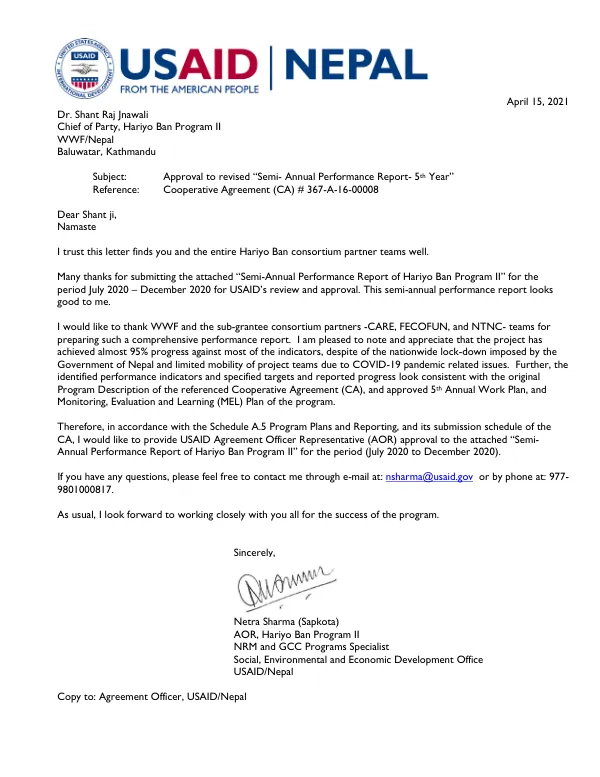
Semi-Annual Performance Report of Hariyo Ban Program II
The Hariyo Ban Program is a five-year initiative aimed at conserving biodiversity and promoting sustainable livelihoods in Nepal.
2021 · 117 pages
Sign in to readA free account is required to download.
Abstract
The program is implemented by WWF in partnership with CARE, FECOFUN, and NTNC, and is funded by the United States Agency for International Development (USAID). The program's goal is to conserve and restore degraded forests, promote sustainable agriculture practices, and improve the livelihoods of local communities. The program focuses on four key areas: biodiversity conservation, climate change adaptation, gender equality and social inclusion, and governance. In the semi-annual performance report for the period of July 2020 to December 2020, the program achieved almost 95% progress against most of the indicators, despite the nationwide lockdown imposed by the Government of Nepal due to the COVID-19 pandemic. The program's interventions include farmer training in sustainable agriculture techniques, infrastructure development, and market linkage facilitation. The program's overall progress is consistent with the original Program Description and approved 5th Annual Work Plan and Monitoring, Evaluation, and Learning (MEL) Plan. The program's management structure includes a coordination and collaboration mechanism, budget versus expenditure tracking, and an operating environment including a risk and mitigation plan. The program's lessons learned, best practices, and success stories are documented in the report, highlighting the importance of community engagement, participatory approaches, and adaptive management. The program's challenges and anticipated future problems include the COVID-19 pandemic's impact on program implementation, limited access to markets, and the need for more effective irrigation systems. However, the program's opportunities and prospects for the remaining period include the potential for increased market access, improved agricultural productivity, and enhanced community engagement. The Hariyo Ban Program's overall progress and achievements demonstrate its effectiveness in promoting sustainable livelihoods and conserving biodiversity in Nepal. The program's continued support and commitment to its goals and objectives are essential for achieving its desired outcomes.
Related documents