USAID DEC
Modernizing agricultural extension in Guinea: Synthesis and prospects of actions for capacity development and consultation between actors
Sign inUSAID
Modernizing agricultural extension in Guinea: Synthesis and prospects of actions for capacity development and consultation between actors
The modernization of agricultural extension in Guinea is a critical component of the country's efforts to improve the performance and sustainability of its agricultural and food systems.
2021 · 23 pages
Sign in to readA free account is required to download.
Abstract
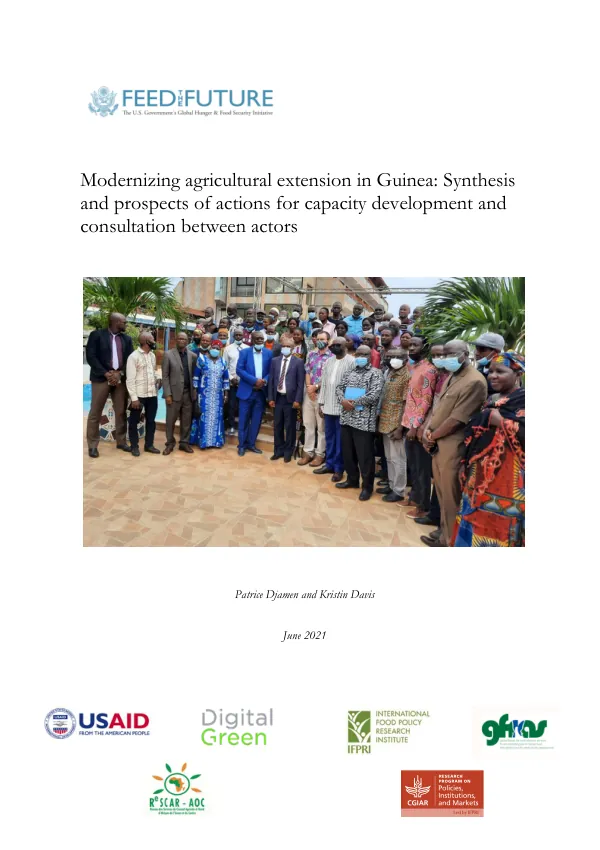
The United States Agency for International Development (USAID) has supported this initiative for several years, and in 2021, USAID financed the implementation of four priority activities to strengthen the dynamics and synergies between extension and advisory services (EAS) actors. The establishment of the Guinean Agriculture Advisory Services Forum (FOGUICA) was a key outcome of this initiative. FOGUICA is a platform for coordinating actors and facilitating exchanges and synergies, and it is open to various actors and stakeholders in agricultural advisory services. The forum comprises four main bodies: the General Assembly, the Board of Directors, an Executive Secretariat, and thematic working groups. FOGUICA's vision is to provide better coordinated and synergistic agricultural advisory services that facilitate the achievement of the objectives of producers and other actors in agricultural value chains in a sustainable manner. FOGUICA was provided with strategic and operational planning tools, including a ten-year strategic plan, an operational plan, and a program of activities and budget for the first year of operation. The strategic plan is organized around four main areas: professionalization of agricultural advisory services, information and communication management, interaction, learning, and synergy between actors, and coordination, harmonization, and monitoring and evaluation. The estimated budget for the implementation of this strategic plan is USD 1,567,073. The intervention also led to the creation of an online directory of agricultural advisory organizations in Guinea. The directory, hosted on the National Agency for Rural Promotion and Agricultural Advisory Services (ANPROCA) website, contains information on 75 organizations, including ANPROCA prefectural branches, agrodealers, consultancies, NGOs, and agro-pastoral producer organizations. The directory offers four filtering or grouping possibilities for searching for organizations: geographical coverage, type of organization, type of advisory services offered, and other criteria. Capacity building on partnership management and resource mobilization was another key outcome of the initiative. A benchmarking of good practices was carried out, and a two-day training session was organized on partnership development and resource mobilization. The training session was attended by 59 people, including representatives from various EAS actors and stakeholders. The assessment of the organizational capacity building needs of EAS providers was also conducted as part of the initiative. An organizational capacity assessment grid was designed to evaluate the capacity of EAS providers in four main areas: structure and governance, resources, functioning, and performance. The assessment revealed that EAS providers face several challenges, including limited resources, inadequate infrastructure, and poor communication and knowledge management practices. Overall, the modernization of agricultural extension in Guinea has made significant progress in recent years, with the establishment of FOGUICA, the creation of an online directory of agricultural advisory organizations, and capacity building on partnership management and resource mobilization. However, challenges remain, and further support is needed to ensure the sustainability and amplification of the dynamics set in motion by the intervention.
Related documents