USAID DEC
Final Performance Evaluation of the USAID/Philippines Microenterprise Access to Banking Services Program
Sign inUNIVERSITY RESEARCH CORPORATION CO., LLC
Final Performance Evaluation of the USAID/Philippines Microenterprise Access to Banking Services Program
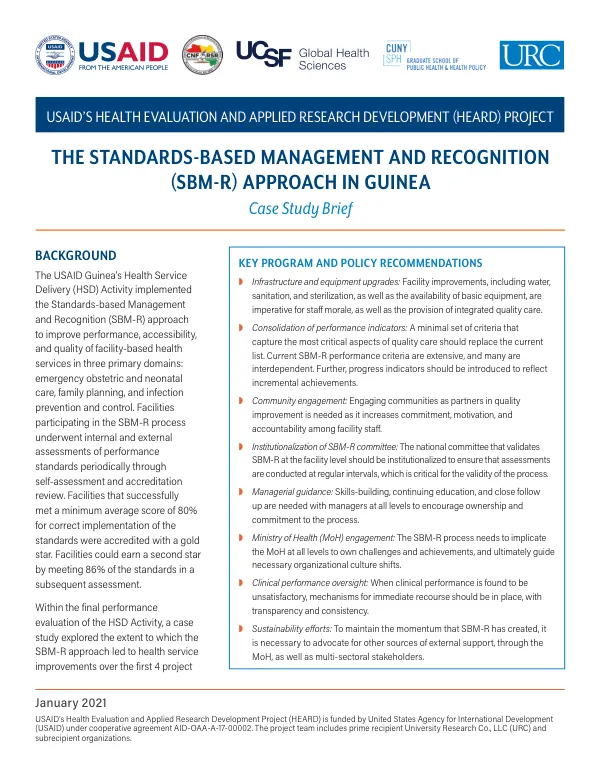
The Standards-based Management and Recognition (SBM-R) approach was implemented in Guinea to improve performance, accessibility, and quality of facility-based health services.
2021 · 4 pages
Sign in to readA free account is required to download.
Abstract
The approach focused on three primary domains: emergency obstetric and neonatal care, family planning, and infection prevention and control. Facilities participating in the SBM-R process underwent internal and external assessments of performance standards periodically through self-assessment and accreditation review. Facilities that successfully met a minimum average score of 80% for correct implementation of the standards were accredited with a gold star. The SBM-R approach was implemented within the context of major structural challenges facing the health system, including chronic staff shortages and turnover, inadequate infrastructure, and community mistrust in the health system stemming from the 2014-2016 Ebola epidemic. The process took place in two steps: a regular self-assessment at the facility-level by a team of providers, senior managers, COSAH representatives, and community members, followed by external evaluation and validation by the national committee. If facility performance on external review was 80% or greater, it received one star. A second star was achieved when a facility with one star demonstrated performance for at least 86% of the standards. Of 272 HSD-supported facilities, 97 implemented the SBM-R program, of which about half (51%) had earned one or more stars. The 97 SBM-R facilities implemented the approach, on average, for four years. Wide variation existed in the frequency of facility assessments, ranging from once per quarter to once per 15 months. Nearly half of all SBM-R facilities (47%) achieved three or fewer assessments from 2017-2019, and were thus categorized as low engagement. The case study demonstrated marked improvements in scores for infection prevention and control practices, ranging from a 25 to 70 percentage point increase. Other large improvements in clinical practice were attributed to obstetric interventions, though more improvements are needed for respectful care and complex newborn health interventions. Managerial performance indicators were quite variable, with managerial issues including poor client-provider communication, low availability of information, education, communication materials, lack of job descriptions for staff, and long wait times for clients. Many of the case study facilities struggled in the initial years to obtain supplies, such as scales, blood pressure gauges, and examination tables. Facilities' capacity to perform sterilization and waste management was particularly problematic, due to a lack of disinfectants, antiseptics, and personal protective equipment. Though space was a major infrastructure issue in early years, most facilities overcame these limitations within two years of their engagement in the SBM-R. The two key factors for performance improvement are HSD-provided inputs, such as training, equipment, and managerial guidance, and facility-level receptivity to SBM-R. Training and equipment alone are insufficient to drive quality improvement. Leadership by facility managers and supervisors, coupled with the engagement and commitment of district and regional actors within the MoH, is essential. Long-term maintenance of facilities and equipment must be managed locally, through participation of government officials, community leaders, and community members.