AFRICAN CHRISTIAN HEALTH ASSOCIATION PLATFORM
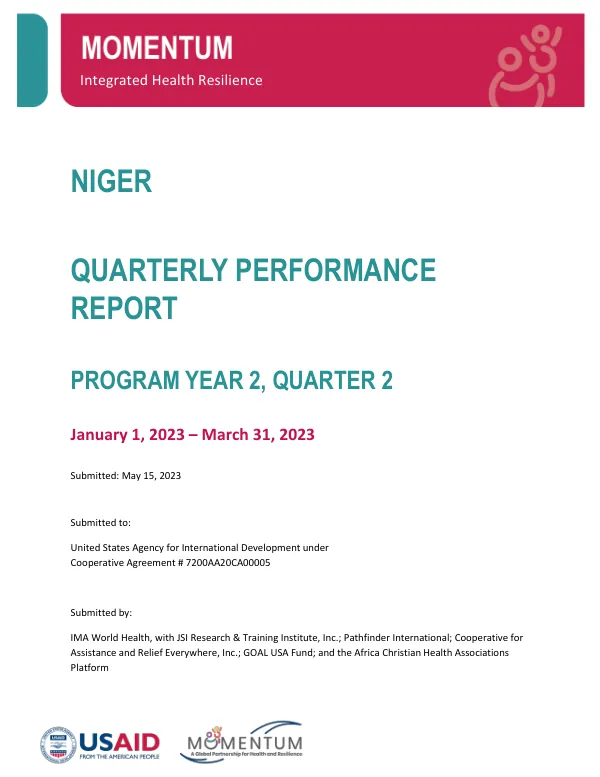
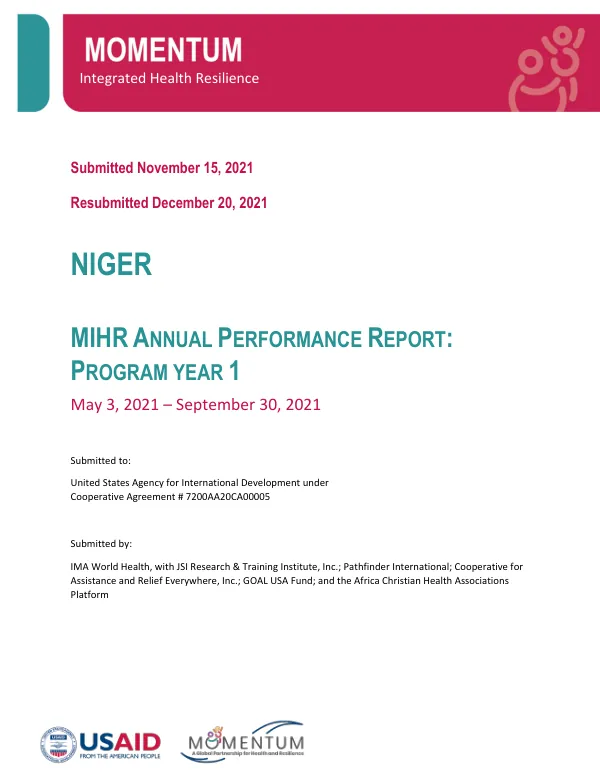
MOMENTUM Integrated Health Resilience MIHR Niger Country Annual Report
The MOMENTUM Integrated Health Resilience (MIHR) project in Niger aims to strengthen quality voluntary family planning and reproductive, maternal, newborn, and child health (MNCH/FP/RH) service delivery in fragile settings.
2021 · 9 pages
Sign in to readA free account is required to download.
Abstract
The project is part of the USAID's MOMENTUM suite of awards, designed to increase the health resilience capacities of families, communities, and health systems. MIHR will support communities to mitigate the impacts of fragility on the population's health and contribute to countries' movement along the development continuum toward reduced maternal and child mortality and increased sustainable development. MIHR will strengthen the capacity and resilience of health systems, including community structures, in focus countries to enable them to plan and implement health strategies that reach underserved populations and address the underlying determinants of poor health and fragility. The project will work with governments through the ministries of health (MOHs) to enhance the resilience of countries through strengthened youth and gender responsiveness, contraception, and voluntary family planning programming to improve health and wellbeing of women, children, and their families; empower women and girls; and improve interactions between populations, health, and the environment. In May 2021, MIHR received a Program Description (PD) from USAID/Niger requesting a multi-year field support buy-in to strengthen quality maternal, newborn, and child health (MNCH), family planning/reproductive health (FP/RH), nutrition services, and support for improved resilience, building on USAID's extensive malaria activities among communities in Dosso, Tahoua, and Niamey. Following the receipt of the PD, MIHR began the scoping process and drafting of the PY1 work plan and budget. Submission of the work plan took place in July, provisional approval was received from USAID at the end of August, and final approval was received after resubmission, addressing USAID's comments. MIHR conducted a security risk assessment (SRA) in the Niamey, Dosso, and Tahoua regions to inform activities, implementation strategies, and administrative processes of the project to ensure safe and effective project implementation that is responsive to the current security situation in MIHR's project areas. This assessment was conducted by a contracted firm, Other Solutions, and an internal security assessment report was finalized on August 10th. On August 18th, the lead consultant presented to MIHR staff on the main findings of the assessment and key considerations for the project moving forward. During the reporting period, MIHR engaged in start-up activities, including the development of a comprehensive work plan for Year 1, which was informed by findings from the scoping phase and suggested implementation strategies shared with USAID. MIHR also revised the PY1 work plan and budget based on USAID comments and resubmitted on September 21st, 2021. MIHR received full approval of the revised work plan and budget submission from USAID on October 28th, 2021. The project will focus on sub-national technical assistance to increase equitable access to and use of quality facility- and community-based health services, by advancing adaptive, locally owned implementation approaches tailored to realities and needs of these fragile contexts. MIHR will work with governments, non-governmental organizations (NGOs), and other stakeholders to strengthen the capacity and resilience of health systems, including community structures, in focus countries to enable them to plan and implement health strategies that reach underserved populations and address the underlying determinants of poor health and fragility. MIHR will also collaborate with other multi-sectoral partners to build resilience and ensure measurement, dissemination, and use of evidence-based practices. The project will reinforce evidence-based decision-making and identification of promising innovations to strengthen health systems in fragile settings. In FY21 Q4, MIHR revised the PY1 work plan and budget based on USAID comments and resubmitted on September 21st, 2021. MIHR received full approval of the revised work plan and budget submission from USAID on October 28th, 2021. The project's geographic focus is on the Niamey, Dosso, and Tahoua regions in Niger, where MIHR will work with governments, NGOs, and other stakeholders to strengthen the capacity and resilience of health systems, including community structures, in focus countries to enable them to plan and implement health strategies that reach underserved populations and address the underlying determinants of poor health and fragility. The project's timeframes are from May 2021 to September 2021, with a focus on sub-national technical assistance to increase equitable access to and use of quality facility- and community-based health services. The project's recommendations include advancing adaptive, locally owned implementation approaches tailored to realities and needs of these fragile contexts, strengthening the capacity and resilience of health systems, including community structures, in focus countries to enable them to plan and implement health strategies that reach underserved populations and address the underlying determinants of poor health and fragility, and collaborating with other multi-sectoral partners to build resilience and ensure measurement, dissemination, and use of evidence-based practices.