AFRICAN CHRISTIAN HEALTH ASSOCIATION PLATFORM
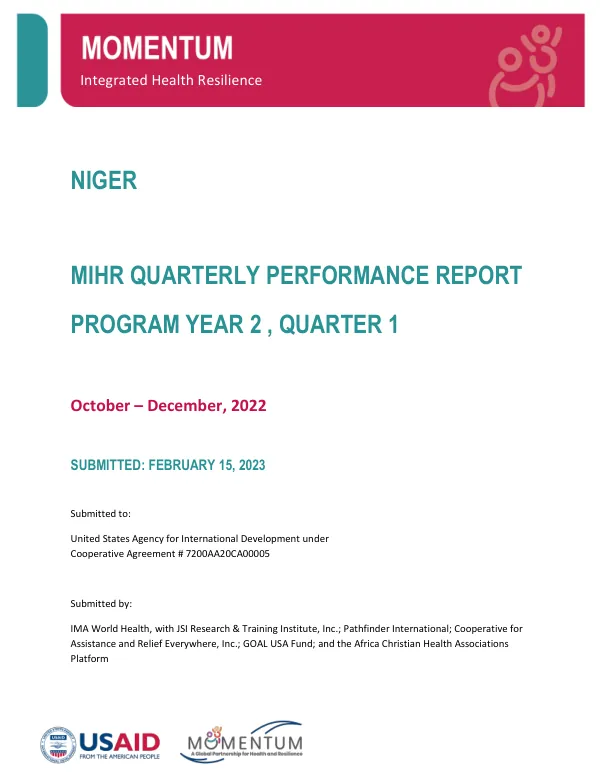
MOMENTUM Integrated Health Resilience Niger PY1 Annual Performance Report
MOMENTUM Integrated Health Resilience is a program implemented by IMA World Health with partners JSI Research & Training Institute, Inc., Pathfinder International, Cooperative for Assistance and Relief Everywhere, Inc., GOAL USA Fund, and the Africa Christian Health Associations Platform, among others, under USAID cooperative agreement #7200AA20CA00005.
2023 · 43 pages
Sign in to readA free account is required to download.
Abstract
The program aims to improve maternal, newborn, and child health (MNCH) and family planning and reproductive health (FP/RH) services in Niger. The program focuses on four intermediate results: (1) scaling up and sustaining access to and use of evidence-based, quality MNCH/FP/RH information, services, and interventions; (2) improving the capacity of host country institutions, local organizations, and providers to deliver evidence-based, quality MNCH/FP/RH services; (3) increasing adaptive learning and use of evidence in MNCH/FP/RH programming through sustained host country technical leadership; and (4) increasing cross-sectoral collaboration and innovative partnerships between MNCH/FP/RH and non-MNCH/FP/RH local organizations. In Quarter 1 of Program Year 2, the program implemented various activities to achieve these intermediate results. The program supported health facilities in Dosso District, with a total of 15 facilities receiving assistance. The program also conducted a health facility assessment in Dosso District, which identified gaps and challenges in the health system. The assessment found that the district had a shortage of health workers, particularly in the areas of maternal and child health. The program also implemented a vaccination campaign in Dosso District, which reached a total of 1,200 children and 500 pregnant women. The campaign resulted in a significant increase in vaccination coverage, with 95% of children receiving the recommended vaccinations. The program also conducted a series of focus group discussions with community members, which provided valuable feedback on the program's activities and services. In terms of capacity building, the program provided training to health workers on maternal and child health, family planning, and reproductive health. The program also established a technical working group to provide technical assistance and support to the program. The group consisted of representatives from the Ministry of Health, local organizations, and implementing partners. The program also implemented a resilience assessment in Tahoua Region, which identified gaps and challenges in the health system. The assessment found that the region had a shortage of health workers, particularly in the areas of maternal and child health. The program also conducted a series of focus group discussions with community members, which provided valuable feedback on the program's activities and services. Overall, the program made significant progress in Quarter 1 of Program Year 2, with a focus on scaling up and sustaining access to and use of evidence-based, quality MNCH/FP/RH information, services, and interventions. The program also made progress in improving the capacity of host country institutions, local organizations, and providers to deliver evidence-based, quality MNCH/FP/RH services. The program's next quarter will focus on implementing a series of activities to achieve the intermediate results, including the establishment of a technical working group to provide technical assistance and support to the program. The program will also continue to provide training to health workers on maternal and child health, family planning, and reproductive health. Additionally, the program will conduct a series of focus group discussions with community members to provide valuable feedback on the program's activities and services. The program's overall goal is to improve maternal, newborn, and child health and family planning and reproductive health services in Niger. The program's activities and services are designed to address the gaps and challenges identified in the health system, with a focus on scaling up and sustaining access to and use of evidence-based, quality MNCH/FP/RH information, services, and interventions.