USAID DEC
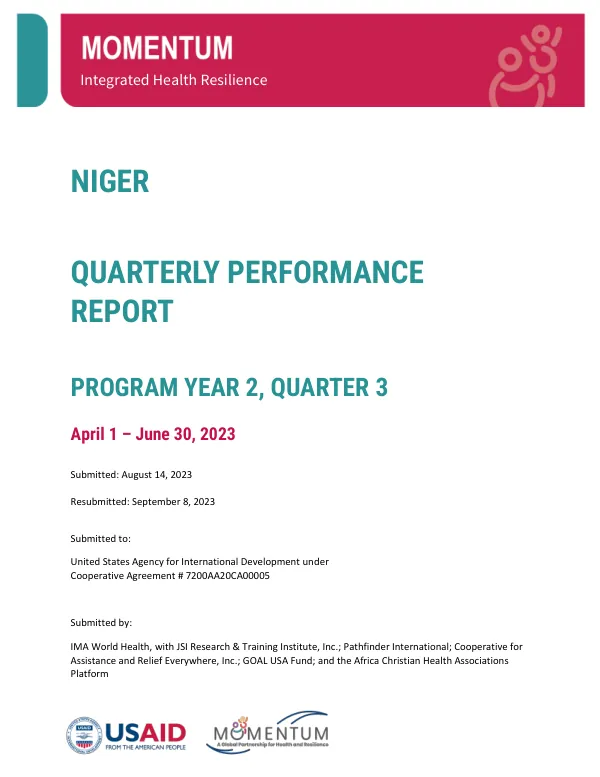
MOMENTUM Integrated Health Resilience | Niger Quarterly Performance Report, FY2023 Q3
Sign inAFRICAN CHRISTIAN HEALTH ASSOCIATION PLATFORM
MOMENTUM Integrated Health Resilience | Niger Quarterly Performance Report, FY2023 Q3
MOMENTUM Integrated Health Resilience is a program implemented by IMA World Health, with partners JSI Research & Training Institute, Inc., Pathfinder International, Cooperative for Assistance and Relief Everywhere, Inc., GOAL USA Fund, and the Africa Christian Health Associations Platform, under USAID cooperative agreement #7200AA20CA00005.
2023 · 56 pages
Sign in to readA free account is required to download.
Abstract
The program aims to improve maternal, newborn, and child health (MNCH) and family planning (FP) services in Niger. The program focuses on four intermediate results: scaling up and sustaining access to evidence-based, quality MNCH/FP/RH information, services, and interventions; improving the capacity of host country institutions, local organizations, and providers to deliver evidence-based, quality MNCH/FP/RH services; increasing adaptive learning and use of evidence in MNCH/FP/RH programming through sustained host country technical leadership; and increasing cross-sectoral collaboration and innovative partnerships between MNCH/FP/RH and non-MNCH/FP/RH local organizations. In Quarter 3 of Program Year 2, the program made significant progress in achieving its intermediate results. The number of family planning users from Q1 to Q3 in MIHR-supported regions increased, with a notable increase in the Dosso and Tahoua regions. The program also reported a 27% increase in the number of pregnant women who received antenatal care services during outreach activities. The program implemented various activities to achieve its intermediate results, including training community health workers (CHWs) on integrated community case management (iCCM) and providing them with equipment and supplies. The CHWs treated over 1,000 children during the reporting period, with a significant increase in the number of children referred to health facilities or integrated health centers for health issues. The program also conducted various assessments and evaluations to monitor its progress and identify areas for improvement. The assessments included a fragility, crisis sensitivity, and complexity assessment (F2C) and a health facility assessment (HFA). The program also established a technical advisory group on immunization (GTCV) to provide technical support and guidance on immunization activities. The program's management team reported that the program is on track to meet its targets for the year, with some areas requiring additional support and resources. The team also identified several risks and challenges that need to be addressed, including the need for additional funding and the potential impact of the COVID-19 pandemic on program activities. Overall, the program made significant progress in Quarter 3 of Program Year 2, with notable increases in the number of family planning users and pregnant women who received antenatal care services. The program's management team is working to address the identified risks and challenges to ensure that the program meets its targets for the year. The program's success is attributed to the strong collaboration and partnership between the program's implementing partners, the Ministry of Health, and other stakeholders. The program's management team is committed to continuing to work together to achieve the program's goals and objectives. The program's progress is reflected in the various indicators and metrics reported in the quarterly performance report, including the number of CHWs trained, the number of children treated, and the number of pregnant women who received antenatal care services. The report also highlights the program's achievements in terms of increasing access to family planning services and improving the capacity of host country institutions and local organizations to deliver evidence-based, quality MNCH/FP/RH services. The program's management team is committed to continuing to work together to achieve the program's goals and objectives, and to addressing the identified risks and challenges to ensure that the program meets its targets for the year. The program's success is a testament to the power of collaboration and partnership in achieving development goals and improving the health and well-being of communities.
![MOMENTUM INTEGRATED HEALTH RESILIENCE [Tanzania PY3 Q2] Performance Report](https://covers.devme.ai/gen/148192.webp)