ENCOMPASS, LLC
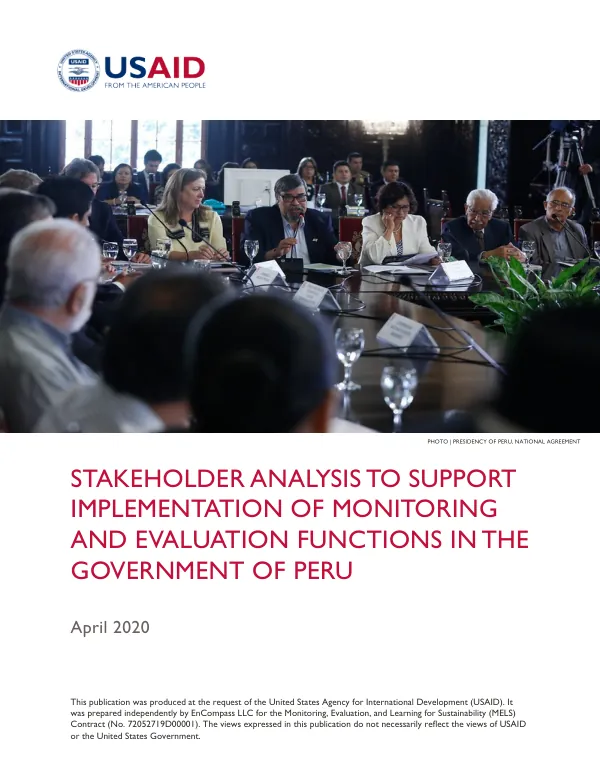
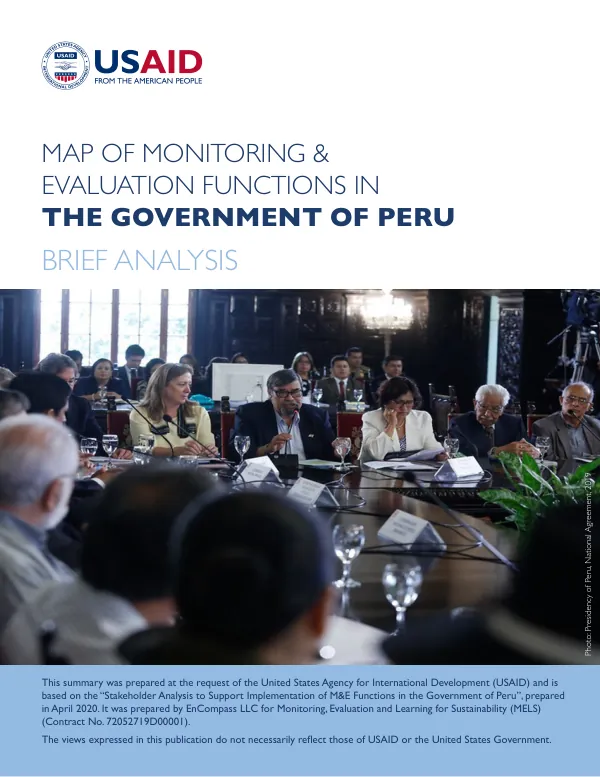
Monitoring and Evaluation Policy Brief
The National Policy for Public Management Modernization in Peru, as of 2021, establishes monitoring and evaluation as a pillar of the State Modernization Policy.
2020 · 5 pages
Sign in to readA free account is required to download.
Abstract
This policy is a component of Results-Oriented Public Management, which aims to ensure that activities and sequences of activities progress as planned within a given period. Evaluation is a process that identifies changes generated by an activity or sequence of activities by comparing the initial state against the current state, using both qualitative and quantitative tools. Peru has signed major international agreements that provide an opportunity for developing monitoring and evaluation systems. The country has committed to aligning and formulating general government policy to the Sustainable Development Goals (SDGs) by adhering to Agenda 2030. A guiding and mandatory regulatory framework is available for all public sector entities to develop monitoring and evaluation processes, which was developed in the 2000s. The National Center for Strategic Planning (CEPLAN) is responsible for strategic planning, while the Ministry of Economy and Finance (MEF) is in charge of financial planning. Both processes need to be closely coordinated to facilitate monitoring and evaluation actions in public entities. The Presidency of the Council of Ministers (PCM) monitors government policies and the public management modernization policy through the Sector Compliance and Innovation Office and the Public Management Department, respectively. Three key institutions have been identified in regard to monitoring and evaluation: CEPLAN, PCM, and MEF. CEPLAN provides guidance for monitoring and evaluating national policies, while PCM monitors government policies and public management modernization policy. MEF has general and specific functions for monitoring and evaluating the public budget. A number of cross-sector linking monitoring and evaluation mechanisms are in place, and monitoring and evaluation evidence is used involving the public sector. Different institutional arrangements are in place for monitoring and evaluation in public institutions. Since 2002, progress in establishing an M&E implementation body has been slow. Implementation of general M&E regulations is progressing at an uneven pace within government institutions. M&E bodies have specific guidelines to perform these functions that have been approved through Ministerial or Department Resolutions. Institutional constraints refer to the location of the M&E body, which can impact the compliance of M&E functions throughout the institution. Staff constraints relate to poor or low preparation in specific M&E issues, high staff turnover, and the burden of work on small teams performing these functions. The constraints of the M&E systems themselves identified were disconnection and poor integration among the various monitoring systems, scattered data collection systems, low data quality, and concentration on monitoring actions, precluding assessment of the public policy cycle. A demand for specialized M&E issues by government personnel to fulfill their functions does not seem to be met. The established functions for monitoring and evaluation are specialized, therefore personnel with different skills is required. Different levels of knowledge and skills are available to public servants who perform these functions. The M&E budget is restricted in view of the requirements of the functions, with only 0.9% allocated to government planning at the three levels of government, and 0.2% to the public information function. The use of information technologies for M&E is not widespread. The country has made significant progress in developing technological tools to support administrative processes, but it has not been similar for M&E. Some institutions have platforms to disseminate M&E results. M&E capacity among public institutions is diverse, with some leaders standing out. The following results are presented after an analysis of the information: 9 out of 19 ministries, 4 out of 5 Decentralized Public Bodies, and 3 out of 24 regional governments have certain M&E capacities. Recommendations include recognizing State M&E by law to ensure institutionalization, promoting implementation of the components and pillars established in the State's modernization policy in parallel, aligning all planning levels with the Country Vision 2030, and coordinating among the responsible entities (CEPLAN and MEF). Additionally, interoperability of sectoral and institutional M&E systems should be considered to feed a national system, starting by the Sustainable Development Goals.