USAID DEC
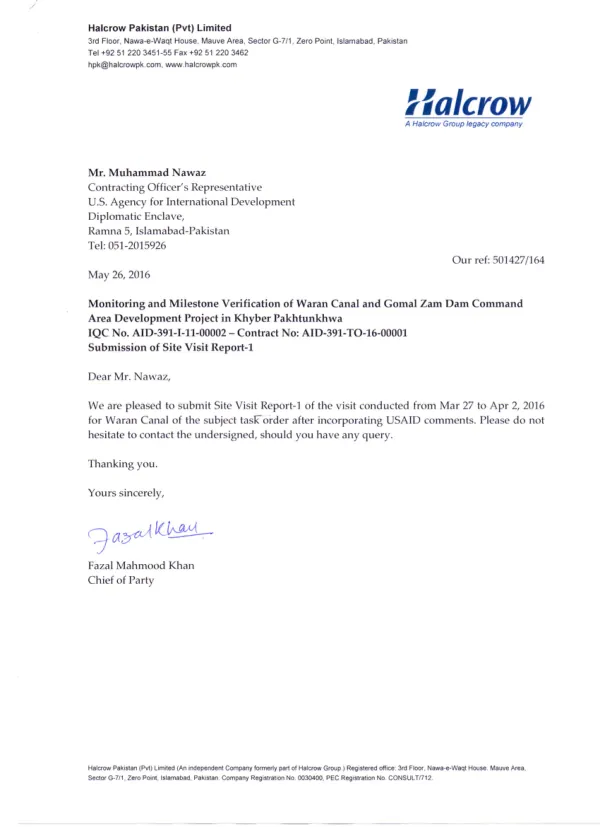
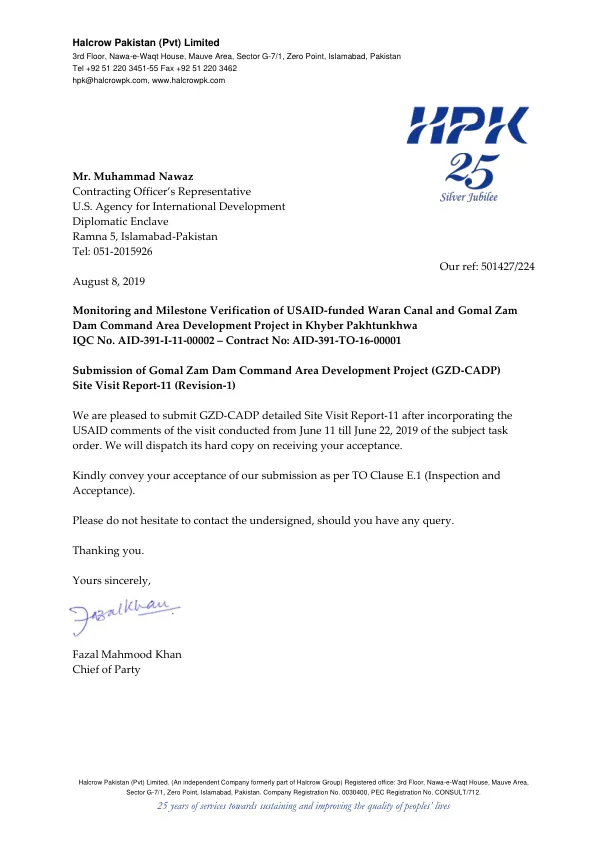
Monitoring and Milestone Verification of USAID-funded Waran Canal and Gomal Zam Dam Command Area Development Project in Khyber Pakhtunkhwa
Sign inUSAID
Monitoring and Milestone Verification of USAID-funded Waran Canal and Gomal Zam Dam Command Area Development Project in Khyber Pakhtunkhwa
The Gomal Zam Dam Command Area Development Project (GZD-CADP) is a USAID-funded initiative aimed at improving agricultural productivity and water management in Khyber Pakhtunkhwa, Pakistan.
2019 · 127 pages
Sign in to readA free account is required to download.
Abstract
The project focuses on four key components: On Farm Water Management and Command Area Development, Productivity Enhancement, Value Added Processing, and Marketing of Products. Component A, On Farm Water Management and Command Area Development, involves the formation and registration of Water Users Associations (WUAs). As of November 2018, a total of 259 WUAs had been organized and registered. However, no new WUAs were formed between November 2018 and June 22, 2019. The verification of 75 WUAs revealed deficiencies, which were discussed with the Project Implementation Unit (PIU) and the Social Mobilization Committee (SMC). Corrective measures were suggested, but no progress was made by June 22, 2019. The SMC committed to completing the deficiencies by August 20, 2019. The total number of outlets was initially 393, but WAPDA increased this number by 67, bringing the total to 460. These additional outlets will require further development and management. Component B, Productivity Enhancement, aims to improve crop yields and productivity through various interventions. The project has implemented demonstration plots, farmer training programs, and the distribution of high-yielding crop varieties. However, the report highlights challenges in the implementation of precision land leveling and high-efficiency irrigation systems. Component C, Value Added Processing, focuses on enhancing the value of agricultural products through processing and value addition. The project has established a value-added processing unit, which is currently operational. However, the report notes that the unit is not functioning at its full capacity due to various challenges. Component D, Marketing of Products, aims to improve the marketing and sale of agricultural products. The project has established a marketing network, which includes the formation of a federation of water users associations (FWUA). However, the report notes that the marketing network is not functioning effectively due to various challenges. The report also highlights implementation issues, including delays in the procurement of consultancies, incomplete implementation of certain components, and challenges in the management of the project. The project has made progress in certain areas, including the construction of watercourses, but further work is required to address the challenges and complete the project. The project has also made significant progress in terms of environmental compliance, with the implementation of various measures to mitigate the environmental impacts of the project. The report notes that the project has made significant progress in terms of environmental compliance, but further work is required to ensure that the project meets the required environmental standards. Overall, the GZD-CADP project has made significant progress in certain areas, but further work is required to address the challenges and complete the project. The project has the potential to improve agricultural productivity and water management in Khyber Pakhtunkhwa, but it requires continued support and resources to achieve its objectives. The project has a strong focus on community engagement and participation, with the formation of WUAs and the involvement of local communities in the decision-making process. The project has also established a strong institutional framework, with the establishment of a project implementation unit and a social mobilization committee. The project has a clear and well-defined project management structure, with a project director and a project management unit. The project has also established a strong monitoring and evaluation system, with regular progress reports and site visits. The project has a strong focus on sustainability, with the aim of ensuring that the project benefits are sustained beyond the project period. The project has established a strong institutional framework, with the establishment of a project implementation unit and a social mobilization committee. The project has a clear and well-defined budget, with a total budget of $X million. The project has also established a strong financial management system, with regular financial reports and audits. The project has a strong focus on gender equality, with the aim of ensuring that women are involved in the decision-making process and benefit from the project. The project has established a strong institutional framework, with the establishment of a women's interest group (WIG) and a social mobilization committee. The project has a clear and well-defined timeline, with a project duration of X years. The project has also established a strong monitoring and evaluation system, with regular progress reports and site visits. The project has a strong focus on environmental sustainability, with the aim of ensuring that the project does not harm the environment. The project has established a strong institutional framework, with the establishment of an environmental management unit and a social mobilization committee.
Related documents