USAID DEC
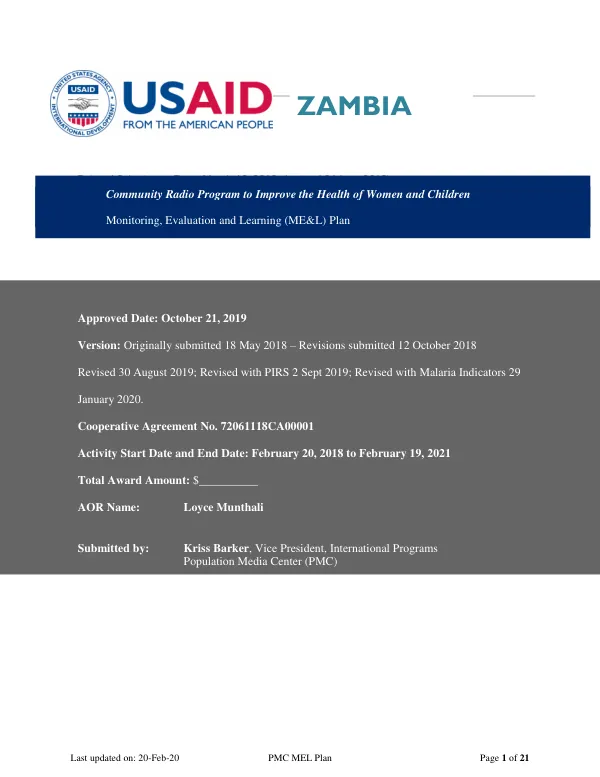
Monitoring, Evaluation and Learning (MEL) Plan for Community Radio Program to Improve the Health of Women and Children
Sign inUSAID
Monitoring, Evaluation and Learning (MEL) Plan for Community Radio Program to Improve the Health of Women and Children
The radio serial drama project in Zambia aims to improve the health of women and children through social behavior change communication.
2018 · 21 pages
Sign in to readA free account is required to download.
Abstract
The project is a three-year initiative funded by USAID, with a cooperative agreement between USAID Zambia and Population Media Center (PMC). The project's main goal is to improve the health of women and children in Zambia, with a focus on addressing key issue areas such as gender equality, maternal health, family planning, nutrition, gender-based violence, human immunodeficiency virus, girls' education, malaria, and civic engagement. The project will produce two unique radio serial dramas, one in Bemba language and one in Lozi language, each consisting of 156 15-minute episodes. The dramas will be broadcast on strategically selected community and commercial radio stations in priority regions, targeting women and adolescents ages 15-49 as the primary audience, and men ages 15-59 as the secondary audience. The project will utilize PMC's tested entertainment-education methodology for social behavior change communication, incorporating a culturally sensitive approach that considers the Zambian local cultural and provincial contexts. The project's output targets include the production and broadcast of 156 episodes of each drama, while intermediate outcome targets include a 26% increase in mobile phone respondents in the broadcast area who have heard about the drama, and a 20% increase in people in the broadcast area age 15-49 who report having heard about the drama. The geographic areas of focus are all districts within the Central, Muchinga, Northern, and Luapula provinces for the Bemba language drama, and all districts within the Western province for the Lozi language drama. To monitor and evaluate the project's performance, PMC will utilize monthly telephone surveys to gather listener feedback and estimate listenership rates across the broadcast regions. The surveys will capture demographic information about surveyed listeners and their drama comprehension, perception of its effectiveness, and reactions to specific characters or themes. The project will also conduct a cross-sectional outcome survey after the broadcast to assess the impact of the radio dramas on key program indicators. The outcome survey will employ a two-stage stratified cluster sample design, with enumeration areas (EAs) randomly selected during the first stage and households within EAs selected during the second stage. Approximately 1,600 households will be randomly selected for the survey, which will provide estimates of listenership and impact of the PMC drama on key program indicators. The project's monitoring and evaluation plan will provide ongoing performance monitoring and assessment of program impact and progress toward achieving results over the award lifetime.