PALLADIUM INTERNATIONAL, LLC
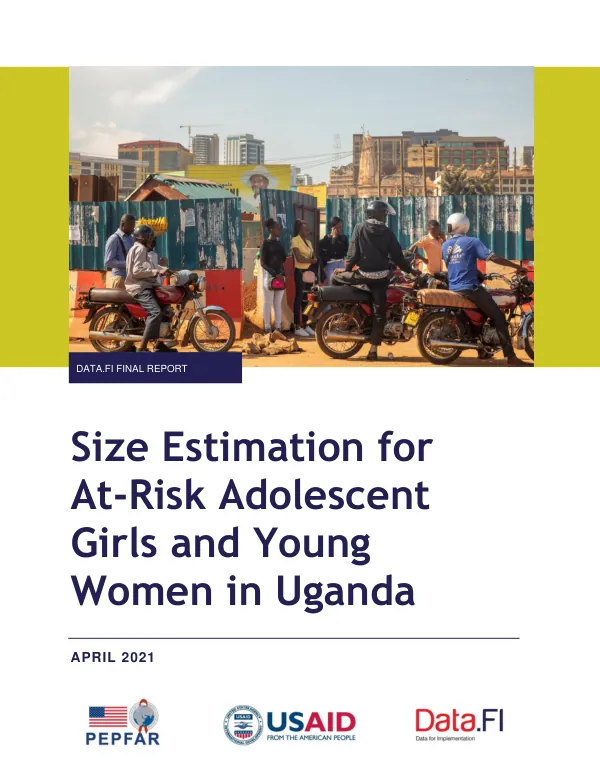
Size Estimation for At-Risk Adolescent Girls and Young Women in Uganda
Adolescent Girls and Young Women (AGYW) in Uganda face significant challenges related to HIV/AIDS, with a high prevalence of the disease among this demographic.
2021 · 46 pages
Sign in to readA free account is required to download.
Abstract
The Ugandan government, in collaboration with international organizations, has implemented various initiatives to address this issue, including the DREAMS (Determined, Resilient, Empowered, AIDS-free, Mentored and Safe) program. A key component of this program is the estimation of the size of the at-risk population, which is essential for resource allocation and program planning. The size estimation for AGYW in Uganda was conducted using a combination of data sources, including the 2016-2017 Uganda Population-Based HIV Impact Assessment (UPHIA) and the WorldPop population count methodology. The data sources and methods used for size estimation are outlined in Table 1, which provides an overview of the data sources and methods used for size estimation. The results of the size estimation indicate that a significant proportion of AGYW in Uganda are at risk of HIV infection. Table 6 shows the HIV prevalence by any-risk profiles, with a national prevalence of 12.1% among AGYW aged 15-19 years and 15.6% among those aged 20-24 years. Table 7 shows the percentage of HIV-negative AGYW at any risk, with 34.6% of AGYW aged 15-19 years and 41.1% of those aged 20-24 years classified as at risk. The high-risk profiles, which are defined as those with a higher likelihood of HIV infection, are also identified in the study. Table 9 shows the HIV prevalence by high-risk profiles, with a national prevalence of 24.5% among AGYW aged 20-24 years. Table 10 shows the percentage of HIV-negative AGYW at high risk, with 14.5% of AGYW aged 20-24 years classified as high risk. The study also examines the risk profiles of AGYW using logistic regression and latent class analysis. Table 12 shows the logistic regression results, which identify several risk factors associated with HIV infection among AGYW. Table 16 shows the full sample, all-risk factors three-class LCA marginal means for AGYW aged 15-19 years, which identify three distinct risk profiles. The study's findings have significant implications for program planning and resource allocation. The high prevalence of HIV among AGYW in Uganda highlights the need for targeted interventions to address this issue. The identification of risk profiles and high-risk groups can inform the development of targeted interventions to reduce the risk of HIV infection among AGYW. The study's methodology and results are presented in detail in the appendices, which provide additional information on the data sources, methods, and results. The appendices include tables and figures that provide further insight into the study's findings and methodology. Overall, the size estimation for AGYW in Uganda provides valuable information for program planning and resource allocation. The study's findings highlight the need for targeted interventions to address the high prevalence of HIV among AGYW in Uganda.