NATIONAL PLANNING DEPARTMENT
Monitoring & Evaluation Plan
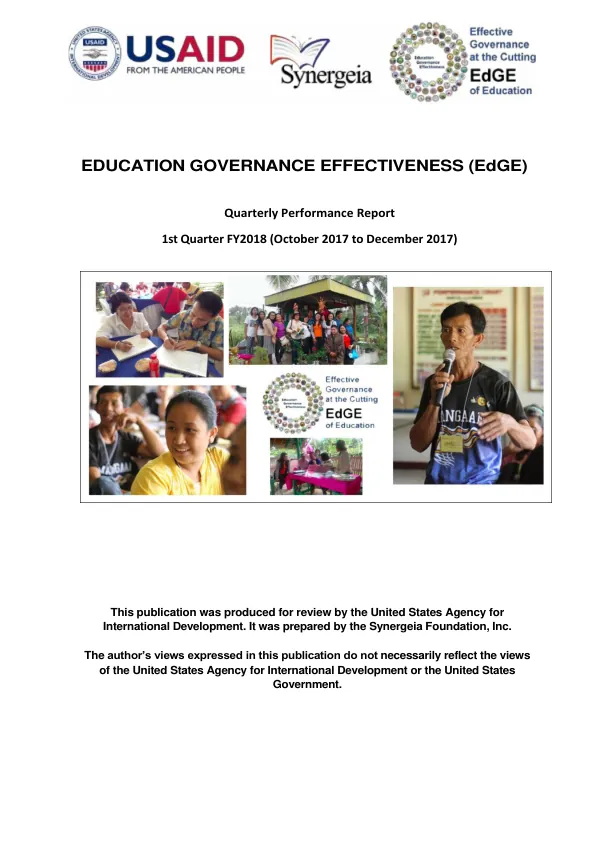
The Education Governance Effectiveness (EdGE) project is a five-year initiative that aims to strengthen education governance in the Philippines.
2016 · 62 pages
Sign in to readA free account is required to download.
Abstract
The project is funded by the United States Agency for International Development (USAID) and is implemented in 10 cities and 40 municipalities nationwide. The project's specific objectives are to strengthen the financial, planning, and management capacities of the Department of Education (DepEd), local government units (LGUs), local school boards (LSBs), and school governing councils (SGCs) to support improved learning performance. The EdGE project focuses on decentralization efforts in education governance, with the goal of improving transparency and accountability at the local level. The project also aims to increase community engagement to support improved learning outcomes of students through parent-teacher associations (PTAs) and proactive participation of civil society organizations (CSOs) and private sector groups. The project's implementation began on May 31, 2013, and is set to conclude on May 30, 2018. The EdGE project is based on the Intermediate Results (IRs) set for the project, which include strengthening financial, planning, and management capacities of DepEd, LGUs, LSBs, and SGCs, improving transparency and accountability of education governance systems, and increasing community engagement to support improved learning outcomes. The EdGE project's approach to achieving its objectives involves a range of activities, including training and capacity-building programs for LSBs and SGCs, support for the development of local education plans, and assistance in establishing transparent and accountable budgeting and financial management systems. The project also aims to promote community engagement and participation in education governance through the establishment of PTAs and the involvement of CSOs and private sector groups. The EdGE project's results framework outlines the project's expected outcomes and indicators, including improved financial management and planning capacities of DepEd, LGUs, LSBs, and SGCs, increased transparency and accountability in education governance, and improved learning outcomes of students. The project's logical framework provides a detailed description of the project's objectives, activities, and expected outcomes, as well as the assumptions and risks associated with the project. The EdGE project's monitoring and evaluation (M&E) system is designed to track progress towards the project's objectives and outcomes. The M&E system includes a range of data collection and analysis tools, including surveys, focus group discussions, and financial management and planning assessments. The project's M&E team is responsible for collecting and analyzing data, as well as providing recommendations for project improvement. The EdGE project's M&E timetable outlines the project's monitoring and evaluation activities, including data collection and analysis, reporting, and review and revision of the project's results framework. The project's performance indicator tracking table provides a detailed description of the project's performance indicators, including targets and baselines. The EdGE project's theory of change outlines the project's assumptions about how the project will achieve its objectives and outcomes. The theory of change includes a range of assumptions about the project's activities, the role of stakeholders, and the expected outcomes of the project. The project's results framework and logical framework provide a detailed description of the project's objectives, activities, and expected outcomes, as well as the assumptions and risks associated with the project. The EdGE project's approach to improving education governance in the Philippines is based on a range of principles, including decentralization, transparency, accountability, and community engagement. The project's activities are designed to support the development of local education plans, improve financial management and planning capacities, and promote community engagement and participation in education governance. The project's M&E system is designed to track progress towards the project's objectives and outcomes, and to provide recommendations for project improvement.